What we do is costly! Your support will help us dig more stories.
Yes, I'm Interested!Ignorance isn't always bliss | Don't stay foolish.
Keep informed | Read our news and analysis.
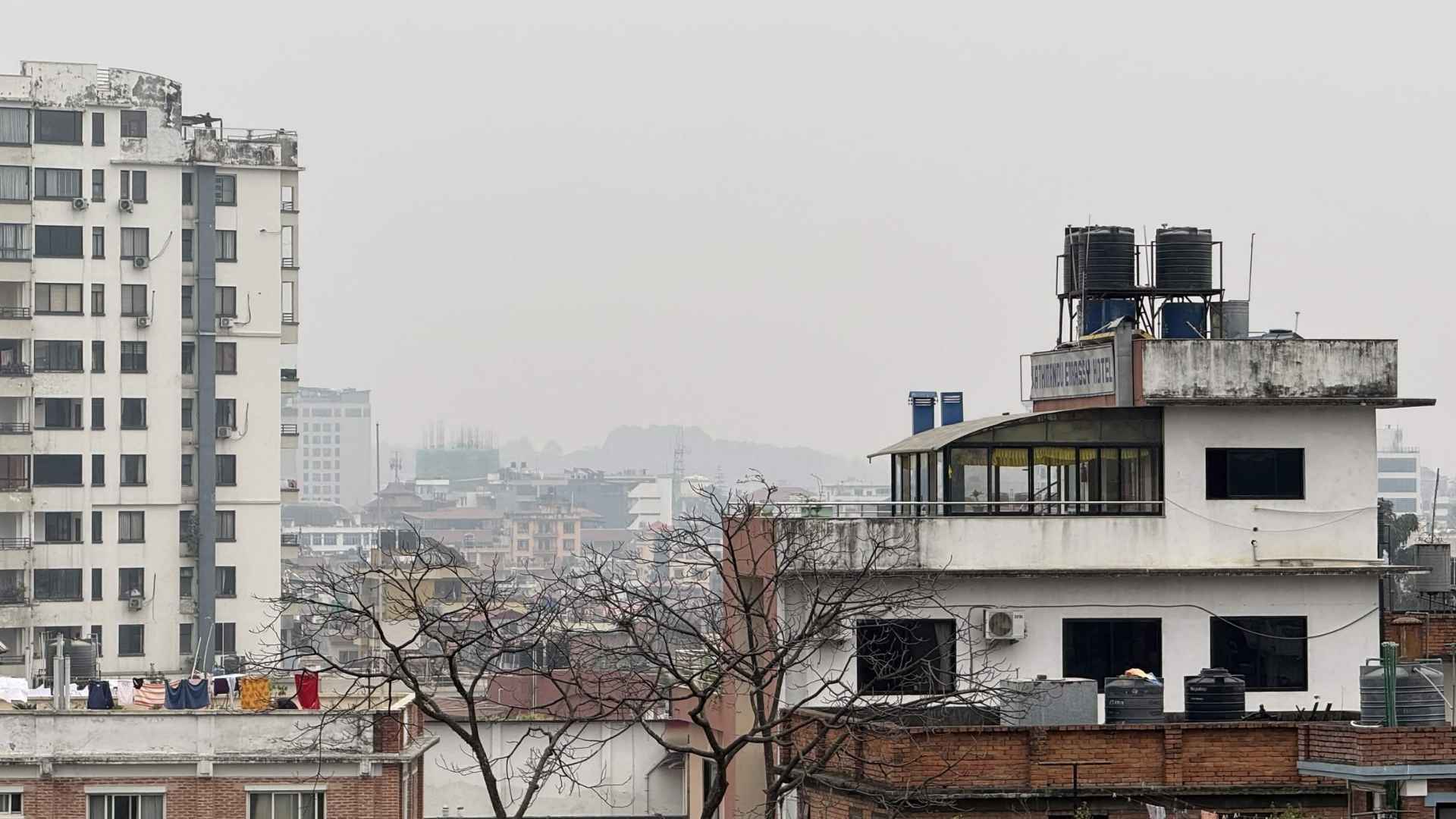
More than four in five Kathmandu Valley residents consider air pollution a health hazard. But most lack the knowledge to check pollution levels, and many are reluctant to take individual action to improve air quality, a new survey by Taza Initiative Nepal finds.
The survey of 1,200 residents across Kathmandu, Lalitpur and Bhaktapur was released alongside the launch of the nonprofit organisation, which focuses on air-quality research, monitoring and evidence-based solutions to pollution.
It found that 81.2% considered air pollution hazardous or extremely hazardous to health. Another 67.5% said they were very or extremely concerned about pollution, while 52.3% rated their neighbourhood’s air quality as poor or very poor.
Despite the widespread concern, 61.7% of respondents said they did not know how to check air pollution levels, and only 22.5% had ever checked air quality.
The findings point to a gap between residents’ awareness of the health risks and their ability or willingness to respond to them. The survey’s Air Quality Awareness Index (AQAI), which measures concern, knowledge, readiness and actual practices, scored 43.1 out of 100.
While the affective dimension, which measures emotional concern, scored 67, the score for actual practices was just 21.7. Knowledge and awareness scored 47, while intentions and readiness scored 36.8.
The findings come as air pollution continues to pose a major public health challenge in Nepal. A 2025 World Bank assessment identified air pollution as the country’s leading health risk factor and estimated that it causes around 26,000 premature deaths annually. It also found that pollution reduces the average Nepali life expectancy by 3.4 years and costs the economy more than 6% of gross domestic product each year.
Residents rely on sensory cues
The survey found that residents often rely on smell, visibility, dust and eye irritation to judge air quality rather than regularly consulting monitoring data.
Among respondents who had checked air quality, 94.1% reported using such physical observations. Social media was another commonly reported source, at 87.4%, followed by websites at 38.9% and mobile applications at 31.5%.
Government announcements and data accounted for 17% of reported sources, while local media, including television, FM radio and newspapers, accounted for 13.7%. Only 3% reported using home air-quality sensors.
The findings suggest that reliable air-quality information has yet to become part of many residents’ daily routines. The survey also found that 53% of users of air-quality applications and websites checked them only every few months, with usage concentrated among people aged 18–24.
Reliance on visible haze, dust and other physical signs can leave residents without an accurate understanding of pollution levels. Fine particulate matter, particularly PM2.5, can pose health risks even when the air appears clear.
The survey did not establish whether respondents who used social media relied on verified pollution readings or understood how to interpret them.
Public support for cleaner transport
Respondents overwhelmingly identified motor vehicles and traffic emissions as major sources of air pollution, with 98.6% naming them. Road construction and infrastructure dust were identified by 94.8%.
Residents living closer to particular pollution sources were more likely to identify those sources as major contributors, according to the report. Those living near brick kilns also identified kilns as a source of pollution.
These findings reflect public perceptions rather than scientific estimates of the relative contribution of each source. The World Bank has identified transport, industrial emissions, household cooking fuels, forest fires and pollution transported across borders as contributors to Nepal’s air pollution.
Respondents expressed strong support for institutional measures to address the problem. Nearly 80% supported expanding public transport and promoting electric mobility, while 71.5% backed dust control and urban greening. Another 68.8% supported stricter vehicle-emission testing.
Support was much lower for congestion charges, pedestrian-only zones and odd-even vehicle restrictions, which received support from 26.3%.
The results suggest that residents are more receptive to some interventions than others, particularly measures that could restrict mobility or impose additional costs. Expanding affordable public transport and enforcing existing emissions standards could help address pollution while reducing the burden on individual commuters.
Most respondents unaware of government initiatives
Nearly six in 10 respondents said they were unaware of government initiatives to improve air quality. Although 59.3% knew about the fuel pollution tax, 70.5% were dissatisfied with government intervention.
The survey does not establish whether dissatisfaction stems from weak implementation, limited public communication or a lack of visible improvements in air quality.
The federal Department of Environment has published a Kathmandu Valley Air Quality Management Action Plan and maintains air-quality monitoring and reporting mechanisms. However, the existence of policies does not in itself demonstrate that they are being implemented effectively or reducing pollution.
Hasana Shrestha, an environment officer at the Department of Environment, said air-quality monitoring needed to produce information that authorities could use to identify pollution sources and guide enforcement.
“Enforcement needs evidence,” Shrestha said, stressing that collecting more data was not enough unless authorities could establish how and where to use it.
Shrestha pointed to research around Kathmandu Durbar Square, where sensors were installed to examine changes associated with a vehicle-free zone. The monitoring did not identify pollution hotspots in the immediate vicinity as expected, she said, attributing the finding to haphazard parking around the area.
“Whenever we create some zone as a vehicle-free zone, we have to manage the traffic area around them,” she said.
The example illustrates how restrictions in one area can be undermined by traffic and parking patterns in surrounding streets. It also highlights the need to monitor pollution beyond designated intervention zones rather than assessing the success of a policy solely within its immediate boundaries.
According to Shrestha, conventional reference-grade monitors can show broader pollution conditions, while more localised measurements can help inspectors investigate what is happening at particular locations and why.
“Reference-grade monitors show what is happening,” she said. “And for the particular inspector to identify what is happening in a particular place, why is this happening, we need primary data.”
Read also:
Neglected flames: Nepal’s wildfire crisis
In Nepal, air pollution is reducing life by 3.4 years
Air pollution in the valley rises drastically
Air pollution shortens average life expectancy in Madhesh by six years: A study
How Kathmandu’s lethal pollution is its worst economic adversary?
Nepal’s air crisis is a policy test new government must attend to
Cleaner air at a cost: A $52 million loan for industrial pollution
Shrestha said low-cost sensors could help fill gaps in the existing monitoring network, which has a limited number of stations. However, she cautioned against treating them as replacements for official monitoring equipment.
“Definitely, the Department of Environment is not going to use this low-cost sensor for compliance monitoring,” she said. “But then, if we can fill the data gap with this low-cost sensor, it could help inspectors identify locations requiring further investigation.”
She emphasised that low-cost sensors must be calibrated and maintain data quality before their readings can be used reliably. Such devices could serve as screening tools to help inspectors prioritise inspections, rather than as the final basis for determining regulatory compliance.
Shrestha also pointed to limited enforcement capacity, saying the department had only two inspectors. A network of properly calibrated sensors could help them identify potential hotspots more efficiently and direct scarce resources towards areas of concern.
She said the government also had a responsibility to protect vulnerable groups from the effects of pollution. Used alongside reference-grade monitoring and satellite data, local sensors could help authorities identify areas where people face heightened exposure and respond more quickly.
“The government is also the body which is the voice for the vulnerable,” she said.
The survey findings highlight the need for authorities to make information about air quality and pollution-control measures more accessible. Regular public updates on monitoring results, enforcement and the impact of government interventions could help residents understand what is being done and hold institutions accountable.
Concern has yet to translate into action
More than 40% of respondents selected none of the listed actions they were willing to take to improve air quality.
Only 4.9% said they would donate to environmental activities, while 9.7% were willing to pay more for cleaner public transport. By contrast, 30.1% expressed willingness to participate in tree-planting or clean-up drives, and 19.9% said they would switch to electric vehicles.
The survey also found that 53% had undertaken no environmental action in the preceding year. Meanwhile, 37.2% had planted trees, and 13% had participated in environmental awareness walks or protests.
The figures do not explain why respondents were unwilling to act. Financial constraints, limited access to alternatives and doubts about the effectiveness of individual action could be factors, but further research would be needed to establish their relative importance.
The findings nevertheless suggest that individual behaviour alone cannot address the problem. Residents can take precautions and make changes to their daily routines, but they cannot independently regulate vehicle emissions, industrial pollution or construction dust.
Pollution shapes daily routines and relocation plans
Air pollution is also influencing how residents protect themselves. Around four in five respondents reported using surgical masks, scarves or similar face coverings, while more than half kept windows and doors shut. Nearly four in 10 limited their outdoor activities, and around one in five used N95 masks.
The survey also examined whether air pollution could influence decisions to leave the Valley. It reported that 44.6% of respondents considering pollution-related relocation would consider leaving temporarily during peak-pollution months if they had the means. Another 20.7% would consider a permanent move, while 35.1% said they would reconsider moving if air quality improved.
The report summary does not clearly establish the denominator for all these relocation figures, so they should not be interpreted as proportions of the entire Valley population. Nor do stated intentions necessarily translate into actual migration.
Still, the findings indicate that air quality is one of the factors residents consider when thinking about their future in the Valley.
A regional problem requires coordinated action
Kathmandu Valley’s geography can restrict air circulation and allow pollutants to accumulate, particularly during dry periods and temperature inversions. But the problem is not confined to the Valley. Pollution from transport, industries, household fuels and forest fires affects other parts of Nepal, while pollutants also travel across national borders.
The 2025 World Bank assessment called for coordinated action across sectors and jurisdictions to reduce pollution. In March 2026, it approved $52 million in financing for the Nepal Clean Air and Prosperity Project, which aims to reduce fine particulate matter emissions, particularly from industrial and commercial boilers and furnaces, and strengthen air-quality management.
The project is intended to support around 400 industrial and commercial enterprises in adopting cleaner technologies. Its effectiveness will depend on implementation, enforcement and measurable reductions in emissions.
The survey suggests that public awareness should also be part of the government’s response. Making monitoring data easier to understand, communicating health risks through trusted channels and publishing evidence of progress could help turn concern into informed action.
Better monitoring could also help bridge the gap between identifying pollution as a citywide problem and addressing its sources at specific locations. As Shrestha argued, low-cost sensors can complement conventional monitors by helping inspectors identify potential hotspots, provided the devices are calibrated and their data quality maintained.
However, monitoring and communication alone will not clean the air. Reducing emissions from vehicles and industries, controlling construction dust, improving public transport and enforcing pollution standards remain central to any effective response.
With an overall awareness index of 43.1 out of 100, the survey presents a clear challenge for policymakers: residents recognise the threat, but concern has yet to translate into sustained action. Addressing that gap will require reliable information, affordable alternatives, stronger monitoring and visible results from the institutions responsible for improving air quality.
Taza Initiative Nepal said it plans to address the information gap by expanding air-quality monitoring, developing accessible data platforms and strengthening air-quality literacy programmes across the Valley.
Read More Stories

Market rises for sixth straight session, NEPSE closes at 2,625
The stock market extended its rally for a sixth consecutive trading session on...

Nepal proposes BIMSTEC disaster-response task force amid rising climate risks
Home Minister Sudan Gurung has proposed a regional disaster preparedness and response framework...

NEPSE on a rising spree pre-Dashain
The Nepal Stock Exchange (NEPSE) rose by 21.33 points (0.82%) on Wednesday, closing...