What we do is costly! Your support will help us dig more stories.
Yes, I'm Interested!Ignorance isn't always bliss | Don't stay foolish.
Keep informed | Read our news and analysis.
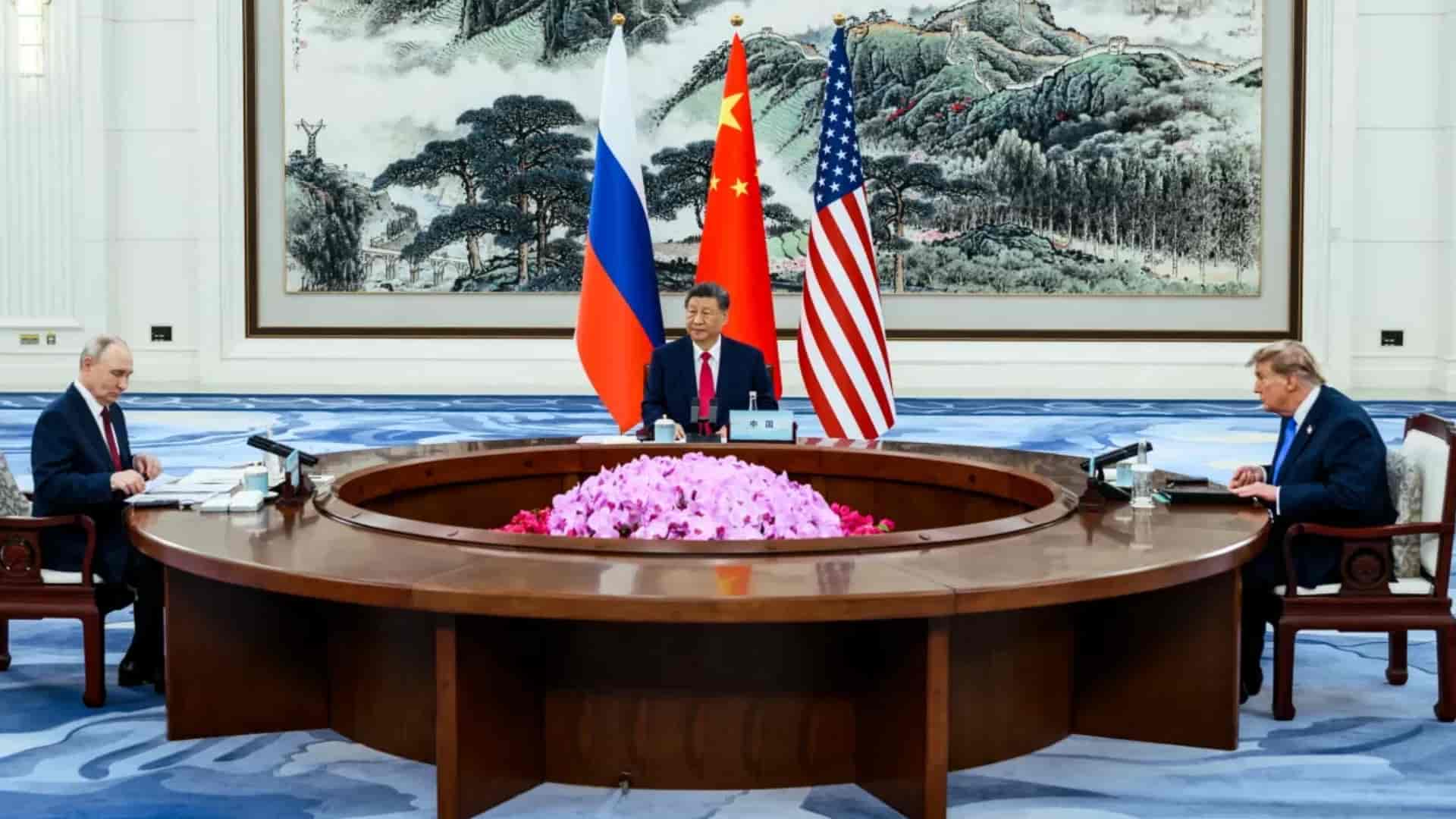
US President Donald Trump, Russian President Vladimir Putin and Chinese President Xi Jinping have signed a four-point joint declaration pledging greater cooperation on global peace, nuclear security and international stability following their first-ever trilateral meeting.
The 90-minute summit took place on November 19, 2026, at the Kylin Villa in Shenzhen, southeastern China, on the sidelines of the Asia-Pacific Economic Cooperation (APEC) summit. It marked the first time the three leaders had met together, despite previously holding separate bilateral discussions.
In their joint declaration, the leaders reaffirmed that “nuclear war cannot be won and must never be fought.” They also pledged to maintain dialogue on reducing nuclear risks, preventing nuclear proliferation and strengthening international security.
The three countries further agreed to pursue reforms to the United Nations to make it more effective in addressing global challenges.
Other commitments included increasing the production and supply of petroleum products and ensuring that the International Criminal Court (ICC) and similar institutions do not exceed their jurisdiction.
Ukraine war remains a major point of disagreement
Despite the declaration’s emphasis on peace, the Ukraine conflict exposed significant differences between the leaders’ positions.
Putin said Russia wanted to end the war but accused Ukraine and European countries of being unwilling to make the compromises necessary for a settlement. He also indicated that Moscow had invited European representatives to Russia to discuss their positions on future negotiations.
However, Putin’s remarks came amid the ongoing war where Russian drones continue to strike Ukraine’s capital Kyiv, raising questions about the credibility of Moscow’s commitment to peace.
The Russian president also threatened a much stronger response to Ukrainian attacks on the bridge connecting Russia to occupied Crimea, describing the structure as a civilian facility.
Meanwhile, Trump said he had held lengthy discussions with Putin about Ukraine and expressed hope that both sides would work towards ending the conflict.
Leaders highlight cooperation and personal relations
During the summit, Xi emphasised that positive engagement among major powers was essential in an increasingly interconnected world.
Trump described the United States, China and Russia as countries with a special responsibility to maintain international stability. He also highlighted their nuclear capabilities, arguing that cooperation among the three was vital to reducing nuclear weapons and preventing their spread.
Putin described the meeting as an important moment in diplomatic history, saying the leaders had developed a better understanding of one another on several major international issues.
Following the summit, Xi reportedly characterised the discussions as positive, constructive and highly productive.
Trump also praised the visit in a social media post aboard Air Force One, describing it as a great and highly consequential trip.
Controversy surrounding the International Criminal Court
Another potentially contentious aspect of the declaration concerns the authority of international legal institutions, particularly the International Criminal Court.
The three countries expressed opposition to what they described as the misuse or expansion of jurisdiction by the ICC and similar institutions. They also raised concerns about the legal protections and immunity enjoyed by state officials.
The issue is particularly sensitive for Putin, who faces an ICC arrest warrant issued in connection with alleged war crimes relating to the deportation and transfer of Ukrainian children.
The position outlined in the declaration could deepen disagreements between the three powers and countries that support the ICC's role in holding political and military leaders accountable for alleged international crimes.
It also raises broader questions about the relationship between national sovereignty, international law and accountability for violations committed during armed conflicts.
International reactions and political concerns
The summit has generated mixed reactions internationally, particularly in the United States and Europe.
Some US lawmakers welcomed the leaders’ commitment to preventing nuclear war but expressed concern about Trump’s friendly approach towards Putin and Xi.
Republican Senator John Curtis warned that treating the Russian and Chinese presidents as friends could undermine American national security and weaken confidence among US allies. Democratic Senator Jeanne Shaheen was more critical, describing Putin as a war criminal.
Former British foreign secretary Jeremy Hunt also criticised the summit, arguing that it gave Putin international legitimacy despite Russia’s ongoing war in Ukraine.
In an article offering her insights, Bonnie S. Glaser, an American foreign policy analyst, observed that the four-point is short on specifics and sets no timetable, no targets, and no delegations.
Some analysts suggested that the meeting’s greatest achievement might have been its diplomatic symbolism rather than any concrete policy breakthroughs. Although the joint declaration outlined several areas of cooperation, it contained few specific commitments or practical measures for resolving ongoing international conflicts.
China emerges as a key diplomatic beneficiary
The summit was also an important diplomatic opportunity for Xi Jinping, who hosted the two other leaders in Shenzhen.
By bringing Washington and Moscow together, Beijing demonstrated its ability to convene major international powers and position itself as an influential participant in discussions about global security.
For China, the meeting also offered an opportunity to strengthen its international diplomatic standing while maintaining strategic relationships with both Russia and the United States.
However, Beijing faces a difficult balancing act. Its relationship with Moscow remains strategically important, while stable relations with Washington are essential to managing economic, technological and security tensions.
It therefore provided Xi with an opportunity to demonstrate China’s diplomatic influence without necessarily committing Beijing to resolving conflicts involving the other two powers.
The summit also provided Putin with an opportunity to participate in a major international gathering alongside Western leaders and other global representatives, despite continuing efforts by many Western governments to isolate Moscow following its invasion of Ukraine.
A historic meeting with uncertain consequences
The Shenzhen trilateral talk represents a significant diplomatic development, bringing together the leaders of three major global powers at a time of heightened geopolitical tensions.
However, important questions remain about whether the declaration will translate into meaningful action, particularly regarding the Ukraine war, nuclear security and international law.
Ultimately, the meeting demonstrated a willingness among Washington, Moscow and Beijing to maintain direct communication. Whether this diplomatic engagement can produce lasting peace and tangible international cooperation remains uncertain.
Read More Stories
The fate of the world in the whims of five: UN’s veto dilemma
Last week was a mighty affair as three of the largest countries and...

NEPSE starts the week on a positive note, gains 2.27 points
The stock market started the week on a positive note, with the Nepal...
India has announced NRs 240 billion in development assistance to Nepal and exchanged...