What we do is costly! Your support will help us dig more stories.
Yes, I'm Interested!Ignorance isn't always bliss | Don't stay foolish.
Keep informed | Read our news and analysis.
Public Policy | economic debate | industrial pollution | polluters pay
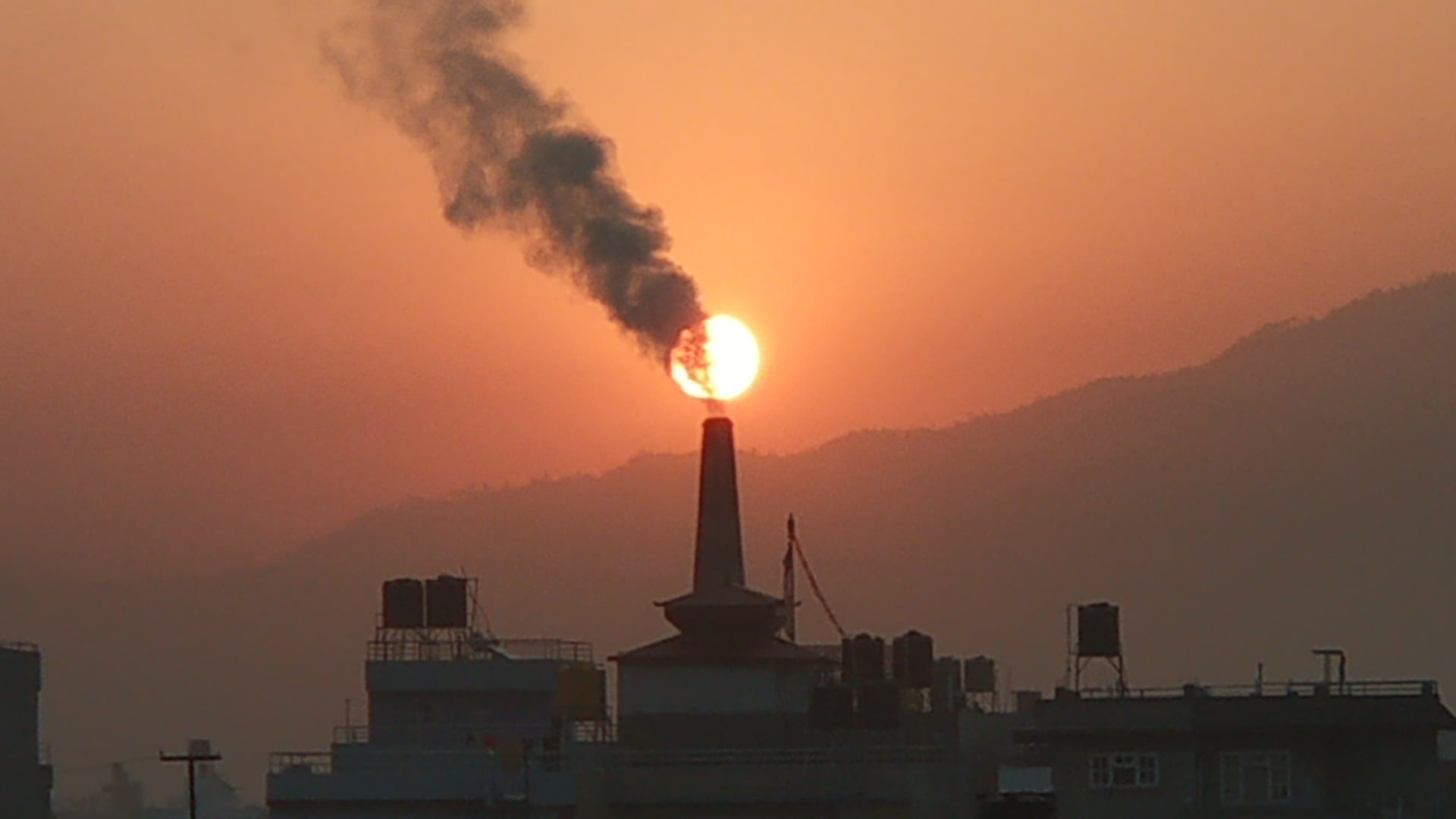
Nepal is grappling with a persistent air pollution crisis, with cities like Kathmandu frequently shrouded in hazardous haze that threatens public health. In response, the previous administration led by Sushila Karki signed a $52 million loan agreement with the World Bank for the Nepal Clean Air and Prosperity Project to reduce air pollution and strengthen air quality management. The loan amount translates to around seven billion rupees.
The project will help reduce fine particulate matter (PM2.5) emissions, particularly from industrial and commercial boilers and furnaces, while strengthening national systems for air quality management. It will focus on the Kathmandu Valley, the Terai, and surrounding foothill regions where air pollution poses severe risks, says the bank’s press release.
The agreement was signed amid a severe pollution crisis that blanketed the country’s capital city in thick haze for several days. Air quality in Kathmandu, along with other cities, reached hazardous levels, with health officials warning of its hazardous impact on the public, particularly the elderly and children.
Air quality in several cities frequently reaches alarming levels. Last year, too, toxic haze engulfed Kathmandu for days in April. Although pollution levels tend to ease afterwards, Nepal continues to face persistently modest to high pollution levels, a prolonged exposure to which poses significant health risks to the public.
Considering this, the ongoing fiscal year’s budget includes plans to relocate industries currently operating in the Kathmandu Valley to designated industrial zones outside the Valley, offer land free of charge and provide concessional loans to factories to convert their traditional boilers into electric systems. It also expressed commitment to using advanced technology to monitor vehicle emissions more effectively.
The government’s decision to secure this concessional World Bank loan begs multiple questions. One critical question is whether such industries, which are commercial entities, should be funded with public debts and taxpayers’ money?
The current agreement with the WB will establish a Clean Industrial Technology Financial Facility (CITFF) to: (i) provide long-term, commercially viable loans, with longer tenures and reduced monthly repayments to about 400 enterprises for adopting electric or biomass boilers/furnaces with emission controls; and (ii) offer capital grants covering 20% of CAPEX for electric technologies and 10% for biomass systems. The longer loan tenors offered will be up to 15 years, compared to the 7-10 years typically offered by financial institutions, and will reduce monthly repayments by approximately 40%.
The mixed model will mobilise $34 million for this, which will be used to replace traditional, high-pollution boilers with cleaner alternatives such as electric systems, improved biomass technologies, and advanced emission control mechanisms.
Even if some concessions are warranted, such grants to private entities set a bad precedent, where the costs of pollution are ultimately borne by the public, rather than those responsible. In this light, the World Bank-backed initiative appears as a case of socialising the losses, privatising the profits. While industries benefit from concessional loans and on top of that government grants to adopt cleaner technologies, the financial burden ultimately falls on the public.
The arrangement risks rewarding polluters instead of holding them accountable. Once industries realise the government will eventually fund the clean-up of the environmental mess they make, they may have less incentive to follow environmental rules or invest in cleaner practices on their own, a moral hazard risk. This is, in effect, incentivising pollution.
Passing the costs onto the public also undermines the polluter pays principle, which is also enshrined in the Constitution under articles 30(2) and 51(g)(8). Already, consumers, including households, businesses and industries, contribute through pollution taxes when using petrol and diesel, which should be used to develop pollution control measures.
Nepal started collecting pollution tax on every litre of petrol and diesel sold since 2008/09, starting at NRs 0.5 per litre, later hiked to NRs 1.5 per litre. So far, the government has collected over NRs 25 billion from this tax, over three times the World Bank loan. This prompts another critical question: how has the fund been utilised in curbing the rising pollution in the country?
According to reports, the raised funds have largely stayed idle in the government’s coffers, instead of being spent in pollution targeted programs. While the Nepal Oil Corporation (NOC) collects the taxes under the pollution tax category and deposits them in the federal government’s account, the government spends the funds at its discretion. There is no accounting of how and where the pollution tax revenue is being spent.
Typically, the money may be diverted to sectors like roads, transportation or routine government expenditure, leaving little for air pollution due to the absence of concrete programs under respective authorities. This is a serious governance issue.
There, however, are also compelling arguments in favour of such grants. Many industries in Nepal operate with thin margins and limited access to affordable capital. Cleaner technologies often require high upfront investment. Without financial support, firms may delay or avoid transitioning altogether. The proposed financing model appears to address this challenge effectively: capital grants are only disbursed to enterprises adopting cleaner boilers, while enterprises installing only emission control devices will be able to access only long-tenor loans.
From this perspective, targeted subsidies/grants can be seen not as rewards for polluters, but as pragmatic tools to accelerate a transition that benefits society at large. Cleaner air reduces healthcare costs, improves worker productivity, and enhances overall quality of life, benefits that extend far beyond individual firms.
However, concerns remain that such policies may still amount to incentivising polluters, even when grants are tied to the adoption of cleaner technologies. Critics argue that industries should bear these costs themselves rather than rely on public funds.
This concern gains further weight in light of Nepal’s rising public debt, which is a concerning trend, with a significant share of the budget each year going into repaying debt. As of mid-March, Nepal’s public debt is NRs 28.78 trillion, equivalent to 47.13% of the GDP. A quarter of the total debt is external debt.
Viewed from another angle, extending such incentives to industrial air pollution brings up an important question of whether similar support should also be provided in other environmental areas. Take for instance, river pollution, which is another pressing problem that further affects the availability of safe drinking water.
In the_farsight’s previous report highlighting Birgunj’s water crisis, Environmentalist Dr Deep Narayan Shah noted that existing ponds and water bodies in Birgunj are shallow and polluted. The Sirsiya River that flows through the middle of the city, he described, is filled with “black water, with industrial toxicants.”
The approach taken with the industrial air pollution project, using debts and public funds to subsidise industries, could risk setting a precedent that could extend to all types of polluters, including households in the future, further entrenching a system where the public bears the costs of environmental damage while responsible parties face little accountability.
Read More Stories

Nepal needs to repeat to brand itself
Last year Nepal's goods exports jumped 81.8% to NRs 277.03 billion. That is...

Banking stocks gain momentum as dividend season begins
Dividend announcements by banks and financial institutions (BFIs) for fiscal year 2025/26 have...
Nepal’s challenge of building strong democratic institutions
Over the past few decades, institutional dysfunction and massive dissatisfaction with political establishments...