What we do is costly! Your support will help us dig more stories.
Yes, I'm Interested!Ignorance isn't always bliss | Don't stay foolish.
Keep informed | Read our news and analysis.
Pollution | Particulate matter | Life expectancy | Terai region
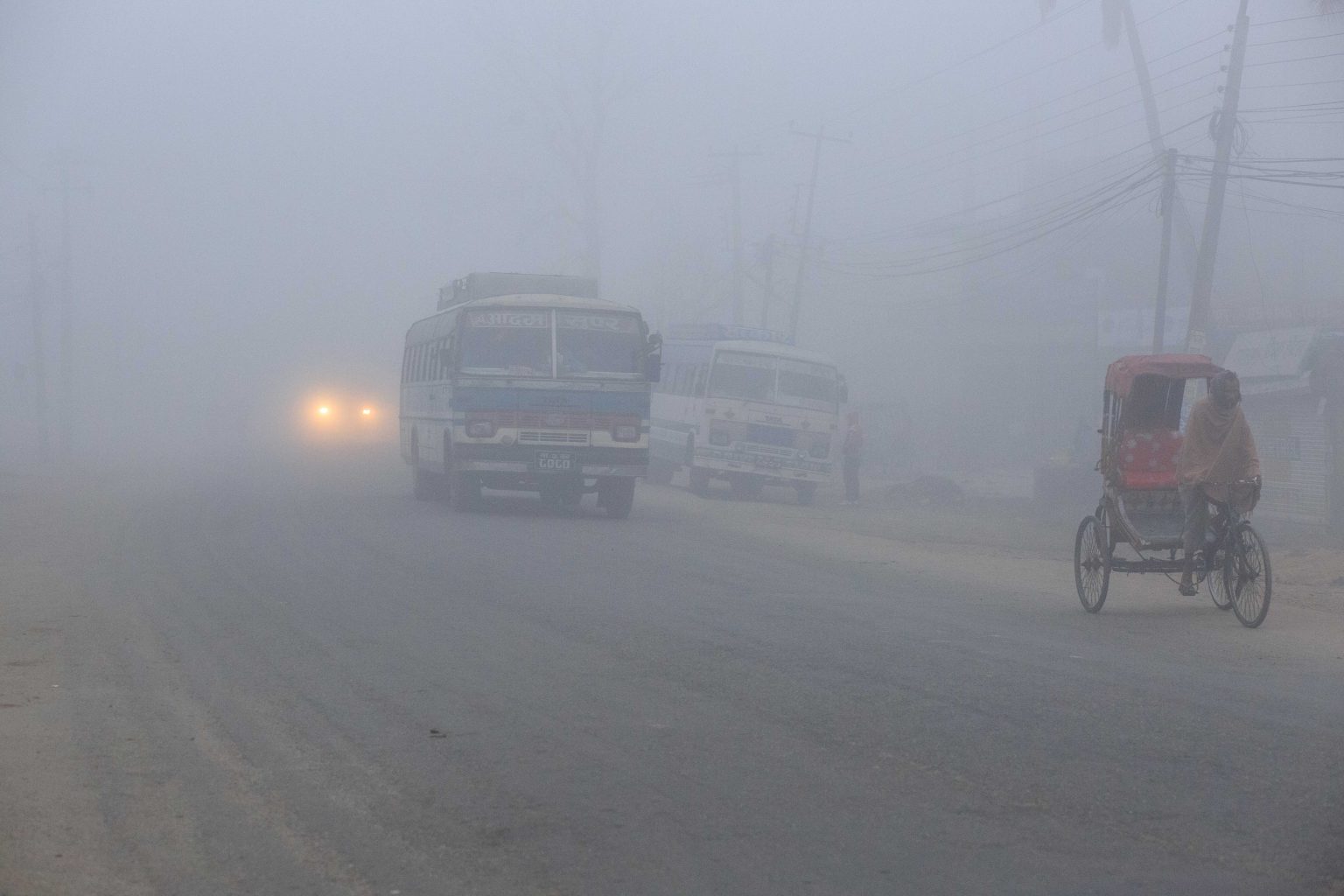
A study by the Energy Policy Institute at the University of Chicago led by economist Michael Greenstone — Air Quality Life Index (AQLI), which is a calculation of the impact of air pollution on life expectancy — says that Nepalis face a horrifying effect of air pollution through a significant loss in their average life span.
According to estimates, Nepal’s air pollution reduces its average life expectancy by 4.1 years while child and maternal malnutrition reduces average life expectancy by about 1.3 years, while smoking shortens life by 2.5 years on average.
The most severe air pollution concentrations are observed in Nepal’s southwestern districts, particularly those sharing borders with the highly polluted Indo-Gangetic Plain of India.
In these regions, residents face an even more alarming situation, with potential life expectancy losses of nearly seven years due to the extremely poor air quality.
Half of Nepal’s population resides in the Outer Terai region, where the average life expectancy reduction due to air pollution exceeds 6 years.
Meanwhile, the populous capital city residents are also on track to lose 3 years on average.
The Air Quality Life Index (AQLI) is a pollution index used to assess the relationship between long-term human exposure to particulate air pollution and its impact on life expectancy.
The AQLI’s life expectancy calculations are based on two peer-reviewed studies conducted in 2013 and 2017 — which found that sustained exposure to 10 μg/m3 of PM10 reduces life expectancy by 0.64 years, and 10 μg/m3 of PM2.5 reduces life expectancy by 0.98 years.
Read More Stories

Nepal needs to repeat to brand itself
Last year Nepal's goods exports jumped 81.8% to NRs 277.03 billion. That is...

Banking stocks gain momentum as dividend season begins
Dividend announcements by banks and financial institutions (BFIs) for fiscal year 2025/26 have...
Nepal’s challenge of building strong democratic institutions
Over the past few decades, institutional dysfunction and massive dissatisfaction with political establishments...