What we do is costly! Your support will help us dig more stories.
Yes, I'm Interested!Ignorance isn't always bliss | Don't stay foolish.
Keep informed | Read our news and analysis.
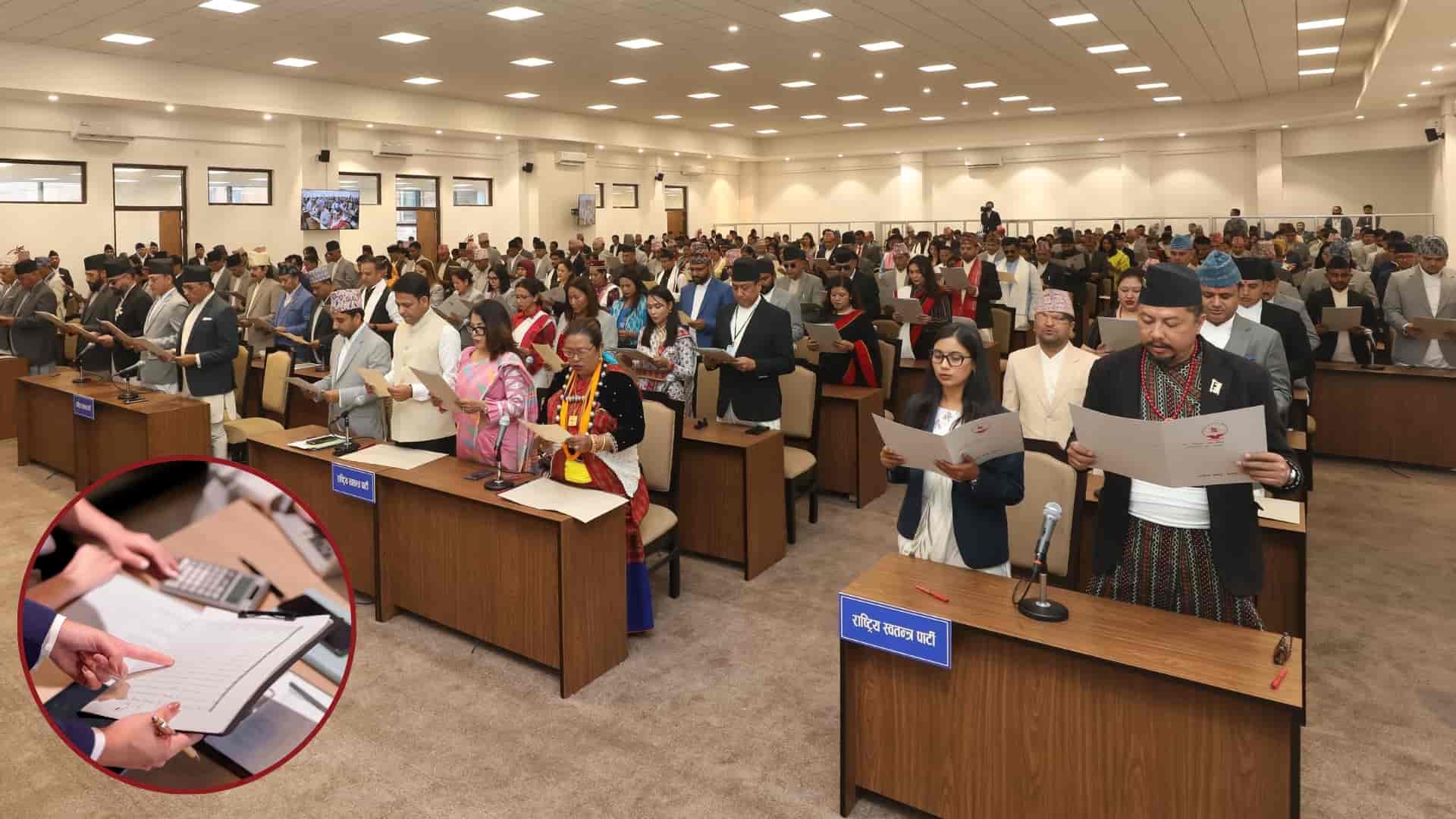
Last week, the government decided to allow members of Parliament (MPs) to appoint personal secretaries, with benefits equivalent to the basic salary of a government officer. The decision has attracted criticism from various quarters, with opponents arguing that it places an unnecessary burden on the state at a time of fiscal constraint. While concerns over public spending deserve consideration, the debate has largely overlooked a more fundamental question: how can MPs effectively perform their constitutional responsibilities without adequate institutional support? This article argues that providing MPs with secretariat support is not a privilege but an investment in a stronger, more effective Parliament.
Nepal’s constitution along with House Acts/Rules provides a framework for duties and responsibilities of a member of Parliament. Broadly, this includes legislative responsibilities such as deliberating on bills, budget proposals, policies, and oversight functions aimed at ensuring accountability of the executive and, where constitutionally applicable, the judiciary.
Additionally, MPs are also responsible towards their constituents and political parties. Under these frameworks of duties, MPs contribute to good governance, uphold public interest and ensure smooth and inclusive service delivery.
Given the wide scope of their mandates, MPs cannot reasonably be expected to function as standalone individuals and still deliver an effective parliamentary tenure. In many parliamentary democracies, MPs are supported not merely as individual officeholders but as offices, with dedicated staff and budgets to assist their work. In South Asia, India provides a formal secretarial assistance component within MPs’ office expense allowance, while Sri Lanka recognises allowance for MPs to maintain an office.
Meanwhile, Pakistan’s Parliament Secretariat provides institutional parliamentary support and assistance “to every individual Member regardless of party.” These variations are shaped by a combination of factors, including population size, the size of Parliament, availability of state resources, institutional capacity, and the relative strength of parliamentary systems.
Why MPs need secretariats
The secretariat plays a pivotal role in ensuring that an MP is administratively and technically equipped to handle their responsibilities, manage competing priorities and be in touch with the citizenry. Members of the Secretariat are often considered the ‘unsung heroes’ or ‘invisible force’ who do much of the groundwork for MPs.
Secretariat staff support MPs by conducting background research, advising on legislative opportunities, preparing reports and briefs for Parliament and committees, filtering public concerns, drafting speeches and media commentary, liaising with constituencies, and helping communicate parliamentary work through social media. They further serve as compromise facilitators by supporting coordination among decision-makers, helping bridge differences, initiating informal dialogues and curating environments to build consensus. Their role is inherently political as staff regulate access and information flow to the MP which may reflect their own judgement, biases and interests.
A secretariat can also serve as an entry point for younger voices to engage directly in political and policy processes, strengthening their sense of ownership in the state. Beyond supporting MPs, such spaces can create a practical training ground for future leaders, offering exposure to legislative work, constituency engagement, and policy decision-making. In some cases, former aides and secretariat staff have gone on to become elected representatives themselves, as reflected in the current rise of some younger leaders within RSP.
MP Personal Secretaries in Nepal: Origins, misuse, and abolition
Nepal introduced dedicated private secretariat and staff support for parliamentarians through the Parliament Office-Bearers and Members Remuneration and Facilities Act, 2052. A Supreme Court judgment confirms that Section 14 of the Act provided for “private secretariat and staff arrangements.” Before the act was in place, provisions included remuneration and general parliamentary support, but not a verified system of state-funded staff for each ordinary MP.
In the aftermath of the September 2025 protests, the interim government led by Sushila Karki decided to scrap provisions for personal secretaries assigned to lawmakers, including those in the provincial assemblies, as part of its austerity measures.
This occurred against a backdrop of longstanding concerns that MPs had misused personal secretariat provisions, and, in the case of office-bearers, expanded secretariat support, either by informally retaining state-allocated salaries through proxy appointees or by using these positions to reward party cadres and relatives.
The move would reportedly save approximately NRs 250 million annually, equivalent to around 0.012% of national budget for 2026/27, which is NRs 2,124.34 billion. Such a marginal saving is difficult to justify if they come at the cost of strengthening legislative institutions across the federal system.
The return of secretariat support
The government's recent decision to restore personal secretaries for MPs, after being stayed put despite the new RSP government with a commanding almost super-majority in Parliament, now marks a significant reversal of the austerity-driven policy adopted after the 2025 protests. Not long ago, RSP’s general secretary Bipin Kumar Acharya voiced the need to empower MPs starting with ensuring provisions of a personal secretary. Additionally, numerous other MPs, from both the ruling party and opposition, had also made public calls for the restoration of at least a personal secretary to assist with their duties as a lawmaker. Some have pushed for the need to move away from the traditional idea of a personal secretary to a more policy focused appointment framed as ‘Research Assistant.’
With approximately 85% of MPs serving for the first time, many lack prior exposure to political and parliamentary processes, further reinforcing the need for secretariat support. This prompted discussions on reviving the position of personal secretary, albeit with stricter guidelines governing appointments and responsibilities.
However, the Balen Shah led government seemed reluctant to expedite the process due to potential criticism stemming from the past misuse of the system. Yet with a plethora of bills and ordinances tabled in the Parliament, including major financial bills, one wondered how the MPs would be able to pay due diligence to their jobs as law drafters. The government's eventual decision to restore personal secretaries is therefore a step in the right direction.
Deliberation around bills in the parliament is a highly nuanced exercise requiring thorough study, comparative and local research, consultation with stakeholders/experts and gathering public feedback to be integrated in the drafts. Combined with their wider responsibilities, it is unrealistic to expect individual MPs to sufficiently probe policy issues and work on refining them with the long view in mind. This is where secretariat staff becomes imperative.
Moreover, the absence of dedicated secretariat support can create a vacuum around MPs, allowing interest groups to offer informal assistance and potentially compromise the independence, integrity, and objectivity of their parliamentary work.
The legislative-executive imbalance
The government’s reluctance to provide secretariat support to MPs reflects a broader and long-standing tendency in the country’s policymaking to outright scrap or ban provisions, if misused, rather than regulate it. Given the criticism surrounding it, there still remains a risk to reverse the course. Such an approach would ultimately weaken the institutional capacity and the voice of MPs.
At the same time, ministers are allowed to further expand their own secretariats. This creates a potential imbalance: while Parliament is denied the support needed to perform its legislative and oversight functions, the executive moves to strengthen its own institutional machinery.
The real question, therefore, is not whether MPs should get institutional support, but what form it should take for MPs to function effectively. Discussions should be tied to transparent recruitment criteria, defined responsibilities, and accountability mechanisms. Alternative models in which the role/capacity of the Parliament Secretariat is reimagined can also be explored.
The costs associated with provisions of a secretariat, be it a lean one, with limited state resources at disposal, should be seen as a forward looking investment which shall empower MPs and subsequently enhance the quality of policy discourse and efficacy of Parliamentary duties. Afterall, last year’s protests were a call for a paradigm shift in our political culture and how we approach policy. The latter cannot manifest with under-resourced MPs at the helm.
Read More Stories

Nepal needs to repeat to brand itself
Last year Nepal's goods exports jumped 81.8% to NRs 277.03 billion. That is...

Banking stocks gain momentum as dividend season begins
Dividend announcements by banks and financial institutions (BFIs) for fiscal year 2025/26 have...

Nepal’s challenge of building strong democratic institutions
Over the past few decades, institutional dysfunction and massive dissatisfaction with political establishments...