What we do is costly! Your support will help us dig more stories.
Yes, I'm Interested!Ignorance isn't always bliss | Don't stay foolish.
Keep informed | Read our news and analysis.
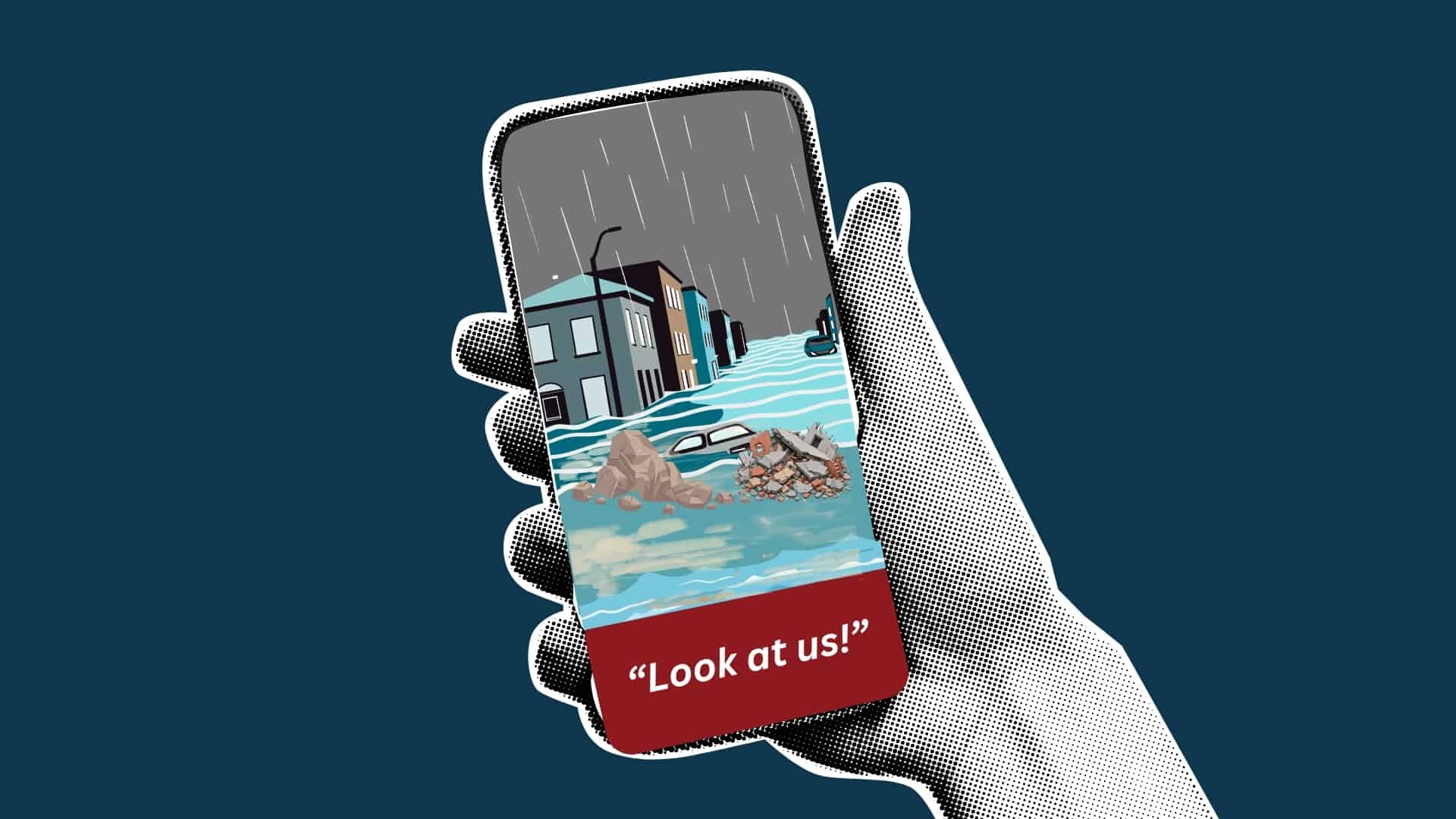
Two days after the Bhotekoshi flood, a video circulated of a man trying to work a gold earring loose from a body pulled out of the debris. Before the clip played in full, it stopped for five seconds.
A beverage ad. Bright, loud, exciting. And the footages were, in my opinion, circulated heavily with or without permission from the original handle.
I doubt anyone at that company sat in a room and decided to put its ad against that footage. That is the part worth understanding, because the fix depends on it. I don't think this was cruelty. It was a commercial arrangement with a gap in it, and the gap is fixable.
Here is how the problem appears to have worked. On some Nepali news portals, all videos run with a short highlight, followed by a sponsor break (5 sec standard), then the full clip, sometimes with banners along the bottom. In a standing sponsorship arrangement, the same sponsor can appear across videos in a particular slot regardless of what each individual video contains.
That creates a peculiar chain of responsibility.
The brand buys the sponsorship. The media house controls the footage and the placement. The contract determines what normally happens. But nobody has necessarily decided what happens when the normal context disappears.
A sponsorship sold as convenience can become a danger. Your brand rides every video in the slot, no approvals needed. The convenience is that you don't have to make a decision every time. The problem is that, without an off switch, the system will keep running when it shouldn’t. It apparently looks autonomous.
There is a simple test for a brand in a disaster:
Did you give what only you could give, or did you give what would be seen? Were you donating to help or to be seen?
Well, helping during these times is a noble and empathetic gesture. The two can look similar from outside. However, they are very different once we dig deeper.
Look at what useful help looked like during this disaster.
Restaurants and small kitchens fed stranded people for weeks. Businesses set aside part of their sales. Schoolchildren saved up a part of their lunch money and deposited what they collected.
And one bank did something particularly interesting. It contributed to the relief fund in millions of rupees, but it also sent surveillance drones, generators and power banks to the Army camp coordinating the search in Nuwakot & Rasuwa.
Drones are not a bank's product, neither are the generators and power banks. The bank used something it actually had: the ability to procure, pay and move equipment quickly. That is a more interesting way to think about corporate help. The question is not simply whether a company gave. It is what the company had that was useful.
The media industry offered another example. A media outlet used the one asset only it controlled. It gave its front page to a donation appeal for the relief effort. Not a house advertisement. Not a campaign about its own generosity. Its most valuable piece of commercial real estate was simply handed to the cause.
That is a media house using its capability the way the bank used its procurement desk. One can view this from a counterpoint as well as why such a large publishing house just promoted the single window donations so prominently? Was it signaling that other support or charitable organisations weren’t reliable? Some even viewed it as a way to appease the current government.
It is also a useful answer to the question of what a brand can do in a crisis without making the crisis about itself.
Then there was the other mode.
By 8 September, the Prime Minister's Disaster Relief Fund had reached almost NRs 12 billion, with approximately NRs 1 billion arriving in a single day. Banks, insurers, distilleries, auto dealers, telecom companies and much of the visible economy contributed, often in photo-op ceremonies with the Finance Minister himself, where the cheque and the photograph arrived together.
The money is real. The country needs it. I will not question a check that feeds a displaced family and puts a blanket over a terrified little child. But look at the numbers that appeared in the published lists: NRs 30.1 million. NRs 25.1 million. NRs 11.1 million. There was and still is a pattern. Well we can argue that sometimes it’s the religious or faith to not provide in numbers ending with zero, agreed, but was that the only motive?
The odd hundred thousand is striking. Whether intentional or not, it makes a donation something that can be compared line by line with somebody else's donation. The state periodically published a ranked table, and it acquired the status of a leaderboard of some sorts, like the league table, if you will. That is where the distinction becomes uncomfortable.
Publicity is not inherently bad. A public donation can encourage others to give. It actually did inspire millions of people and thousands of businesses to contribute as per their capabilities. It also helps create accountability. It can make generosity visible. But visibility should be a consequence of a useful action, not the substitute for it.
That is also why the beverage ad that we started this piece with, matters.
Giving money loudly is not the same failure as running a logo against a body. One is potentially performative. The other is potentially harmful. But both raise the same organisational question: When a disaster changes the meaning of your normal commercial activity, who is responsible for noticing? Other countries have faced versions of this problem.
After the 2011 earthquake and tsunami, Japanese advertisers pulled commercials and broadcasters filled much of the space with public-service messages. The response was associated with ‘jishuku’, a period of self-restraint.
It wasn't perfect. The same public-service spots were repeated so often that viewers eventually complained about those too. But there is one useful principle in it. The answer to advertising in a disaster is not necessarily silence. It is substitution.
A media house running disaster coverage is doing expensive work at exactly the moment you are asking it to give up advertising revenue. Telling it to run nothing means asking it to lose money while spending more. So don't tell it to run nothing. We could perhaps build the alternative into the deal.
A brand that sponsors a video slot can agree in advance that, during a disaster, its five/ten seconds are offered to an authorised relief QR code, an emergency message or a public-service announcement. The sponsorship does not have to disappear. The commercial can disappear from sensitive footage.
The brand can still be acknowledged as the sponsor that offered the space. The media house can still maintain the commercial relationship. The public gets something useful instead of a sales message and will definitely admire the business better. And, most importantly, someone has already decided what to do. Because that is the real gap. Not taste. Not tone. Not whether one manager happens to have better judgement than another, a true alive and empathising policy.
A brand signs a sponsorship without specifying what happens during an exceptional event. A media house sells a slot without defining what that slot may sit next to. The disaster arrives. Nobody has to make a decision because no decision was provided for.
The editorial side has already begun confronting this problem. The Press Council monitored flood coverage and flagged widespread breaches in the material it reviewed. What is less clear is where those editorial rules meet the commercial layer sitting inside the same video. That is the part brands and media houses should fix. Every major sponsorship should have a disaster clause.
It should define what triggers it, who can activate it, what replaces the advertisement and who has authority to act immediately. It should also define categories of content that automatically require review: dead bodies, severe injuries, mass casualties and other footage where a commercial message can change the meaning of what the viewer is seeing. This isn't about making brands solemn or sensitive. It is about making them competent.
Two things I could not confirm and will not assume. I have described standing sponsorships because that is one common arrangement, but individual portals differ and some advertising is sold or inserted differently or maybe there are some agreements when the video consumption is high regardless of disaster or national achievement. As I have not seen every sponsorship contract in Nepal, I cannot say that none contains a suspension clause.
What the incident tells us is simpler: at least one commercial system allowed the advertisement to remain when the context had changed completely. Which leaves the question I would put to both rooms. Who, at your organisation, has the authority to pull a logo out of a video in the first hour of a disaster, and have they ever been told they have it? If the answer is nobody, you do not have a taste problem. You have an empty chair, and the next flood will fill it for you.
Read More Stories

Nepal needs to repeat to brand itself
Last year Nepal's goods exports jumped 81.8% to NRs 277.03 billion. That is...

Banking stocks gain momentum as dividend season begins
Dividend announcements by banks and financial institutions (BFIs) for fiscal year 2025/26 have...
Nepal’s challenge of building strong democratic institutions
Over the past few decades, institutional dysfunction and massive dissatisfaction with political establishments...