What we do is costly! Your support will help us dig more stories.
Yes, I'm Interested!Ignorance isn't always bliss | Don't stay foolish.
Keep informed | Read our news and analysis.
Nepal Floods 2026 | Legal Recognition of Death | Vital Registration Laws
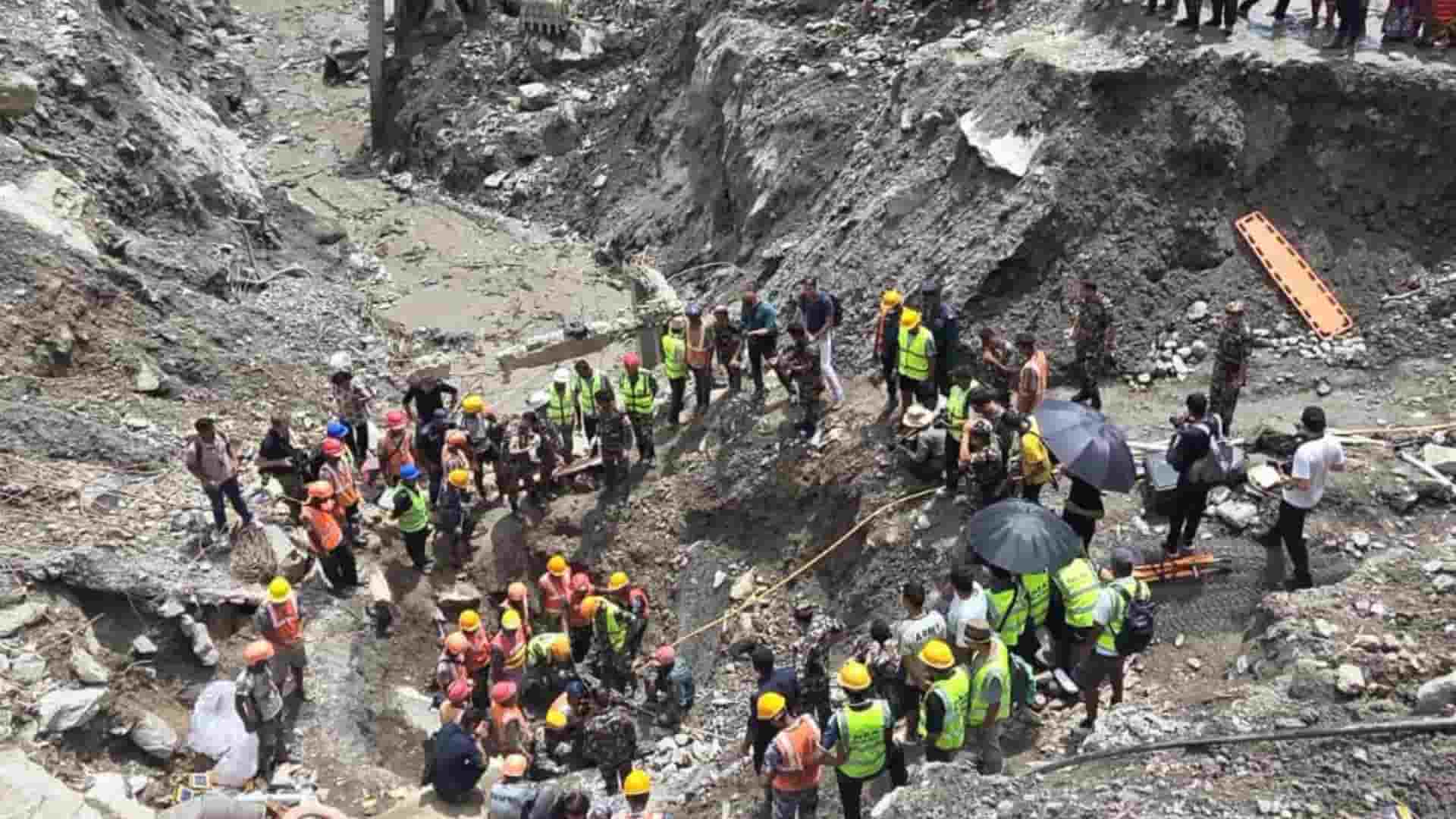
A month after floods and landslides devastated the Bhotekoshi corridor in Rasuwa and adjoining areas, the disaster’s human toll remains unresolved, with thousands of people still listed as missing and families waiting for authorities to establish whether their relatives are dead or alive.
More than 1,450 bodies have been recovered so far, according to the latest figures from authorities, with 5,285 still unaccounted for. As the number of missing remains in the thousands, it has left families caught between hope and mourning, as search teams still continue recovering bodies and remains from rivers, debris and inaccessible areas. Meanwhile, the government has scaled back its search operations.
The uncertainty has also exposed a legal problem. Existing laws allow a person believed to have died in a disaster or accident to be declared dead by a court, even when a body has not been recovered. But the process is designed largely around individual cases and has become difficult to apply to a disaster involving thousands of missing people.
The National Disaster Risk Reduction and Management Authority (NDRRMA) has called for legal amendments to simplify the process of establishing the status of missing people and enable their families to access relief, compensation and other state services.
The proposed changes would involve the Disaster Risk Reduction and Management Act, the Civil Code and laws governing vital registration. Authorities are discussing a mechanism that could allow disaster-related missing people to be formally recognised as deceased after sufficient evidence, without requiring families to navigate a lengthy individual process.
Under the existing Civil Code, a court can declare a person dead when there are grounds to believe that the person died in a disaster or accident. The provision means families do not necessarily have to wait the 12 years generally associated with the presumption of death for missing persons.
But obtaining such a declaration can still require families to approach the court and provide evidence establishing that the person was in the affected area and is unlikely to have survived.
That presents a formidable challenge in Rasuwa, where the scale of the disaster has made individual verification particularly difficult.
DNA testing becomes central to identification
As the search moves from rescue towards recovery and identification, forensic testing has become a crucial part of determining the fate of those who remain unaccounted for.
According to an update issued by the Ministry of Science, Technology and Innovation on Tuesday, the National Forensic Science Laboratory has received 1,796 DNA samples since September 1 to identify people affected by the Rasuwagadhi-Bhotekoshi floods.
Of the total, 945 are reference samples collected from the blood of relatives of missing people, while 851 are questioned samples obtained from bones and teeth of unidentified human remains.
The laboratory has so far obtained 1,552 DNA profiles: 887 from blood samples provided by relatives and 665 from unidentified remains. Another 243 samples are still being processed, according to the ministry.
The figures do not mean that 1,552 people have been identified. Rather, they represent DNA profiles obtained from samples that can be used for comparison between relatives of missing people and unidentified remains.
The identification process therefore depends on matching the profiles obtained from the remains with reference samples from relatives. The laboratory began receiving samples for identification on September 1, according to the ministry. The latest figures cover samples received through September 29.
Families remain in limbo
For families, the absence of a body has created a second crisis after the floods themselves.
Some have already performed funeral rituals without recovering the remains of their relatives. In several cases, families have used symbolic bodies made from kusha grass to perform Hindu last rites. But performing funeral rites does not automatically establish a person’s legal death.
Without formal confirmation, families can face difficulties obtaining death certificates, accessing compensation and settling insurance, property and other legal matters. This is why the question of when a missing person can legally be treated as dead has become increasingly urgent.
Authorities have to balance the need to continue searching and identifying remains with the need to provide families with legal certainty and access to support.
Foreign tourists among the missing
The uncertainty has also extended beyond Nepali families.
Hundreds of foreign nationals and Nepali tourists were reported missing in the aftermath of the disaster, adding a diplomatic and logistical dimension to the search and identification effort.
Reportedly, 607 foreign nationals and 188 Nepali tourists were still missing nearly three weeks after the floods. Their families and governments have sought information about their whereabouts as authorities work to reconcile missing-person records with recovered bodies.
Many of those affected were travelling through the Rasuwa corridor, a major route towards the Nepal-China border and a gateway for tourists and travellers heading towards destinations including the Kerung and Kailash areas.
Establishing the number of people actually present in the affected areas has itself proved difficult. Authorities have had to cross-check information from security agencies, local administrations, transport operators, hotels, immigration records and relatives.
For foreign nationals, identification also depends on cooperation between Nepali authorities and institutions in their home countries.
The DNA process is consequently not limited to Nepali families. Reference samples from relatives living abroad can also be used to identify unidentified remains recovered in Nepal.
From search to identification
The government is gradually shifting its focus from immediate rescue towards recovery, identification and rehabilitation. But the transition is complicated by the number of people whose final status remains unknown.
Authorities must now undertake two parallel tasks: continue searching for people who could still be alive or whose remains have not been recovered, while developing a credible process for formally establishing the death of those who cannot be found.
Declaring a missing person dead is irreversible in legal terms, while prematurely closing a case could deprive families of answers and undermine the identification process.
The government therefore faces pressure to establish clear criteria for when a missing person can be presumed dead, what evidence will be required and which authority will make the determination.
A faster legal mechanism could allow families to access compensation and other support without waiting indefinitely for bodies to be recovered. But such a system would also need safeguards to prevent people from being wrongly declared dead.
For families, however, the immediate demand remains simpler: information.
As the Bhotekoshi disaster moves into its second month, the death toll is no longer measured only by bodies recovered. It also includes thousands of unresolved cases, unidentified remains and families who still do not know whether they should continue waiting or begin mourning.
The government’s next challenge is to give those families a legally recognised answer.
Read More Stories

Nepal needs to repeat to brand itself
Last year Nepal's goods exports jumped 81.8% to NRs 277.03 billion. That is...

Banking stocks gain momentum as dividend season begins
Dividend announcements by banks and financial institutions (BFIs) for fiscal year 2025/26 have...
Nepal’s challenge of building strong democratic institutions
Over the past few decades, institutional dysfunction and massive dissatisfaction with political establishments...