What we do is costly! Your support will help us dig more stories.
Yes, I'm Interested!Ignorance isn't always bliss | Don't stay foolish.
Keep informed | Read our news and analysis.
Handmade paper | Traditional | Craft | Daphne bushes
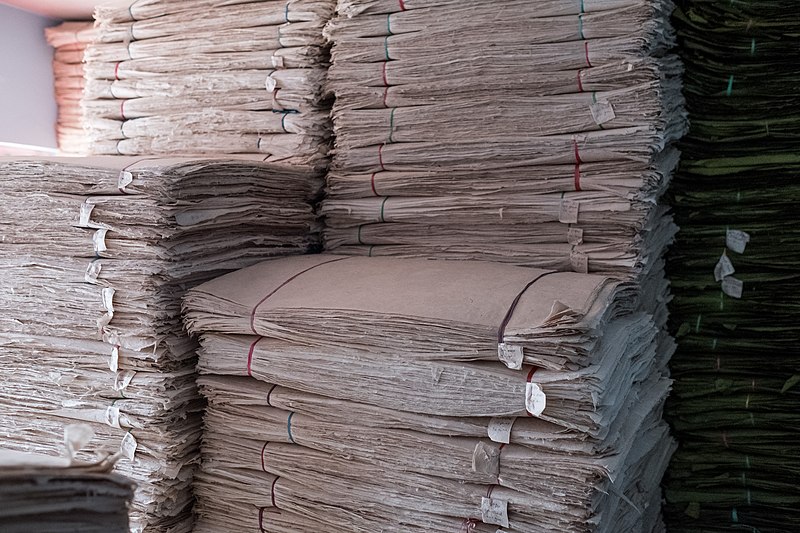
Lokta paper — Nepali kaagaz — is a traditional Nepali handmade paper, native to the Himalayan region.
The paper is highly robust, flexible, durable, and insect-resistant, making it ideal for valuable legal and religious documents — land transactions at the Land Registration Office, bank documents, paper incense, and letter pads.
The use of Lokta is experiencing a steady rise for regular purposes such as printing, packaging, and crafting within the local market.
Outside the local market, Lokta paper and varieties of products made from it like postcards, writing pads, papers, woodblock prints, calendars, gift wrap, lampshades, etc. are exported from Nepal — the major markets being the USA, Japan, Canada, and European countries.
Historical records found in different monasteries indicate that the production of handmade paper for commercial purposes in Nepal has been in practice since the 12th century.
The Lokta paper was introduced to the international market in the early 1980s by the United Nations Children’s Fund (UNICEF) which built a paper product manufacturing unit in Bhaktapur — the production concentrated in Baglung and Myagdi districts.
For over 35 years now, local inhabitants of Baglung and Myagdi districts have been manufacturing Lokta paper with no environmental damage.
The artisanal Lokta paper of Nepal originates from the fibrous inner bark of alpine evergreen shrubs, predominantly sourced from two Daphne species: Daphne bholua and Daphne papyracea.
In local parlance, these shrubs are commonly referred to as Lokta bushes.
Harvesters carefully remove the bark of the Lokta bush within the woodland, after which they sun-dry it. The dried bark is later soaked in water for tenderization and cleansing. Subsequently, the softened Lokta undergoes boiling in a solution of water and either ashes or caustic soda.
Following this, the Lokta is meticulously washed and subjected to beating with a wooden mallet (hammer), transforming it into a pulpy consistency.
The supple pulp is then skillfully shaped onto wooden frames, where it is spread thinly to take form. These paper-laden frames are left to dry under the sun, allowing the paper to be separated from the frames once the drying process is complete.
Read More Stories
Nepal needs to repeat to brand itself
Last year Nepal's goods exports jumped 81.8% to NRs 277.03 billion. That is...

Banking stocks gain momentum as dividend season begins
Dividend announcements by banks and financial institutions (BFIs) for fiscal year 2025/26 have...

Nepal’s challenge of building strong democratic institutions
Over the past few decades, institutional dysfunction and massive dissatisfaction with political establishments...