What we do is costly! Your support will help us dig more stories.
Yes, I'm Interested!Ignorance isn't always bliss | Don't stay foolish.
Keep informed | Read our news and analysis.
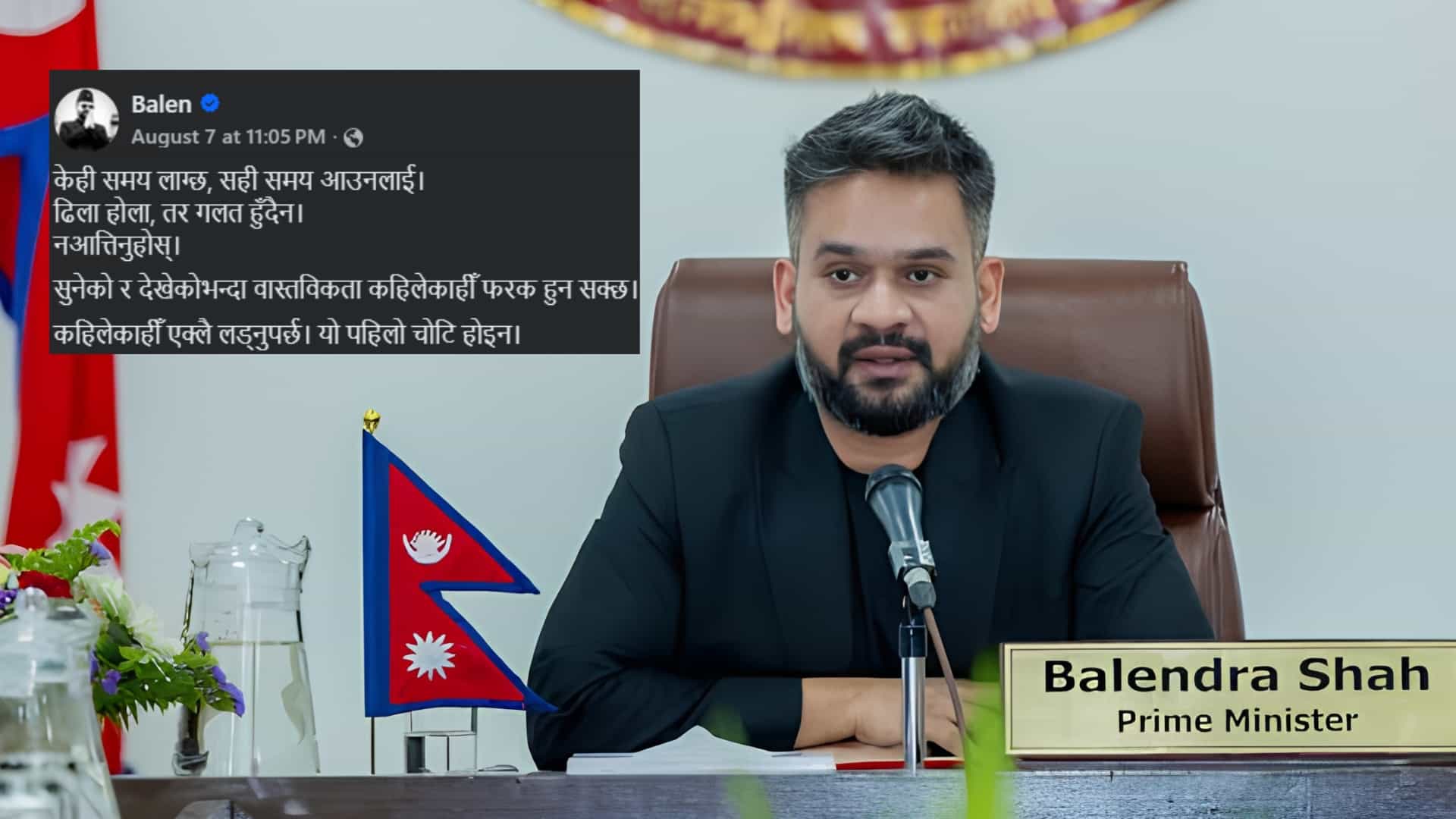
Prime Minister Balendra Shah’s cryptic social media post late Friday night drew speculation about mounting pressure within his own party, but the following day he shifted the focus to the government’s performance, presenting progress across five troubled state-run industries and institutions.
Shah’s Friday-night message, posted without identifying any specific issue or person, said that some things take time, that people should not panic, and that sometimes one has to fight alone. The post triggered debate on social media, particularly because several lawmakers from the Rastriya Swatantra Party (RSP) had questioned the government’s performance in Parliament earlier that day.
RSP lawmakers, including former spokesperson Manish Jha and assistant spokesperson Ramesh Prasai, had raised concerns over issues ranging from gas shortages to other aspects of government functioning. Jha subsequently said that questioning the government in Parliament was a normal part of democratic accountability and that lawmakers would continue to scrutinise its work.
Several observers argue that Shah’s political style and limited engagement with broader party structures may be contributing to perceptions of his isolation. However, criticism from within the party is also growing. In the first few days, party lawmakers largely remained silent over the prime minister’s conduct, amid mounting public scrutiny of his government. That silence now appears to be giving way to increasing internal unease and criticism.
The uncertainty surrounding Shah’s message was followed the next day by a markedly different communication: a detailed account of the government’s progress during its first four months, centred on five state-owned enterprises and institutions that have faced prolonged losses, inefficiency or operational difficulties.
Shah highlighted Nepal Drugs Limited, Hetauda Textile Industry, Nepal Airlines Corporation, Dairy Development Corporation (DDC), and the Singh Durbar Vaidyakhana Development Committee as examples of institutions where he said recent reforms had produced encouraging results.
According to the prime minister, Nepal Drugs Limited sold medicines worth NRs 238 million during the past four months. The company also obtained Good Manufacturing Practice certification from the World Health Organization, while Shah said it recorded a profit of NRs 30 million in the previous fiscal year. The government has set a target of NRs 300 million in medicine sales for the current fiscal year.
The government also plans to expand domestic pharmaceutical production. Of 37 types of medicines targeted for production this year, preparations for 25 have reportedly reached the final stage, while 11 types are already being manufactured. A longer-term government plan aims to produce 98 types of essential medicines through Nepal Drugs Limited.
The Hetauda Textile Industry, which has remained closed for years, has also entered a testing phase. Shah said the Nepal Army had been assigned responsibility for trial production after repairs to the factory’s looms. The government is preparing to determine the future operating model after the trial period.
Nepal Airlines Corporation was another major focus of the prime minister’s report. Shah said the national carrier generated NRs 6.27 billion in revenue between the last four months of the last fiscal year, an increase of NRs 1.1 billion compared with the same period a year earlier. Seat occupancy reportedly reached 86%, six percentage points higher than the previous year.
During the same period, Nepal Airlines also paid NRs 106.19 million in installments on loans taken from the Employees Provident Fund and Citizen Investment Trust for aircraft purchases.
At the Dairy Development Corporation, Shah highlighted efforts to reduce the backlog of payments owed to farmers. The payment cycle, which had stretched to as long as eight months, has reportedly been reduced to two to three months, while outstanding liabilities have fallen from NRs 720 million to NRs 350 million.
The government has also added a one-rupee-per-litre incentive for farmers supplying milk. Shah said DDC’s daily sales increased by 35% following the reforms, with average daily revenue rising from NRs 6 million to NRs 9 million. According to Shah, the corporation has discontinued unauthorised employee benefits involving milk and ghee, which the government estimates will reduce annual expenses by around NRs 30 million.
DDC is preparing to export ghee to Gulf countries and butter and chhurpi to China, while cheese production is expected to resume at its Nagarkot facility.
The Singh Durbar Vaidyakhana Development Committee has likewise reported increased activity, states the PM. Shah said the institution had produced and marketed Ayurvedic medicines worth NRs 110.2 million since the formation of his government. Its medicine transaction reached about NRs 130 million in the previous fiscal year, nearly four times the figure recorded a year earlier.
The Vaidyakhana is currently moving toward self-sufficiency in the production of 35 types of medicines distributed free of charge. It is producing 105 types of Ayurvedic medicines and has set a target of increasing that figure to 150 during the current fiscal year.
The government also plans to obtain GMP certification for powdered and tablet medicines and establish a processing centre for medicinal herbs and pharmaceutical raw materials.
Taken together, Shah’s two consecutive social media posts presented contrasting images of his premiership: the first fuelled speculation over political pressure and possible isolation, while the second sought to demonstrate measurable progress through administrative reform and the revival of struggling state institutions.
But the stated performance also raises several questions.
The first is the government’s decision to involve the Nepal Army in trial production at a state-owned factory. The move may help restart an institution that has remained dormant for years, but it also raises questions about the appropriate role of the military in commercial and industrial activity. The army’s role during last year’s September violence, when it was criticised for remaining inactive as the nation witnessed some of the worst violence in years, including its failure to protect the office of its Supreme Commander, has already come under heavy scrutiny. The prime minister’s proximity to the institution, coupled with his consistent tendency to deflect parliamentary scrutiny, has also raised serious doubts.
The second is the state’s continued willingness to remain directly involved in running businesses. The third is the broader assumption that loss-making or effectively defunct state enterprises can and should be revived rather than restructured, privatised or allowed to close.
Fourth is Shah’s continued reliance on social media as his primary channel for expressing himself, over institutional channels. Criticism abound the PM is reinforcing an increasingly personalised, cult-like image of leadership overshadowing the institutions he leads.
The timing and the style of the two posts has therefore added a political dimension to what the prime minister presented as a four-month performance report. While party leaders close to Shah have played down suggestions of a growing rift, questions remain over how the government will respond to criticism from its own lawmakers as it continues to insist that its intentions are sound.
Read More Stories
Inside Nepali Congress’s 15th General Convention
The Nepali Congress began debating its political and organisational direction for the next...

NEPSE continues downtrend, sheds another 20 points, turnover drops to NRs 3.27 billion
The stock market extended its decline on Monday, with the Nepal Stock Exchange...
National Medical College residents’ protest widens into scrutiny of PG programme
A dispute between postgraduate resident doctors and the administration of National Medical College...