What we do is costly! Your support will help us dig more stories.
Yes, I'm Interested!Ignorance isn't always bliss | Don't stay foolish.
Keep informed | Read our news and analysis.
Nepali Congress | 15th General Convention | Gagan Thapa Presideny | Political Reset Promise
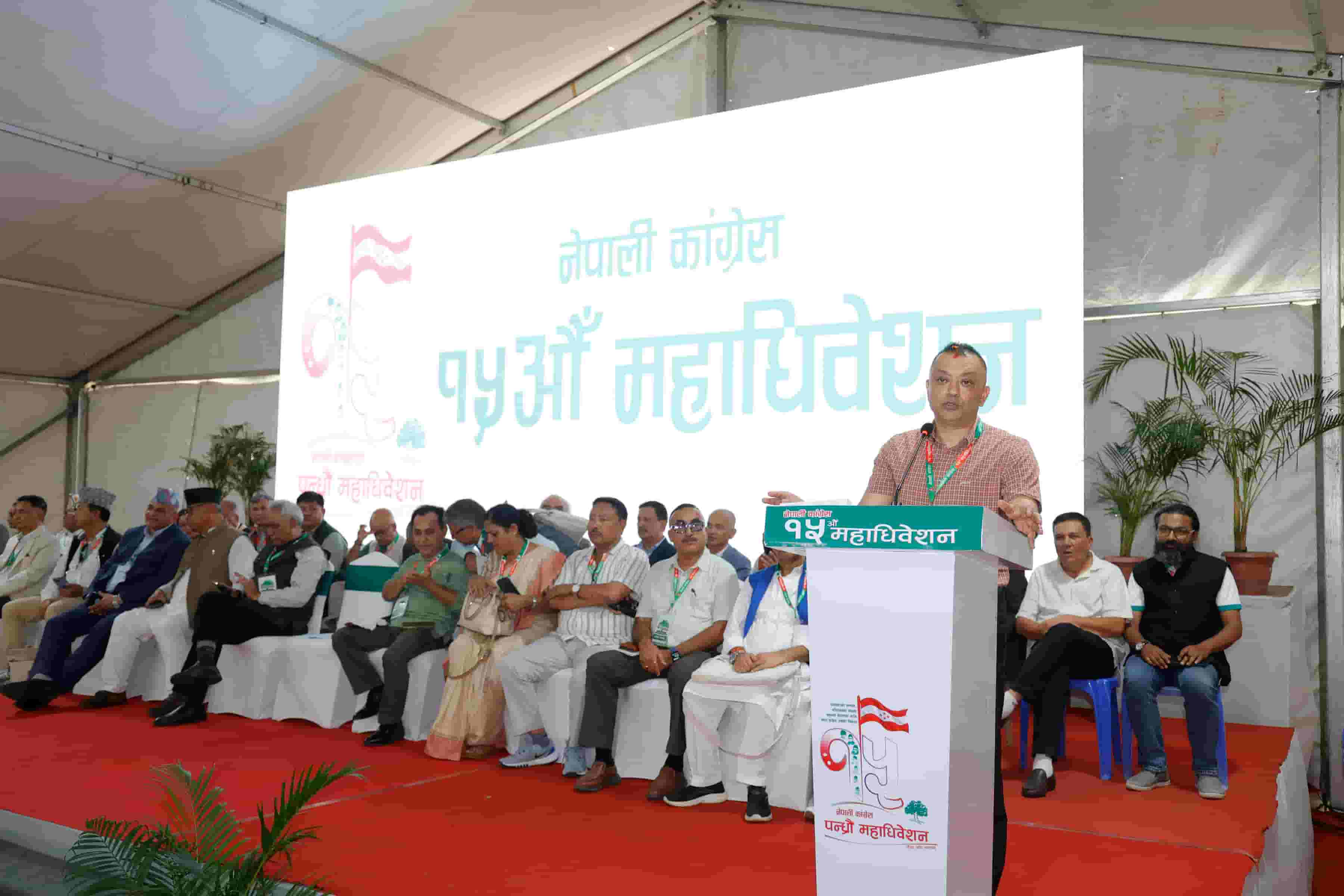
The Nepali Congress began debating its political and organisational direction for the next four years on Monday, with party President Gagan Kumar Thapa calling for a break from the power-sharing, factionalism and transactional politics that he says have weakened the party over the past two decades.
The proposals being discussed at the 15th General Convention go beyond changes to the Congress organisation. Thapa’s political report sets out a broader programme built around institutional accountability, greater participation of younger generations, a production-led economy, stronger federalism and what it describes as a vision of a “Prosperous Nepal, Respected Nepali.”
The party’s Central Working Committee (CWC) approved Thapa’s political proposal, Vice-President Bishwa Prakash Sharma’s proposal on contemporary issues, and General Secretary Pradip Paudel’s proposals on party operations and amendments to the statute before the closed-door session began on Monday.
More than 7,000 delegates are taking part in the convention, with 6,933 delegates divided into Mountain, Hill and Terai-Madhes groups for the policy discussions. The final voter list for the leadership election is expected to establish the number of delegates eligible to cast ballots.
The proposals remain subject to discussion and amendment at the convention.
A reckoning with two decades of Congress politics
Thapa’s report offers a direct assessment of the party’s recent record.
It acknowledges that Congress increasingly prioritised positions and access to power over its political objectives. Coalition management, power-sharing and factionalism, it says, weakened the party’s moral standing, while its protection of people affiliated with the party in corruption and irregularity cases undermined public institutions.
The report also acknowledges that Congress has become increasingly distant from younger generations and failed to keep pace with changing public expectations.
Thapa argues that the response to that crisis should not be less democracy but “deeper and more result-oriented democracy.” The report says public frustration with slow institutions and party infighting should not be used to justify weakening institutional independence or citizens’ rights.
One of its clearest political commitments is that Congress should not enter pre-election alliances. Instead, it should contest elections under its own symbol and seek a mandate on its own programme.
The report also proposes primary elections, greater use of public opinion in candidate selection and greater emphasis on merit, contribution and performance rather than access to party factions.
From party reform to state reform
The report proposes stronger scrutiny of governments, including an open citizen dashboard showing public projects, spending, progress and responsible officials.
It also proposes a framework based on five questions for major public decisions: what was decided, why it was decided, who is responsible, what result it produced and what should change if the expected result was not achieved.
For the party itself, Thapa proposes greater financial transparency, public auditing, stronger ethical standards and an internal ombudsman. The report also says Congress should not protect its members from corruption investigations.
Other proposals include a two-term limit for prime ministers, voting rights for Nepalis abroad and changes to candidate selection and electoral processes.
The economic vision also seeks to move Congress away from an economy dependent on imports and remittances towards one driven by production, investment and employment.
The report identifies agriculture, hydropower, energy, tourism, industry and digital technology as key sectors and proposes closer cooperation with the private sector. It also calls for greater investment in education, healthcare, nutrition and skills as a way of reducing inequality before it becomes entrenched.
Climate change is framed not only as an environmental concern but also as an economic and national-security issue, with disaster risks to be incorporated into infrastructure and development planning.
Rastriya Swatantra Party Chair Rabi Lamichhane, addressing the convention on Sunday, offered support for political renewal while directly challenging Congress over its record.
Lamichhane told Thapa that leaders who repeatedly create internal disputes should not continually be persuaded to return. He also questioned a political culture in which loyalty, wealth and access could matter more than contribution when opportunities are distributed.
He argued that Congress had spoken for years about proportional representation, Madhes and marginalised communities but that constitutional commitments had not always translated into representation in practice.
Lamichhane also made a generational argument, saying Congress’s celebration of a 50-year-old president should prompt reflection on why younger leadership had not been given greater space earlier.
His intervention came as Congress itself debates whether its political renewal should involve a decisive break from the party’s older leadership structures.
Nepali Communist Party convener and former prime minister Pushpa Kamal Dahal also urged Thapa and Lamichhane to break with political continuity, but framed the issue around protecting the constitutional order.
Dahal said democracy and the country were facing difficulties and expressed concern that some government statements and activities could push the country towards authoritarianism. He called for political forces to work together to strengthen the federal democratic republic and the Constitution and to complete the remaining work of the peace process.
Dahal contrasted his own political trajectory with the challenge now facing younger leaders.
“I broke with continuity by moving from war to peace, to a republic and to the constitution,” he said, urging Thapa and Lamichhane to make their own break with political continuity.
The convention has also become a forum for competing views of the country’s political future.
CPN-UML General Secretary and former Lumbini chief minister Shankar Pokhrel called for cooperation among parties on democracy, the Constitution, national sovereignty and climate change while questioning whether the government was sufficiently committed to democratic institutions and Parliament.
Former prime minister Baburam Bhattarai argued that political parties should compete through long-term national development plans rather than merely over changes in government. He urged the new generation to take greater responsibility for the country’s future.
Rastriya Prajatantra Party Chair Rajendra Lingden called for a new national understanding among political parties and younger generations.
Janata Samajbadi Party-Nepal leader Sharat Singh Bhandari called for greater cooperation to protect the federal democratic republican system and warned against what he described as “controlled democracy.”
Nagarik Unmukti Party leader Resham Chaudhary, meanwhile, argued that constitutional rights for communities such as the Tharus needed to be reflected in actual political representation.
Parliament, federalism and the Madhes question
Thapa has also made Parliament central to his argument for political openness.
Speaking at the convention’s inauguration, he said Nepal needed “open grounds” for political dialogue but that Parliament had to be open first. He criticised Prime Minister Balendra Shah for not appearing before the legislature and said the prime minister must respect the Parliament that elected him.
Thapa extended the same principle beyond Parliament, calling for dialogue among Madhes and other parts of Nepal, ethnic and religious communities and different generations. He also said Congress members should be able to question their leaders without fear of expulsion or intimidation.
The party’s proposed policy direction retains federalism but calls for stronger implementation, including improved coordination between federal, provincial and local governments and greater attention to fiscal and administrative capacity.
The report also links the country’s changing population patterns to public-service planning, noting migration towards Terai-Madhes and major urban and highway corridors. It proposes that services be planned according to population distribution and demand rather than administrative boundaries alone.
A convention with two unresolved questions
The policy debate is taking place alongside a deeper dispute over who has the authority to represent the Nepali Congress.
The Thapa-led Congress is holding its regular 15th General Convention after his election as party president at the second special general convention earlier in January. Former president Sher Bahadur Deuba faction does not recognise the process and is preparing a separate general convention in December. The dispute remains before the Supreme Court on review.
That leaves Congress with two questions to answer at the same time.
The first is what kind of party it wants to become.
The second is whether it can resolve its own organisational dispute while applying the principles of internal democracy, accountability and institutional reform that its new political report advocates.
Delegates will discuss the proposals through Tuesday, with the election of the new leadership and CWC scheduled for October 7 and 8. The new CWC is proposed to have 232 members, including 171 elected members and 61 nominated members.
Read More Stories

NEPSE continues downtrend, sheds another 20 points, turnover drops to NRs 3.27 billion
The stock market extended its decline on Monday, with the Nepal Stock Exchange...
National Medical College residents’ protest widens into scrutiny of PG programme
A dispute between postgraduate resident doctors and the administration of National Medical College...
CK Raut re-elected Janamat chair, Sanjay Yadav elected general secretary
Dr CK Raut has been re-elected chair of the Janamat Party, securing 958...