What we do is costly! Your support will help us dig more stories.
Yes, I'm Interested!Ignorance isn't always bliss | Don't stay foolish.
Keep informed | Read our news and analysis.
BIRGUNJ | MEDICAL EDUCATION | HOSPITAL | Resident Doctors | Postgraduate Medical Education
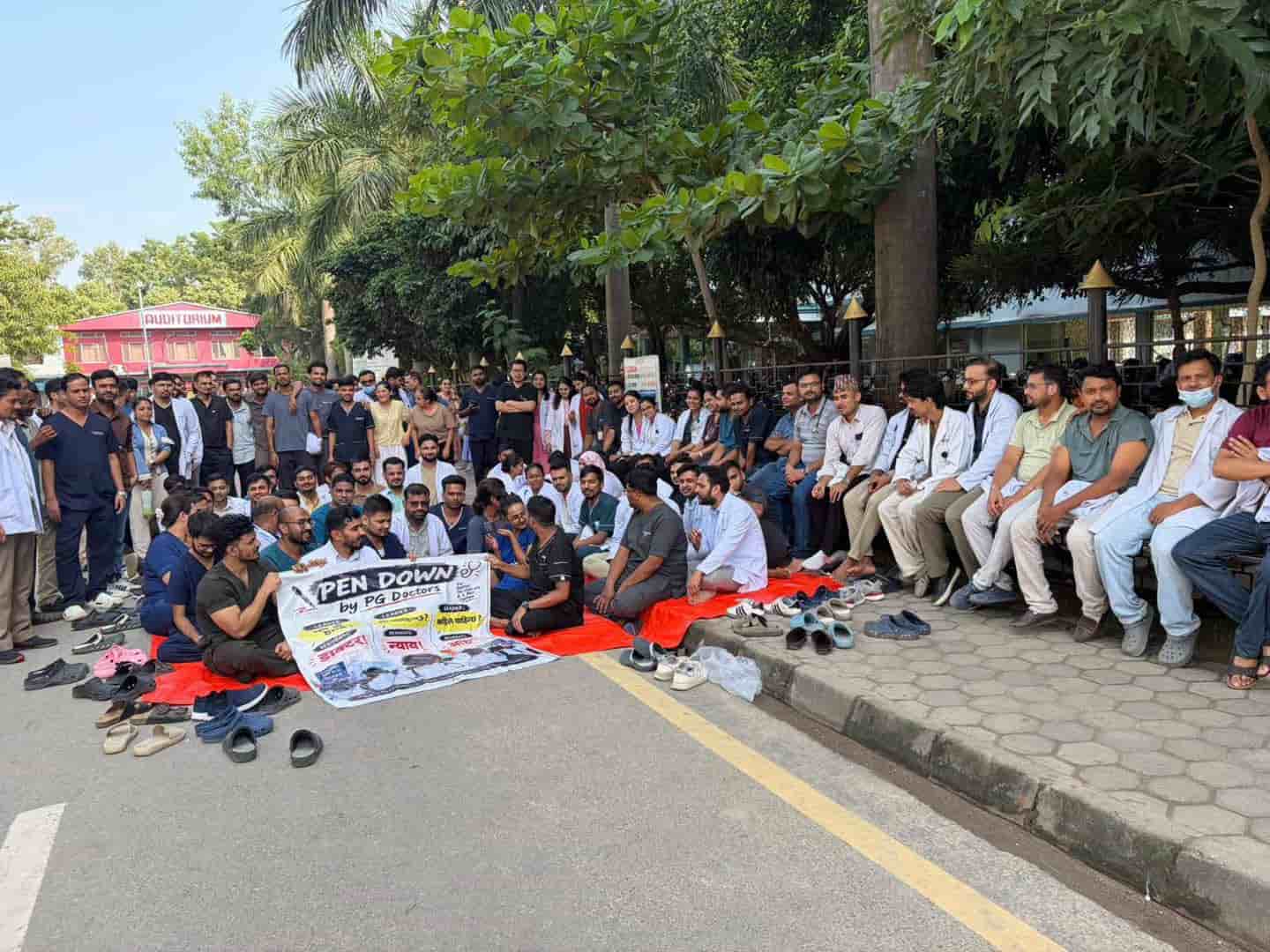
A dispute between postgraduate resident doctors and the administration of National Medical College and Teaching Hospital in Birgunj has escalated into a broader confrontation over working conditions, disciplinary action and the regulation of private medical education.
The protest began over the conditions under which first-year postgraduate residents were working and studying. Residents have accused the college of assigning duties of up to 36 hours, withholding or deducting stipends, imposing compulsory hostel and other facility charges, and using attendance rules that they say unfairly penalise doctors.
The dispute has since led to the suspension of first-year PG activities at the college, an order asking residents to vacate their accommodation, intervention by the Institute of Medicine (IOM) and the Medical Education Commission (MEC), and a political controversy over allegations of irregularities in the college's postgraduate programme.
The allegations about the PG programme at the college, however, remain unverified. National Medical College has rejected them and said no competent regulatory or government body has substantiated the claims. The college has said it is willing to cooperate with an impartial investigation.
How the dispute began
The immediate dispute involves first-year postgraduate residents admitted through the national medical education matching system and affiliated with Tribhuvan University’s Institute of Medicine.
Residents say problems emerged soon after they joined the college. Among the policies they objected to were compulsory use of the college hostel, mess and Wi-Fi, strict biometric attendance rules and the college control over educational certificates.
Residents also say that missing a biometric attendance entry could result in them being marked absent for the entire day and losing their stipend. They further claim that an earlier understanding reached in the presence of the chief district officer in Parsa to make hostel, mess and Wi-Fi use optional was later not implemented by the college.
The residents submitted a detailed complaint to several government and regulatory bodies, including the Ministry of Health and Food Safety, the Ministry of Education and Sports, the MEC and the IOM Dean Office. The residents subsequently intensified their protest after what they described as a failure by the college to resolve the issues.
On September 14, the residents submitted a memorandum to the principal office demanding, among other things, regulated duty hours, timely payment of the prescribed allowance and an end to what they described as arbitrary disciplinary action. After their two-day ultimatum expired without a settlement, they began a sit-in at the hospital on September 16.
The Nepal Medical Association has also called on the college to address the students’ concerns, citing disputes over duty hours, salaries, allowances and disciplinary action.
Seven demands
The residents have submitted a seven-point demand.
They have asked the college to withdraw a defamation case filed against seven first-year residents and to cancel disciplinary action against three residents in the obstetrics and gynaecology department, including the restoration of withheld salaries.
They have also demanded that 24-hour duties be limited to a maximum of two per week, followed by mandatory post-duty rest; that residents receive the salary corresponding to the eighth level under the agreement with the government; and that deductions associated with attendance and leave practices be stopped.
The residents have specifically objected to a practice under which taking leave on a Friday or Sunday could result in Saturday attendance being treated as absent and the corresponding allowance being deducted.
They want departmental heads’ confirmation of a resident’s presence to be accepted when biometric attendance is missed, rather than requiring residents to obtain multiple signatures to establish that they were on duty.
They have also demanded that no resident participating in the protest face salary deductions or discriminatory disciplinary action.
Residents say the demands are based in part on provisions and recommendations governing postgraduate medical training.
From protest to expulsion order
The dispute escalated after the college asked first-year PG residents to leave.
On September 24, the college suspended classes, clinical postings, departmental training, ward and emergency duties and other academic activities for all first-year PG residents of the BS 2082 academic session.
It also formally requested the IOM and Tribhuvan University to recall the residents and instructed them to vacate college hostels, quarters and other accommodation within 12 hours.
The IOM subsequently told the college to resolve the dispute through dialogue and maintain an environment conducive to teaching and learning. It reportedly said recalling the students was not a solution to what was essentially an internal dispute between the college and residents.
The college later suspended the hostel-vacating order amid adverse weather and flood warnings, according to reports. But the underlying dispute remained unresolved.
The residents then travelled to Kathmandu. More than 65 resident doctors from different years reportedly came to the capital at one stage, while 40 of the 52 first-year residents later told the media they had gone to the MEC office in Sanothimi.
Parliament raises separate allegations
The dispute took another turn on October 2 when Rastriya Swatantra Party lawmaker Rahbar Ansari raised the issue in the House of Representatives.
Ansari, who is from Birgunj, alleged that National Medical College had obtained around 25 PG seats by showing professors and other faculty members who did not actually work at the institution.
He also alleged that security guards were made to pose as patients during an inspection by the MEC, including by being placed in the emergency department and given intravenous fluids to create the appearance of patient care.
Ansari further alleged financial irregularities in examinations, including claims that students were asked for as much as NRs 300,000 in the case of Nepali students and NRs 500,000 in the case of foreign students to help them pass subjects. He also alleged that answers were written in examination answer sheets to facilitate students’ passing.
These are allegations made in Parliament and have not been established by an investigation.
The college rejected allegations made by Ansari the following day, saying no competent regulator or government agency had reached an official conclusion confirming them. It called for public discussion of such matters to be based on verified evidence and said it was willing to face scrutiny.
What the college says
The college has rejected the allegations.
In a statement issued on October 2, the college said claims made against it had not been substantiated by any competent regulatory or government authority. It said National Medical College has operated under the oversight of the MEC, Tribhuvan University, IOM, Nepal Medical Council and the Ministry of Health.
The college also said it was prepared to provide records and documentation for a fact-based, impartial and transparent investigation.
The administration has separately said that some residents engaged in activities that damaged the reputation of the college, its teachers and staff. It has also maintained that some of the allegations made by the residents were misleading or without factual basis.
The college has said that its decision to suspend first-year PG activities and seek the residents’ recall followed unsuccessful attempts to resolve the dispute and concerns that the protest was affecting academic activities and clinical services. It also said that some issues raised initially, including stipend and incentive payments, Saturday attendance and post-24-hour-duty rest, were already addressed.
The college says the residents subsequently raised additional issues, including the withdrawal of legal proceedings, disciplinary matters involving the obstetrics and gynaecology department, salary and attendance during the protest, and biometric attendance.
A wider regulatory concern
The allegations have emerged at a time when the country’s medical education regulators are already examining concerns over faculty credentials and inspection practices at private medical colleges.
In August, the Nepal Medical Council said it had formed a committee to investigate the credentials and employment status of foreign doctors after discovering cases in which doctors authorised to work in Nepal appeared to be working simultaneously in their home countries.
Council officials said they suspected that some private medical colleges were bringing foreign doctors to Nepal primarily to present them during inspections so that colleges could qualify for additional seats. The council also said some documents submitted by foreign doctors had raised questions about their authenticity.
MEC standards require medical colleges to have approved teaching faculty, and faculty members are subject to approval and registration requirements. The commission also maintains procedures for assessing the quality and determining the number of seats at medical education institutions.
That broader regulatory context does not, by itself, establish the allegations against National Medical College. But it makes the residents’ complaints and the allegations raised in Parliament matters for the relevant regulators to examine through evidence rather than competing claims.
What happens next
For now, the immediate dispute remains unresolved.
The first-year residents want to return to a functioning academic environment without losing their stipends, facing retaliation or abandoning their postgraduate training. The college maintains that it has attempted to resolve the dispute and that some of the residents’ claims are unfounded.
The IOM has urged the parties to maintain an environment conducive to education, while the residents have approached the MEC seeking a way to continue their training.
The separate allegations concerning PG seats, faculty, inspections and examinations will require scrutiny by the regulatory authorities before they can be treated as facts.
For the residents, however, after entering a three-year postgraduate programme through the national selection process, they want to know where and under what conditions they will be allowed to complete it.
Read More Stories
Inside Nepali Congress’s 15th General Convention
The Nepali Congress began debating its political and organisational direction for the next...

NEPSE continues downtrend, sheds another 20 points, turnover drops to NRs 3.27 billion
The stock market extended its decline on Monday, with the Nepal Stock Exchange...
CK Raut re-elected Janamat chair, Sanjay Yadav elected general secretary
Dr CK Raut has been re-elected chair of the Janamat Party, securing 958...