What we do is costly! Your support will help us dig more stories.
Yes, I'm Interested!Ignorance isn't always bliss | Don't stay foolish.
Keep informed | Read our news and analysis.
Inside The Tunnel Row | Disaster Reporting | Stories of Resilience | Media Ethics Concerns
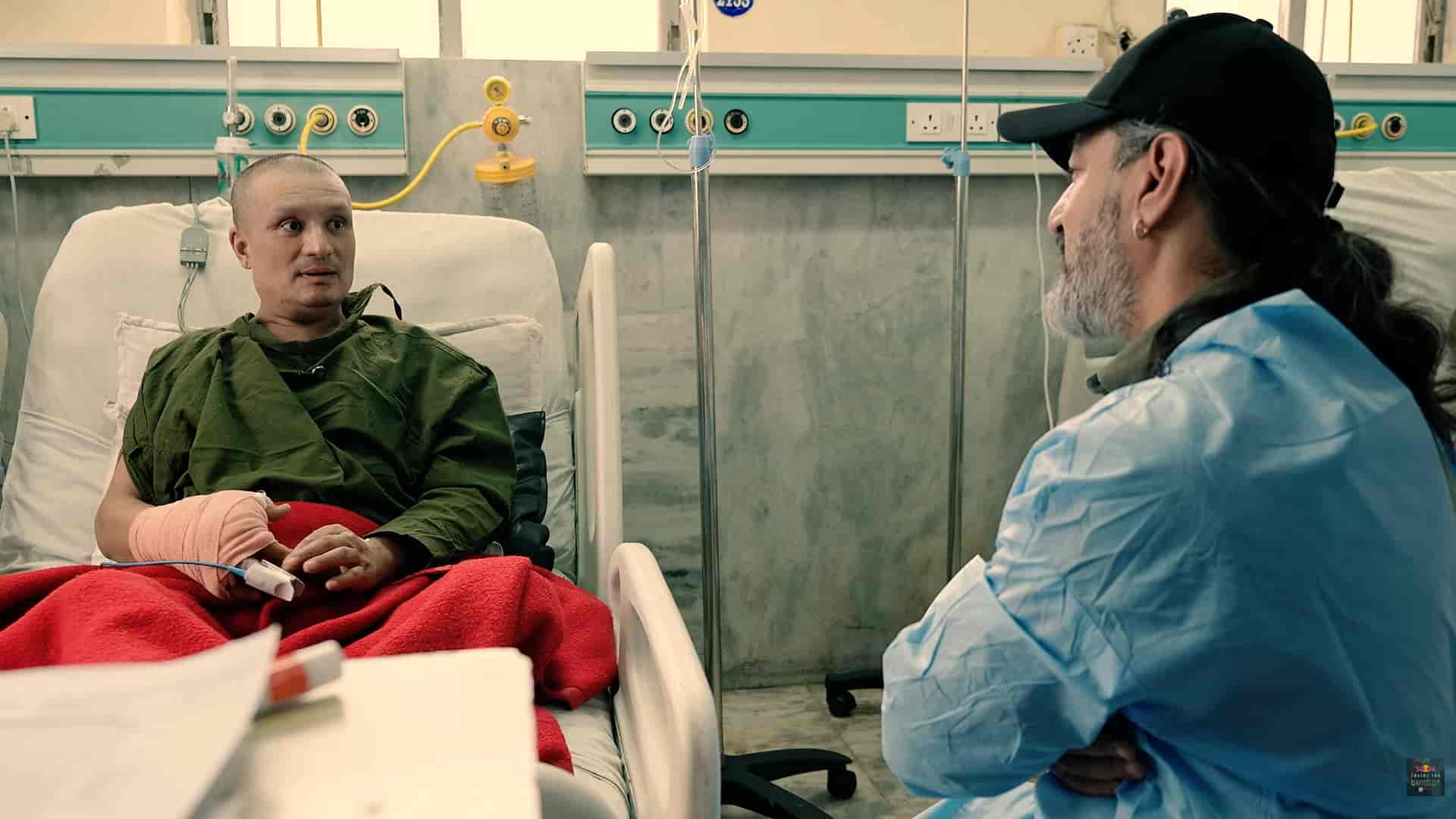
An interview with two survivors of the Rasuwa flood who spent 10 days trapped inside the Upper Trishuli 3A Hydropower Project has triggered a debate over the ethics of interviewing disaster survivors while they were still receiving intensive medical care at Birendra Military Hospital in Kathmandu.
Inside the Bunker, a YouTube channel run by media personality Suraj Singh Thakuri, broadcast the interview titled ‘INSIDE THE TUNNEL - Exclusive Interview with Trishuli 3A Survivors’ on September 13. It was recorded while the two survivors were being treated in an intensive care unit. The episode was initially titled ‘INSIDE THE ICU - Exclusive Interview with Trishuli 3A Survivors’.
The controversy has since reached the Press Council Nepal, which on September 14 said it was studying and monitoring the material under the Journalists’ Code of Conduct.
The debate widened on September 15, when five health professional councils issued a joint appeal on recording and interviewing patients in ICUs and other sensitive treatment areas. The Nepal Medical Council, Nepal Nursing Council, Nepal Ayurveda Medical Council, Nepal Health Professional Council and Nepal Pharmacy Council said patient safety, privacy, autonomy and dignity must take priority in such settings.
Their statement was not specifically about the Trishuli 3A interview. But it raises a question at the centre of the controversy: is a patient’s agreement to speak enough for an interview inside an ICU?
What happened?
Two men working on the Upper Trishuli 3A project were trapped after the August 26 disaster in Rasuwa. They were rescued after days inside the project area and were subsequently taken for medical treatment.
Inside the Bunker later interviewed them in the ICU with the host Thakuri wearing an isolation gown but no mask. The programme presented the conversation as an exclusive account of their experience inside the tunnel.
The interview drew criticism on social media and among journalists and others concerned about the media’s treatment of disaster survivors. Critics questioned the decision to conduct an extended interview while the survivors were still hospitalised, particularly inside an ICU.
The concerns centred on their physical condition, their vulnerability following the ordeal and whether an ICU was an appropriate environment for a media interview.
Was the interview unauthorised?
That remains unclear. The controversy is sometimes framed as though the journalists entered an ICU without permission. Available information does not support such a simple account.
Host Thakuri claimed at the beginning of the interview that all necessary institutional permissions with the Nepal Army and consent from the survivors were obtained. He said the interview was conducted with the survivors’ consent and in the presence of medical personnel, with consideration given to their physical and mental condition. However, during the interview he is seen wearing an isolation gown but no mask.
Emerging media reports also quoted one of the survivors and his family as saying they were not contacted for prior consent. Nepal Army Headquarters, which fully administers the hospital, has also said it was unaware of the interview.
Those accounts leave several questions open: who authorised the interview, who gave consent, and what did that consent cover?
The five health councils’ joint appeal adds another distinction. It calls for both prior institutional approval and the patient’s informed and explicit consent before recording or interviewing patients in sensitive treatment areas. It also says journalists should consider the patient’s condition and decision-making capacity, and obtain a legal guardian’s or parent’s permission where necessary.
The statement therefore treats institutional approval and patient consent as separate safeguards.
What does the journalists’ code say?
The Press Council’s inquiry is taking place under the Journalists’ Code of Conduct. Clause 5(4)(1) states that journalists and media outlets should not produce, publish, broadcast or distribute details, images, signs or other material in a manner that causes additional suffering to people affected by disasters or mourning, people experiencing pain and suffering, or their relatives, or that adversely affects public sensitivity.
The Code does not automatically prohibit interviews in hospitals or ICUs. An interview conducted in an ICU does not, by itself, establish a violation.
The question is how the material was obtained and presented, and whether the process caused or risked causing additional suffering or failed to respect the survivor’s dignity and vulnerability.
The Press Council has sought information from the concerned media workers, the hospital and the Nepal Medical Council. Their responses may help establish the patients’ medical condition, the circumstances surrounding the interview and whether their participation was appropriate at the time.
Why the ICU matters
An ICU is primarily a medical environment, not a media setting.
Patients may be medically unstable, exhausted and vulnerable to fatigue, infection and stress. For people recently rescued from a disaster, the effects of the ordeal may extend beyond what is physically visible.
The five health councils' statement makes the setting itself part of the ethical question. It says ICUs and other sensitive treatment areas should not be used for interviews, video production or promotional material. Where communication is necessary, it recommends arranging a safe and appropriate alternative outside the treatment area.
That does not establish that the Trishuli 3A interview breached any rule. It does, however, provide a clear professional position from the health sector on how such spaces should be treated.
The councils also say that when a patient’s identity, health information, photographs, video, audio or other personal material is collected, used or published, privacy, dignity, autonomy and the patient’s best interests must be respected.
For journalists, that raises practical questions beyond whether a patient said yes.
The tension between medical care, cameras and public interest is not entirely new. Cameras and boom microphones may now be an everyday part of reporting across social media and other platforms, but the platform itself does not determine whether a product meets journalistic standards. What matters is how journalists gather the material and the editorial judgement they apply to it, including decisions about consent, context, potential harm and the circumstances in which information is obtained.
In January 2023, then State Minister for Health and Population Dr Toshima Karki came under criticism after a video emerged from the ICU of the Kirtipur-based burn hospital, where entrepreneur Prem Prasad Acharya was being treated after setting himself on fire outside Parliament.
Contemporary reports said Karki entered the ICU with a few people, while questions were raised about how the interaction was filmed. The hospital administration said she had not obtained permission to visit Acharya in the ICU. Critics also questioned the presence of cameras and whether ICU protocols had been followed.
Karki later said she had not known who was filming the interaction. She defended the visit, saying she had gone to make Acharya feel that the state was present and that, as a doctor, she felt professionally obliged to check on him.
The circumstances differed from the Trishuli 3A case. Karki was a public official, while Inside the Bunker was conducting a media interview with disaster survivors. But the episode illustrates a recurring question: how should access, filming and public interest be balanced against the patient’s privacy, dignity and medical needs?
What about the survivors’ consent?
Consent remains central to the debate.
If the two survivors knowingly agreed to be interviewed, that weighs significantly in the programme’s favour. So does any evidence that medical personnel considered the interview safe and appropriate.
But the circumstances in which consent is obtained also matter.
The five councils’ appeal specifically refers to informed and explicit consent and says the patient's condition and decision-making capacity should be considered. It also calls for legal guardian or parental permission where necessary.
For disaster survivors, the issue can be particularly sensitive. Someone who has just emerged from a prolonged ordeal and remains under intensive medical care may have very different circumstances from someone giving an interview after returning home.
That does not mean that a survivor cannot consent to an interview while hospitalised. Nor does criticism of the setting establish that the interview caused harm.
It means the circumstances surrounding the consent are part of the question.
The controversy is not limited to Inside the Bunker
The Press Council’s September 14 statement also referred to a separate BBC Nepali interview.
According to the Council, BBC Nepali had previously interviewed an Everest guide who was found on the seventh day after going missing. The guide was also receiving treatment in an ICU when the interview was conducted.
The Council’s decision to mention both cases places the Trishuli 3A interview in a wider debate about how media professionals approach disaster survivors while they are receiving intensive medical treatment.
The Council has not said that either Inside the Bunker or BBC Nepali violated the Journalists’ Code of Conduct.
What remains to be established
The Press Council’s inquiry could clarify several facts that are currently central to the controversy.
Who authorised the interviews? What consent was obtained, and from whom? What was the survivors’ medical condition at the time? Did doctors approve the interviews? How long did the recordings last? Did they interfere with treatment or recovery?
The content and manner of the questioning are also relevant, as is the way the final material was edited and presented.
The health councils’ statement introduces another question: whether the interview should have taken place inside the ICU in the first place. Their stated position is that sensitive treatment areas should not be used for interviews or video production and that an appropriate alternative should be arranged outside them when communication is necessary.
Whether those principles were followed in the Trishuli 3A case remains to be established.
For now, the dispute is less straightforward than a question of whether someone was simply “allowed” into an ICU. It involves institutional permission, informed consent, the condition of the people being interviewed, the setting in which the interview took place, and the way the resulting material was used. The Press Council is now seeking the information needed to assess those circumstances.
Read More Stories

Nepal needs to repeat to brand itself
Last year Nepal's goods exports jumped 81.8% to NRs 277.03 billion. That is...

Banking stocks gain momentum as dividend season begins
Dividend announcements by banks and financial institutions (BFIs) for fiscal year 2025/26 have...
Nepal’s challenge of building strong democratic institutions
Over the past few decades, institutional dysfunction and massive dissatisfaction with political establishments...