What we do is costly! Your support will help us dig more stories.
Yes, I'm Interested!Ignorance isn't always bliss | Don't stay foolish.
Keep informed | Read our news and analysis.
Gorkha Floods | Budhi Gandaki River | Disaster Risk & Response | Loss & Damage
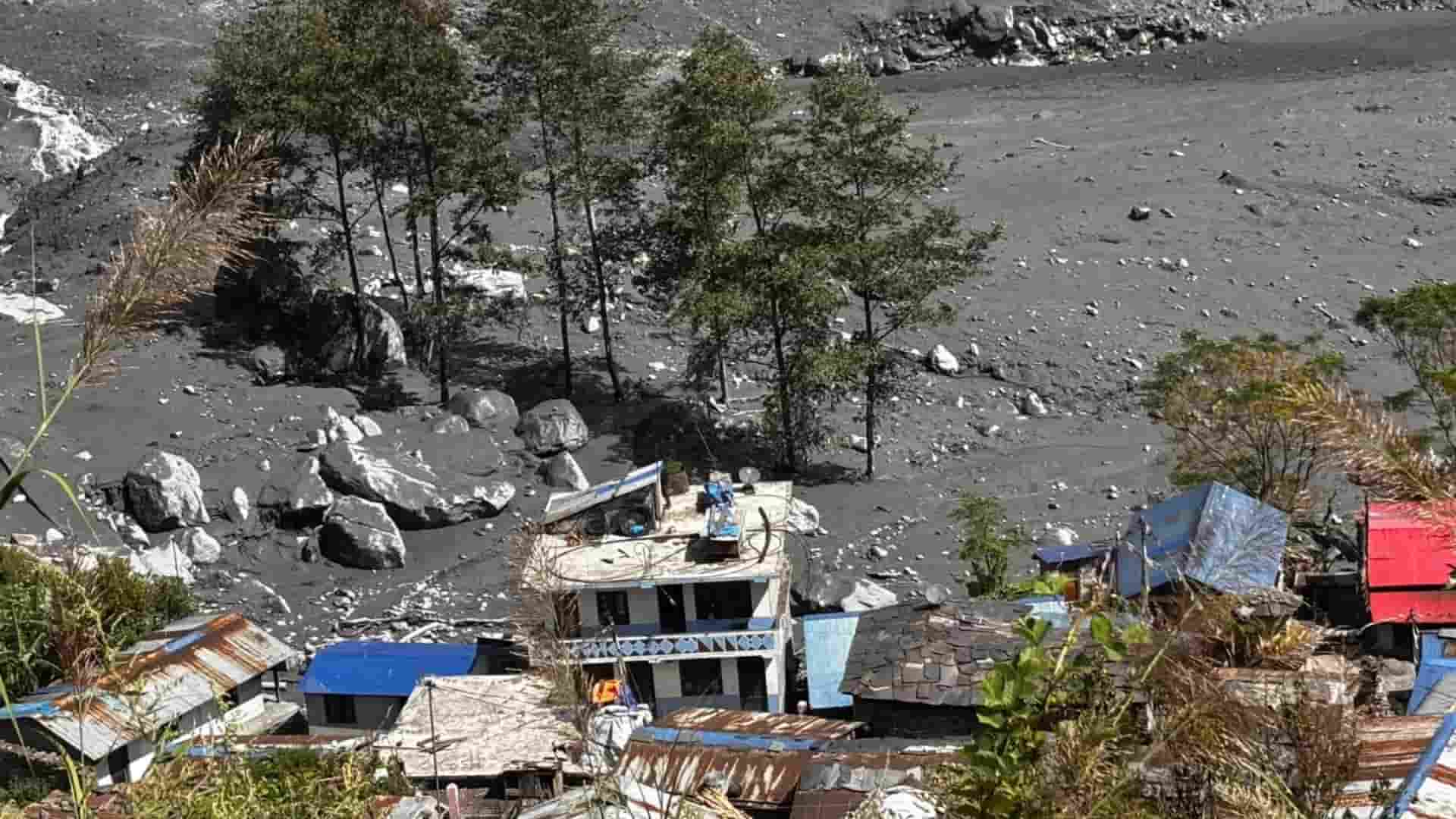
Five people remain missing after a flash flood swept through settlements along the Budhi Gandaki River in northern Gorkha early Sunday, destroying houses, damaging bridges and hydropower infrastructure, and disrupting access to remote communities. Earlier reports suggested at least 10 people were missing after the flood.
However, the flood has left villages isolated, damaged trekking routes and stranded more than 100 tourists in Jagat, Chumnubri Rural Municipality. Rescue teams continue search and evacuation operations, while authorities assess the extent of damage and work to deliver essential supplies to affected settlements.
The five missing people are residents of Chumchet in Chumnubri-6. They had reportedly gone to graze sheep and were staying in a shed near the Ungilung stream when the flood struck.
No deaths had been reported in the latest accounts available by Monday afternoon.
Preliminary assessments indicate that 45 houses were completely destroyed and 27 partially damaged across affected settlements in Chumnubri and neighbouring Dharche Rural Municipality. Thirty-four livestock sheds were also reported damaged or destroyed.
The flood also damaged river crossings and three hydropower projects, disrupting transport and access to essential services in the region.
Rescue operations continue as communities are cut off
The Nepal Army has deployed four helicopters for rescue and relief operations. The Army reported that at least 95 people, including nine foreign nationals, were evacuated to safer locations.
The loss of bridges and foot trails has complicated access to remote settlements. The approach to the motorable bridge connecting Gorkha and Dhading at Arughat was swept away on the Gorkha side, disrupting movement between the districts.
Two villages, Jagat and Salleri, remain cut off from each other and the rural municipality centre after the flood washed away sections of the foot trail, according to media reports. More than 100 tourists were unable to leave Jagat, while around 70 residents, labourers and hydropower workers were reported to be in Salleri.
Authorities have arranged helicopter evacuations, and some food supplies have already been delivered by air. Rescue teams and local officials are assessing alternative routes and the possibility of installing Bailey bridges to restore connectivity.
The flood also destroyed or damaged several other crossings, including suspension bridges serving settlements in Chumnubri and Dharche. The full extent of the damage remains unclear as assessments continue in remote areas.
Hydropower projects sustain damage
Reportedly, the flood damaged three hydropower projects.
The under-construction 341 MW Budhi Gandaki semi-reservoir project in Salleri sustained damage to its construction camp and equipment. The 24.5 MW Dobhan project suffered damage to its camp and Bailey bridge, while the access road to the 16 MW Machhakhola project was damaged.
The destruction has raised concerns about the movement of workers and supplies in an area where road and trail connections are already limited. Authorities continue to assess damage to infrastructure and the needs of affected communities.
Landslide suspected as flood cause
A landslide that temporarily blocked a stream near Chumchet is the leading preliminary explanation for the flood. The International Centre for Integrated Mountain Development said an initial assessment suggested that accumulated water and debris surged downstream after the blockage gave way. The precise sequence of events has not been conclusively established.
The disaster has also raised questions about the reach and timing of Nepal’s early warning systems in remote mountain areas.
Residents began alerting one another at around 4:45 AM on Sunday. The first official warning from the local police post was reportedly issued at 5:30 AM, while mass SMS alerts were sent to communities between 6:30 AM and 6:40 AM.
The nearest automated water-level sensor is at Arughat Bazaar, roughly 65 kilometres downstream from the suspected landslide site, limiting the ability to monitor sudden changes in the upper river system.
Authorities continue to prioritise the search for the five missing people, the evacuation of stranded tourists and workers, and the delivery of relief supplies to isolated settlements. The loss of access routes has also heightened concerns about the safety of residents and visitors should further flooding or landslides occur.
Read More Stories
Houthi attacks on Saudi airports deepen regional tensions
Yemens renewed military offensive against Houthi rebels has escalated into a wider regional...

India’s voter-roll dispute reaches Supreme Court as opposition challenges election chief
A dispute over voter registration in India reached the Supreme Court on Monday...

Market up by 4.01 points, turnover down to NRs 4.46 billion
The Nepal Stock Exchange (NEPSE) increased by 4.01 points (0.15%) to close at...