What we do is costly! Your support will help us dig more stories.
Yes, I'm Interested!Ignorance isn't always bliss | Don't stay foolish.
Keep informed | Read our news and analysis.
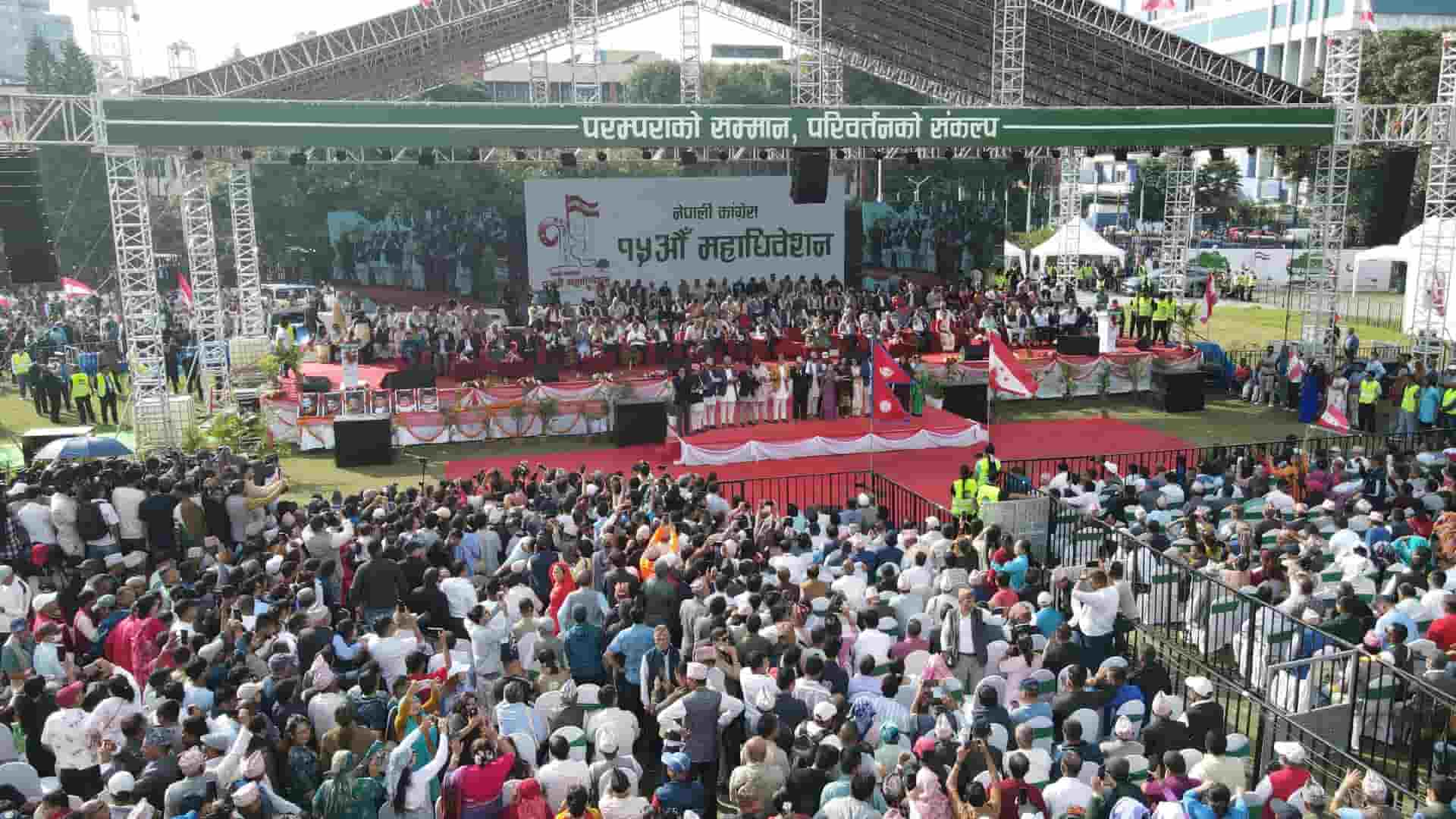
The Nepali Congress entered 2026 with a new leadership and promises of organisational renewal. Nine months later, the party is preparing for two competing general conventions.
The Gagan Thapa-led Congress is proceeding with its 15th general convention, now scheduled to begin on October 4, 2026, after the party revised the timetable by two days. Its convention process began at the grassroots level on September 19.
Meanwhile, former party president Sher Bahadur Deuba’s faction has announced a separate process, beginning with ward-level conventions on October 1 and culminating in a central convention from December 7–9.
At the centre of the dispute is the special general convention held in January, which elected Thapa as party president. The Election Commission recognised the leadership elected through that convention, and the Supreme Court upheld the commission’s decision in April. In August, however, the Supreme Court allowed Deuba and former acting president Purna Bahadur Khadka to seek a review of that ruling.
The April judgment remains in force while the review proceeds. The Supreme Court’s decision to allow the review has nevertheless reopened the legal dispute over which leadership has authority to organise the party’s next general convention.
The dispute has since moved beyond a contest over party leadership. The two factions are now organising separate convention processes at the grassroots level.
The Thapa-led convention was originally scheduled for October 2–5. But heavy rainfall, floods and landslides delayed provincial assembly and House of Representatives constituency-level conventions and the selection of general convention representatives. The Central Election Committee therefore revised the schedule on September 29, moving the inauguration to October 4, being held currently.
The revised schedule provides for delegate registration on October 2 and 3, the inauguration on October 4, closed-door sessions and other programmes on October 5 and 6, and the election process on October 7 and 8. The party has asked that the remaining regional conventions be completed by October 1 and delegate lists submitted to the central election committee.
The change comes as Thapa and other senior leaders have also resumed efforts to prevent the party from holding two separate conventions. Thapa was elected a general convention delegate from Kathmandu-4 unopposed, while Vice President Bishwo Prakash Sharma was elected a delegate from Jhapa-1.
The developments have added a new variable to a dispute that had already produced competing convention calendars: the Thapa-led faction’s October process and the Deuba faction’s separate process beginning October 1 and culminating in a December 7–9 central convention.
October 14–15, 2025: The demand for a special convention
The roots of the current crisis lie in the aftermath of the September 2025 protests and the violence that followed, which intensified demands for political and organisational change inside the Congress.
On October 14, a group of Congress leaders began pushing formally for a special general convention. On October 15, 2,487 of 4,556 valid general convention representatives, or about 54%, had signed the demand. The party statute requires a special convention be called when at least 40% of general convention representatives make such a demand.
Leaders including then-General Secretaries Gagan Thapa and Bishwo Prakash Sharma drove the demands. The central disagreement soon became one of timing: one side wanted the party to complete its organisational renewal before the March 2026 parliamentary election, while the Deuba camp opposed holding a special convention that could divide the party before the polls.
December 1, 2025: Congress fixes a January convention
After weeks of disagreement, the Central Working Committee on December 1 unanimously decided to hold the 15th general convention from January 10–12, 2026.
The decision temporarily appeared to settle the dispute. It did not.
The party subsequently struggled to complete preparations within the agreed timetable. On January 2, the central work execution committee decided to reschedule the regular convention for May 11–14.
Thapa and Sharma opposed the move, arguing that failure to hold the convention within the agreed timeframe activated the demand for a special convention.
January 8–14: The special convention
On January 8, Thapa and Sharma formally called the special convention after negotiations with the Deuba faction failed. The convention began at Bhrikutimandap in Kathmandu on January 11 and concluded on January 14.
It elected Thapa as party president, with Bishwo Prakash Sharma and Pushpa Bhusal as vice-presidents and Pradeep Paudel and Gururaj Ghimire as general secretaries.
Deuba did not participate and rejected the convention’s legitimacy.
The new Central Working Committee subsequently sought formal recognition from the Election Commission, setting up the legal dispute that would dominate the party for much of 2026.
January 16–18: Election Commission recognises Thapa-led Congress
The new leadership submitted the special convention’s decisions to the Election Commission in January.
On January 16, the commission recognised the Thapa-led Congress and decided to update the records of office-bearers elected by the special convention.
The commission said its decision was based, among other things, on the party statute’s provision allowing 40% of general convention representatives to demand a convention and its recognition of the general convention as the party’s supreme authority.
The Deuba faction challenged the decision in the Supreme Court.
The leadership dispute had now moved from the Congress’s internal structures to the courts.
March 5: Congress suffers an electoral setback
Parliamentary election on March 5 temporarily overshadowed the internal dispute.
The Congress won 38 of the 275 seats in the House of Representatives, securing 18 through the first-past-the-post system and 20 through proportional representation.
Thapa himself lost Sarlahi-4 to Rastriya Swatantra Party candidate Amaresh Kumar Singh.
March 19–22: Thapa resigns, then stays
On March 19, Thapa resigned as party president, citing moral responsibility for the election result.
The Central Working Committee considered the resignation on March 22 and rejected it. Members argued that the organisation as a whole should bear the responsibility for the electoral defeat and that changing the leadership during the crisis would further weaken the party.
Thapa therefore remained president.
The decision also kept the leadership elected through the January special convention in place while the dispute over its legitimacy continued in court.
April 17: Supreme Court upholds Thapa-led Congress
The legal dispute appeared to have been settled on April 17.
A division bench of Justices Sharanga Subedi and Nripdhwoj Niraula upheld the Election Commission’s recognition of the special convention and the leadership elected through it.
The court dismissed the challenge filed by the Deuba faction, effectively recognising the Thapa-led Congress as the official party leadership.
The ruling gave the Thapa-led Congress a legal basis to move ahead with its organisational process.
But it did not end the dispute.
August 6: Supreme Court allows review
On August 6, the Supreme Court allowed Deuba and Khadka to seek a review of the April judgment.
A three-member bench comprising Chief Justice Manoj Kumar Sharma and Justices Nityananda Pandey and Shreekanta Paudel allowed the review petition.
The decision did not overturn the April ruling. Instead, it sent the matter for a fresh hearing before a three-member bench. The Thapa-led committee therefore remained in place pending a new ruling.
The review reopened the legal dispute just as the Congress was preparing for its next general convention.
September 13–18: Efforts to bring the factions together
As the convention approached, the Thapa-led leadership made a series of moves to bring leaders associated with the previous Central Working Committee into the new process.
The party decided to allow members of Deuba’s previous Central Working Committee who had been left out of the new committee formed after the special convention to join the current Central Working Committee and participate in the general convention process.
It also decided to recognise active memberships renewed by the previous party leadership before the special convention.
The moves aimed to address concerns raised by leaders who had remained outside the Thapa-led structure.
Thapa also appealed to Deuba and other former office-bearers to participate in the 15th general convention.
On September 18, former acting president Purna Bahadur Khadka urged Thapa to postpone the convention and open talks with Deuba and other senior leaders to prevent the party from splitting its convention process.
The appeals did not prevent the Deuba faction from preparing its own convention.
September 19–26: Thapa faction begins convention process
The Thapa-led Congress began its grassroots convention process in September.
The party scheduled ward-level conventions from September 19 and moved ahead with the next stages of the convention process despite disagreements in several districts.
By late September, more than 6,000 wards in 73 districts had completed their conventions.
The process was significant because representatives elected at the lower levels would ultimately participate in the central general convention.
The party also faced disruptions in several districts. Heavy rainfall affected constituency-level conventions, forcing the election committee to extend deadlines in some places.
On September 27, constituency-level conventions were under way in several districts after the election committee adjusted the timetable because of heavy rainfall. The committee said it would complete the remaining constituency-level conventions by September 29.
The Thapa-led faction had originally scheduled its 15th general convention for October 2–5, 2026.
September 29: Thapa faction revises convention schedule
The schedule was revised on September 29 after heavy rainfall delayed provincial assembly and House of Representatives constituency-level conventions and the selection of general convention representatives in some areas.
The Central Election Committee announced that the inauguration of the 15th general convention would now take place on October 4 at 2 pm at Khula Manch in Kathmandu, two days later than the originally scheduled opening.
General convention delegates will register on October 2 and 3, while the closed-door session and other programmes will take place on October 5 and 6. The election process, including the selection of office-bearers and Central Working Committee members, is scheduled for October 7 and 8.
The Central Election Committee has asked the party to complete the remaining regional conventions by October 1 and submit the list of general convention delegates.
The revision means that the Thapa-led faction's convention is no longer scheduled for October 2–5. The process will now run from delegate registration on October 2 through the election process on October 7–8.
The change came as the party continued to face disruptions caused by heavy rainfall in different parts of the country.
September 14–28: Deuba faction prepares a parallel convention
While the Thapa-led faction continued its convention process, the Deuba faction moved ahead with preparations for a separate general convention.
The faction has set October 1 for ward-level conventions and December 7–9 for its central general convention.
It has also begun establishing its own organisational machinery for the convention. By September 25, the faction had appointed central representatives in 76 of the country’s 77 districts.
The faction has adopted rules that differ from those being used by the Thapa-led Congress.
Under the Thapa-led convention process, central leaders must return to their respective wards and contest elections to become general convention representatives. The Deuba faction, by contrast, has decided that several categories of central leaders will automatically retain the status of general convention representatives.
The two sides have also adopted different provisions on the number of representatives the party president can nominate and have set different nomination fees at various levels of the party.
The differences show that the dispute has moved beyond competing claims over leadership and into the organisation of two separate convention processes.
September 27–29: Two convention calendars take shape
The Deuba faction has continued preparations for its October 1 ward conventions and December central convention. The Thapa-led faction, meanwhile, has continued electing general convention representatives.
On September 29, Thapa was unanimously elected a general convention delegate from Kathmandu-4. Vice President Bishwo Prakash Sharma was elected a delegate from Jhapa-1, receiving 638 of 710 votes.
At the same time, Thapa has continued efforts to avoid two separate conventions and bring leaders from the rival camp into the October process.
The latest developments therefore leave the Congress with two competing organisational calendars. The Thapa-led faction has revised its convention schedule to October 4–8, while the Deuba faction continues to prepare for a separate process beginning October 1 and culminating in a December 7–9 central convention.
What happens next?
The Nepali Congress now faces three overlapping questions.
The first is legal. The Supreme Court’s review of its April decision recognising the Thapa-led leadership remains pending.
The second is organisational. The Thapa-led faction has proceeded with its convention process, while the Deuba faction has announced a separate process beginning with ward conventions on October 1 and culminating in a central convention from December 7–9.
The third, whether the two sides can reach an agreement before their separate organisational processes become further entrenched, is no more an option.
Read More Stories
How does Bhotekoshi disaster compare with 2015 earthquake?
How big was the August 26 Bhotekoshi disaster compared with the 2015 earthquake?...
ADB, NEA advance transmission and battery storage projects under PPP model
The Asian Development Bank (ADB) and Nepal Electricity Authority (NEA) have signed two...

Market reform measures fail to lift sentiment as NEPSE extends weekly decline
The stock market extended its downward trend on Friday, with the Nepal Stock...