What we do is costly! Your support will help us dig more stories.
Yes, I'm Interested!Ignorance isn't always bliss | Don't stay foolish.
Keep informed | Read our news and analysis.
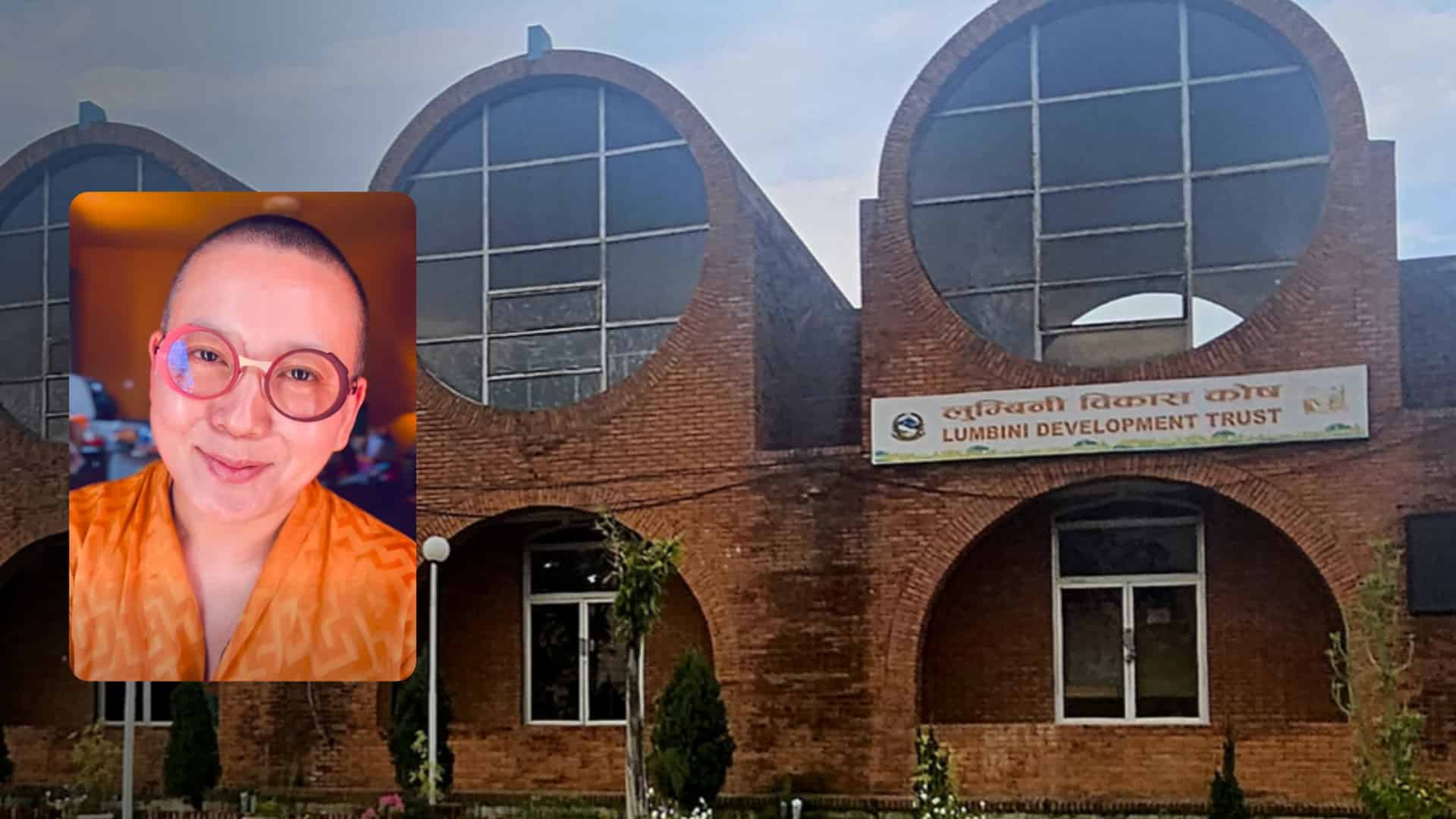
The appointment of Aani Chhoying Dolma as vice-chairperson of the Lumbini Development Trust has drawn protests over a money-laundering investigation dating back to 2018 and questions about her citizenship.
The Cabinet appointed the Buddhist nun and singer on October 16, following a proposal from the Ministry of Culture, Tourism and Civil Aviation. The decision prompted opposition from the Save Lumbini Campaign, whose members have called for the appointment to be revoked.
The financial investigation concerns three transfers totalling US$1,649,940 into Dolma’s account at the then Mega Bank in May 2018. The Financial Information Unit (FIU) of Nepal Rastra Bank (NRB) flagged the transactions and referred the matter to the Department of Money Laundering Investigation, which subsequently froze the account.
The investigation has resurfaced following recent reports that it has neither been formally concluded nor is currently active. Dolma has rejected the allegations against her. No conviction or judicial finding establishing that she committed money laundering has been reported.
Investigation into bank transfers
According to media reports, three deposits were made into Dolma’s account on May 9, 10 and 11, 2018.
The reported transfers were $579,980, $539,980 and $529,980, respectively. The senders were identified in the reports as Liang Chung Hang and Jiori, residents of Hong Kong.
The FIU examined the transactions before referring the matter to the Department of Money Laundering Investigation (DMLI). The department subsequently investigated the source of the funds and froze the account.
Media reports also described an attempt to transfer an additional amount worth more than NRs 180 million into Nepal, which authorities reportedly stopped.
The investigation raised questions about the source of the money and the circumstances surrounding the transfers. The publicly reported information does not establish that the funds were proceeds of crime.
Media reports suggest that the investigation had neither been formally concluded nor was currently under way, while allegations of political pressure affected the handling of the case and the release of the frozen funds. These allegations have not been established through a publicly reported judicial finding.
The DMLI and NRB have not provided a publicly reported final account resolving the questions surrounding the inquiry.
Protests over the appointment
The Save Lumbini Campaign began protesting following Dolma’s appointment, demanding that the government reverse its decision.
Campaigners have raised concerns about the financial investigation, her citizenship and the appointment process. They have also argued that local concerns and representation should receive greater consideration in decisions concerning the development trust.
The controversy has prompted demonstrations in Lumbini and Kathmandu. According to reports, two coordinators of the Save Lumbini Campaign were arrested on October 26 in connection with the protests. They were released the following day after police warned them against repeating the alleged conduct.
The appointment has also raised questions about the selection process. Reports have cited differing figures for the number of applicants, and the ministry has not provided a comparative assessment of candidates that would establish how Dolma was selected.
The government has the authority to appoint the trust’s vice-chairperson under the Lumbini Development Trust Act, 1985. The protests have nevertheless brought attention to the criteria used in making the appointment.
Citizenship complaint
A separate controversy concerns the circumstances in which Dolma obtained Nepali citizenship by descent in 1989.
In December 2019, Praman Singh Lama, the son of the man named as her father on her citizenship certificate, filed a complaint questioning the basis on which the document was issued.
According to media reports, police sought records from the Kathmandu District Administration Office, but the inquiry did not lead to a publicly reported conclusion.
The citizenship complaint is separate from the financial investigation. The available reporting does not establish that Dolma obtained citizenship unlawfully or that her citizenship has been invalidated by a court.
Dolma rejects allegations
Dolma has rejected allegations concerning her financial transactions and citizenship, describing them as attempts to damage her reputation in a video statement. She said people could verify the status of the financial case with DMLI and NRB.
Dolma has also pointed to her religious and social work. She runs Arya Tara School in Pharping, Kathmandu, since 2000, supporting the education of Buddhist nuns.
Former Lumbini Development Trust vice-chairperson Bhikshu Metteya Shakyaputta, also known as Awadhesh Kumar Tripathi, has supported the appointment while calling for the relevant authorities to address the outstanding questions.
The financial investigation remains without a publicly reported conclusion, while the protests have brought renewed attention to the appointment and the government's selection process.
The controversy surrounding Dolma’s appointment is part of a broader debate over the government’s approach to public appointments. After an ordinance removed hundreds of officials appointed by previous administrations, the government filled 611 positions across public institutions.
Some subsequent appointments have faced scrutiny over eligibility, selection procedures, family connections and representation. The Supreme Court has also overturned appointments to Nepal Airlines Corporation on eligibility and procedural grounds, while parliamentary hearings have rejected some ambassadorial nominees.
These cases do not establish that all new appointments were improper, but they raise questions about whether the government is consistently applying the standards of merit, transparency and accountability it pledged to uphold.
Read More Stories

Banking stocks lead as NEPSE gains 31.54 points
The Nepal Stock Exchange (NEPSE) rose for the third consecutive day by 31.54...
Beyond digital payments: Can South and Southeast Asia build a more inclusive financial corridor?
Digital payments are no longer merely about how people pay for goods and...

Red vs blue: Who owns the CAN?
Ask for a Red Bull in a Nepali shop and watch what you...