What we do is costly! Your support will help us dig more stories.
Yes, I'm Interested!Ignorance isn't always bliss | Don't stay foolish.
Keep informed | Read our news and analysis.
Dance | Folk | Magar community
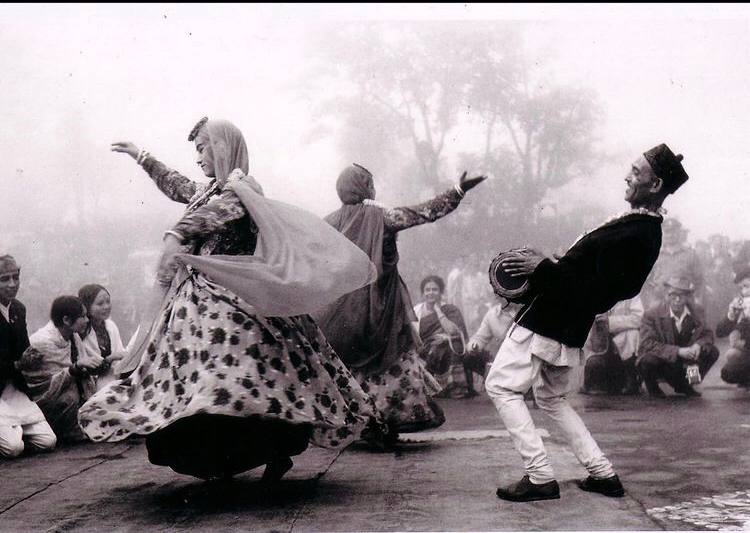
Maruni is one of the oldest and most popular folk dances of the Magar community of Nepal performed in vibrant attires with rich ornaments. Nepali diaspora populations in Bhutan, Myanmar, and India (Darjeeling, Assam, and Sikkim) also practice the dance.
The origin of Maruni choreography is linked with the army of King Balihang Rana Magar in the 14th century.
The dance covers a wide range of themes — from Hindu mythology (lives of deities such as Shiva, Krishna, etc.) to the daily lives of people.
Later, young boys costumed as girls would perform the dance accompanied by a ‘Mridanga’ (maadal player) and a ‘Dhatuwaray’ (prankster).
The dance then extended to Dashain and Tihar festivals performed during Deusi and Bhailo and to celebrate ‘victory of good over evil’ accompanied by the traditional Nau-mati Baja (nine instruments orchestra) — where dancers would do rhythmic movements while holding lit diyas in copper thaalis on their palms.
At the present time, Gurung, Kirat, and Khas populations also tap their feet to the Maruni dance on occasions such as Teej and Mangsir Purnima.
Women’s dance attire constitutes Pati jama, Chaubandi cholo dropping furka on both sides of Patuka, and different gold jewelleries.
The ornaments worn by women include Potey (glass bead necklace), Tilhari (gold pendant with multiple beads), Kantha (round-shaped gold beads paired with red flat pads), Sheerbandi (head jewellery made of gold that hangs a bit from the forehead and is attached to the hair), Chyapte suun (flat gold earring), and Phuli (gold nose stud).
There are different variants of the Maruni dance — Maruni, Thale Maruni, and Sorathi.
Maruni consists of one woman and one maadal player.
In Thale Maruni, there are two women dancers, one maadal player, and one Dhatuwaray.
In Sorathi, there are 16 women and one man, who are considered the queens and the king respectively.
Compiled from various sources by Rebika Kunwar
Read More Stories

Nepal needs to repeat to brand itself
Last year Nepal's goods exports jumped 81.8% to NRs 277.03 billion. That is...

Banking stocks gain momentum as dividend season begins
Dividend announcements by banks and financial institutions (BFIs) for fiscal year 2025/26 have...
Nepal’s challenge of building strong democratic institutions
Over the past few decades, institutional dysfunction and massive dissatisfaction with political establishments...