What we do is costly! Your support will help us dig more stories.
Yes, I'm Interested!Ignorance isn't always bliss | Don't stay foolish.
Keep informed | Read our news and analysis.
INFRASTRUCTURE | DEVELOPMENT | HIMALAYAS | SUSTAINABILITY | mega project
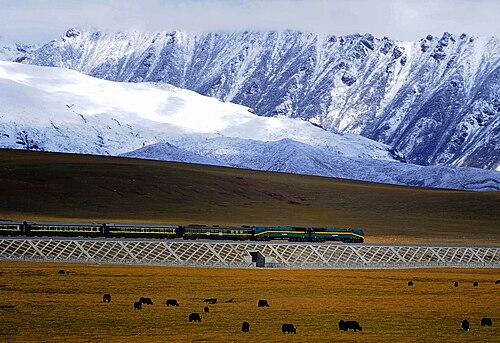
Nepal and China have completed the feasibility study for the proposed Kerung–Kathmandu cross-border railway, marking a major step towards the long-discussed infrastructure project. However, rising construction costs, flood risks in Rasuwa and questions about regional connectivity could complicate its implementation.
The 42-month study, financed through a Chinese government grant, examines the technical feasibility of connecting Kathmandu with Kerung in China's Tibet Autonomous Region. Chinese officials presented preliminary findings to a Nepali delegation during discussions in Xi’an in late October. The final report is expected to be submitted to the Nepal government through diplomatic channels.
The proposed 78-kilometre railway section in Nepal would pass through Rasuwa and Nuwakot before reaching Tokha in Kathmandu. Nearly 96% of the alignment would consist of tunnels and bridges, reflecting the engineering challenges of constructing railway infrastructure in the Himalayan region.
Construction cost could exceed NRs 400 billion
According to preliminary findings shared by Chinese officials, construction of the Nepal section could cost more than NRs 400 billion, significantly higher than the NRs 257 billion estimated in the 2018 pre-feasibility study.
The earlier proposal covered 72.25 kilometres at an estimated cost of NRs 3.55 billion per kilometre. However, the latest figure remains preliminary and will require further assessment through a detailed project report (DPR).
The proposed route includes stations at Kerung, Dhunche, Nuwakot and Tokha, descending from approximately 2,774 metres above sea level at Kerung to around 1,400 metres at Tokha.
Rasuwa floods raise safety concerns
The devastating floods of August 2026 severely damaged the Rasuwagadhi border area, affecting roads, bridges, electricity infrastructure and customs facilities.
The disaster has raised concerns about the railway's vulnerability to floods and other natural hazards. Nepali officials said Chinese technical experts had reviewed the proposed alignment following the disaster.
Preliminary designs reportedly include elevated bridges and tunnels to reduce exposure to flood-prone areas. Chinese representatives have also indicated that the structures could be designed to withstand flooding more severe than the August disaster.
However, these claims will require independent technical verification, particularly regarding earthquakes, landslides, debris flows and other geological risks.
China questions connectivity beyond Kathmandu
Chinese officials have reportedly questioned whether extending the railway only to Kathmandu would generate sufficient passenger and freight traffic to sustain its operating costs.
One possible solution is to connect the proposed railway with the Kathmandu–Raxaul railway, which would link Nepal's capital with India's railway network.
If both projects are implemented, they could establish a north–south transport corridor connecting China, Nepal and India, supporting regional trade and passenger movement.
China has already extended its railway network from Lhasa to Shigatse and is working towards expanding it to Kerung. The Nepal project is part of the broader Trans-Himalayan Multidimensional Connectivity Network.
However, the Kathmandu–Raxaul railway remains in an earlier planning stage, and a formal framework for integrating the two projects has yet to be established.
Expressway also under consideration
The Rasuwa floods have renewed discussions about alternative road connectivity between Kathmandu and Kerung.
The Rasuwagadhi border crossing remained disrupted following the disaster, prompting the Department of Roads to work on temporary access through road tracks and Bailey bridges along the damaged Syafrubesi–Rasuwagadhi section. Four Bailey bridges are planned to restore connectivity.
The government is also considering a Kathmandu–Kerung expressway as a possible alternative or complementary transport link to the proposed railway.
Before the floods, China had been supporting the upgrading of the 16-kilometre Syafrubesi–Rasuwagadhi road section into a two-lane highway. However, the scale of the damage could require substantial changes to the original plan.
The disruption has also affected northern trade. Rasuwagadhi previously handled imports of electric vehicles, electronic goods, garments, machinery and hydropower equipment. Customs sources indicate that electric vehicles accounted for approximately 60 percent of imports through the crossing.
Financing and economic viability remain key challenges
The railway project gained momentum during Chinese President Xi Jinping's visit to Nepal in October 2019, when the two countries agreed to advance the feasibility study. China subsequently committed 180 million yuan, equivalent to approximately NRs 4.12 billion, to finance it.
For Nepal, the railway could diversify trade routes, improve access to Chinese markets, promote tourism and strengthen regional connectivity. It could also support the use of domestic electricity through electric railway operations.
However, an estimated investment exceeding NRs 400 billion would place a significant financial burden on Nepal. The government will need to assess potential economic returns, financing arrangements, maintenance costs and debt sustainability before committing to construction.
The project's commercial prospects will also depend on sufficient passenger and freight demand and its integration with Nepal's domestic transport network and potentially India's railway system.
With the feasibility study completed, the next step is to formally receive and evaluate the report before proceeding with a detailed project report.
The DPR will establish the final engineering design, construction costs, financing structure and implementation arrangements. Environmental impacts, land acquisition and disaster resilience will also require careful assessment.
Read More Stories
10 killed as microbus carrying Chhath revellers plunges in Makwanpur
At least 10 people were killed and six others injured when a microbus...
Madhav Nepal, Minendra Rijal in NRs 735 million land-swap corruption charge
The Commission for the Investigation of Abuse of Authority (CIAA) has filed a...

Trump concedes Iran war and deportation policy hurt republicans in midterm elections
US President Donald Trump has acknowledged that his administration's handling of the Iran...