What we do is costly! Your support will help us dig more stories.
Yes, I'm Interested!Ignorance isn't always bliss | Don't stay foolish.
Keep informed | Read our news and analysis.
Carl Sagan famously characterised Earth as ‘Pale Blue Dot’, a small and fragile planet that sustains an extraordinary diversity of life.
The disproportionate vulnerability
In the past few centuries since the Industrial Revolution, scientific discovery and technological advancement undertaken by human beings have made lives vastly easier than were once unimaginable. But this has come at a heavy environmental cost. Among the most consequential impacts are the depletion of the ozone layer, the rapid rise in Earth’s temperatures, accelerated melting of glaciers, and the intensification of environmental crises worldwide.
The profound ecological changes unfolding across the Himalaya region are particularly significant. As the region integrates into the global economy on an increasing scale, resource exploration and distribution models have severely impacted its environmental security. The risks are further compounded by the presence of dangerous glacial lakes. An ICIMOD report highlights the presence of 47 such lakes, across the major river basins of Nepal, India and Tibet.
The recent Bhotekoshi flood in Nepal, alongside broader climate phenomena such as El Nino, demonstrates the severity of the consequences associated with a warming climate. With the Bhotekoshi flood, the scale at which climate change can transform our surroundings has emerged in front of our eyes. What has been the scenes in some apocalyptic movies unfolded near the glaciers in Nepal-Tibet border, exacting a tremendous human cost, and displacing communities in the riparian belt. Meanwhile, Nepal's stake in global emissions is only 0.1%, but it is one of the most severely affected nations by climate change.
For a landlocked country like Nepal the cost of disasters is far-reaching. These hazards have severely impacted economic security, where such an event causes massive supply chain disruption. Following the devastating earthquake in 2015 that killed nearly 10,000 people, many other disasters have occurred in the past 11 years, impacting the economy severely. How disaster preparedness, institutional capacity, and policy responses, has developed over the years is a subject of a larger interrogation.
The scale of Bhotekoshi flood underscores these concerns. What Nepal endured on August 26 is a testament to the inability of bureaucratic mechanisms and state capacity to cope with massive disasters. It is also notable that no single nation can withstand such calamities alone. As rescue and relief efforts progress across the affected region, the disaster leaves behind grief and uncertainty.
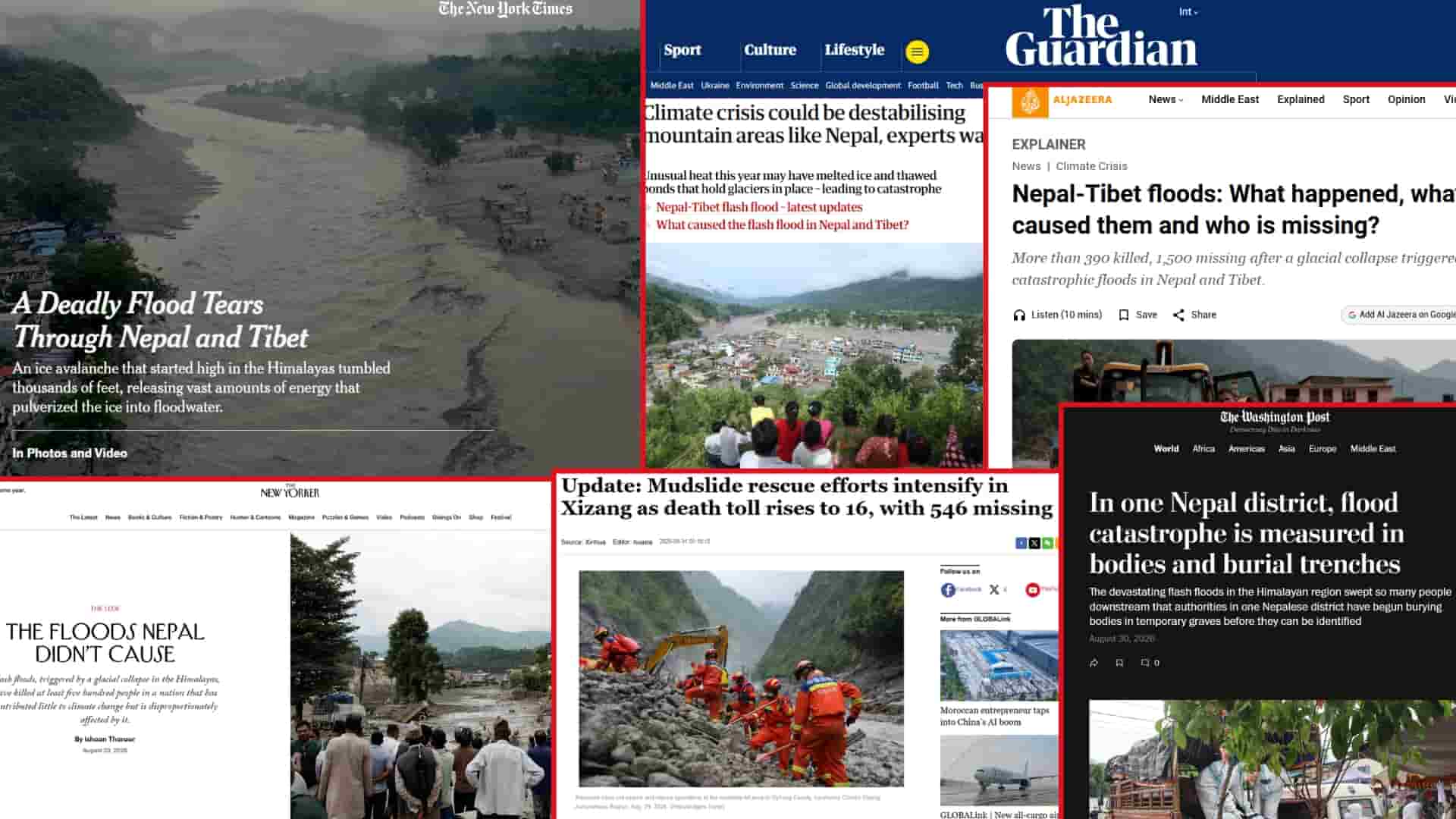
A notable dimension of the disaster lies in how it has been represented by the media. Most international media have referred to the disaster as ‘Nepal-Tibet flood’. Meanwhile, Nepali national dailies have frequently characterised it as ‘Bhotekoshi flood,’ situating it in a local context. The difference in terminology is more than a question of nomenclature; it reflects contrasting ways of understanding and communicating the disaster.
This article explores how the mainstream international media, mainly western, has framed the Bhotekoshi flood, and how it has been presented to the global audience. Their framing of disaster, human consequences, economic impact, environmental security, among others, will be the scope of consideration. The concluding section will account for gaps in framing, complementing what climate justice means for the most affected region across the Himalaya and beyond.
Bhotekoshi flood goes global
The New York Times framed the flash flood with regard to climate change, a humanitarian crisis, and its costly consequences for critical civil infrastructure. Interestingly, the cross-border issue was reiterated by contextualising the strategic location of Gyuryng port and economic activities involving the Tibetan Autonomous Region, which Beijing aims to incorporate under the Belt and Road Initiative (BRI). This underscores that the disaster has a cross-border as well as geopolitical dimension, largely given the geographical proximity and location of the affected area.
Another article focuses on the destruction of Nepal’s hydropower sector. The uncertainty surrounding the sector, which Nepal has long viewed as a promising policy option, and a development option, became more pronounced when a tenth of its capacity was devastated by the debris of the disaster. The author acknowledges Nepal’s limited capacity in establishing hydropower projects without the involvement of India and China. At the same time, India’s reluctance to purchase energy from Chinese-invested projects highlights the complexity for Nepal in operationalising hydropower projects whose economic and strategic implications extend beyond its borders. Most notably, given the effects of global warming in the Himalayas, the location, engineering design, and scale of infrastructure have become increasingly important considerations before the projects are initiated. The framing is more aligned with economic insecurity and uncertainty following the natural calamities and limited policy and hedging choice of small states surrounded by two competing powerful nations.
In a report by The Guardian, it frames the crisis by mentioning how events such as flash floods are consequences of destabilising the geology of the mountain region, threatening the everyday lives of millions of people. It also links the melting of glaciers in the Himalayan region to the burning of oil, coal and gas. This event is situated within the global climate crisis that has unfolded across different regions of the world. Recent heatwaves in different regions, and occurrence of rapid warming in alpine and polar regions as the loss of snow and ice is removing the thermal insulation of the land are highlighted. These examples demonstrate an effort to securitise the climate crisis by portraying how different climatic events manifested in different parts of the world are interconnected and mutually reinforcing rather than isolated incidents.
Along similar lines, The New Yorker’s piece is headlined ‘The Floods Nepal Didn’t Cause’. The article also mentions China’s development ambition on the Tibetan Plateau, which have been achieved through construction of dams and other infrastructural projects. China’s unwillingness to share hydrological data and its avoidance of water-sharing arrangements with downstream countries has become a subject of coercive statecraft, a commentator observes.
In a related article, The Guardian raises issues of climate injustice arguing states with less contribution to the warming of the planet are bearing the greatest consequences, including an existential crisis. The British outlet interviews diaspora of the flood affected region in New York city. Interviewees described their inability to contact relatives and people they had known while growing up. Nepali Americans noted that power outages and infrastructural damage has made communications extremely difficult, while Tibetan Americans expressed skepticism about the transparency from the Chinese government, suggesting that the actual number of deaths and casualties could be much higher. In the changing political circumstances, diaspora’s peculiar sense of having identity in two different parts of the world, and their struggle to maintain a sense of identity and stability, is framed through a human-centered perspective.
The Washington Post report frames the Nepal flood by starting with the magnitude of the glacier, describing it as equivalent to approximately 25 soccer fields (2 million square feet). Readers experience an apocalyptic scenario as a large mass of ice pulverised into small chunks to form huge amounts of water is mentioned. Similarly, reference to CCTV footage showcasing tsunami-like surge of water engulfing public spaces and large buildings reinforce the depiction of the disaster’s destructive consequences. Interestingly, the article mentions instances of glacier outbursts in Switzerland and India in the past five years, implying the global nature of the phenomenon. A cautious fact remains: temperatures in the Himalayas are rising roughly twice the global average, while the degradation of glaciers and permafrost increases the likelihood of landslides and debris flows, further destabilising the ecology of the region.
Similarly, a subsequent article highlights the displacement of the people and tourists and Nepal’s recovery efforts. It also mentions China’s commitment to aid and engage in rescue efforts in other nations.
Similarly, Chinese media Xinhua News Agency has interpreted the event as a mudslide triggered by an ice-rock avalanche. It has extensively reported the effort by the Chinese regional government and the People’s Liberation Army (PLA) and People’s Armed Police Force. The report acknowledges the endeavor from the Chinese side towards rescue and normalcy regardless of high altitude and difficult topography. It does not acknowledge the loss of human life and displacement in the Southern neighbor.
An additional piece from the portal has explained the cause of the disaster, its origin and impacts, noting that the speed of the mudslide generated by the ice avalanche made it difficult to issue early warning. It also states that global warming and greenhouse gas emissions will continue to destabilise glaciers of the Qinghai-Tibetan plateau, often referred to as the Third Pole, in the absence of effective intervention.
Qatar-based Al Jazeera situated the disaster within the broader warming of glaciers and glacial lakes across the Hindukush Himalaya, a region consisting of Myanmar, Bangladesh, China, Bhutan, India, Nepal, Pakistan and Afghanistan. The region reportedly lost 65% of its ice during the 2010, compared with the previous decade. However, the report also mentions that a direct cause between climate change and the specific glacier collapse has not been established. A Nepali climate activist on the same platform argues Nepal urgently needs an early warning system relating to hazards in the high-risk mountains. The proposed measures include the immediate mapping of lakes and river corridors and initiating 24/7 real communication among the monitoring system and river-adjacent communities. The author also argues that the emissions caused by wealthy nations are responsible for the climate crisis while climate finance should be provided in the form of grants to rebuild homes, livelihoods, and climate-resilient infrastructure.
Across these media outlets, numerical framing describing the death toll, potential missing persons, and scale of the destruction is a consistent feature of disaster reporting, illustrating the magnitude of the crisis. Descriptions of the disaster’s effects on inhabited areas and communities along riparian belts add to the severity and consequences of the flash floods. Similarly, the personal experience of the survivors and the ones who lost their family members is used as a testament by different outlets, such as The New Yorker, Reuters, Al Jazeera, Associated Press, and Washington Post.
The international media has also offered a diverse assessment of the rescue efforts undertaken by the Nepal government and relevant authorities. The New York Times, while highlighting the rescue effort made by Nepal Army and other authorities in evacuating lost individuals and trapped workers, also incorporated public criticism of the response. Interviewees argued that rescue operations should have been more timely and planned. Some suggested that the early deployment of e skillful rescue professionals was used early, hundreds of lives could have been saved, they expressed.
Similarly, The Guardian’s Nepali respondent also emphasises the same point, explaining Nepal’s resource and expertise is more suited to tackling small-scale floods. The government initially refused support from friendly countries in rescue efforts and crew deployment until August 30. Since then, Nepal is proactively seeking logistical and technical assistance.
What lies ahead beyond framing
Taken together, the international coverage transforms the Bhotekoshi flood from a localised disaster into a multidimensional crisis involving climate change, humanitarian insecurity, transboundary water politics, infrastructure vulnerability, geopolitical competition, and limited policy autonomy of small states.
However, across all the coverages I examined, including some of their broader coverage on the disaster, they have fallen short in effectively amplifying the fact that climate change has turned the everyday lives of affected communities into a struggle for survival. Unlike the recent heat waves in Europe, which were more readily framed as manifestations of climate change, the coverage of the Bhotekosh disaster was far less willing to establish this connection. Additionally, it took a disaster so pronounced and visible for international media to pay significant attention to the region in the first place. These platforms, beyond highlighting the immediate cause and consequences of an event, must interrogate the direct link of global warming in the catastrophe-stricken region, perpetuated by the industrialised world and rapidly developing economies.
Another failure is in highlighting climate injustice. As the lives of downstream communities in the Himalayas are likely to be an existential struggle, the media must emphasise the unequal burden of historic emissions. This is more important in the present time when the world is turning disorderly, driven by Hobbesian politics, with Dons at the helm of power, and a weakened United Nations. At a time of weakening global cooperation and governance, the media, which are important stakeholders, can securitise an event for the greater good, by drawing attention to human suffering and structural inequalities associated with climate change.
Read More Stories
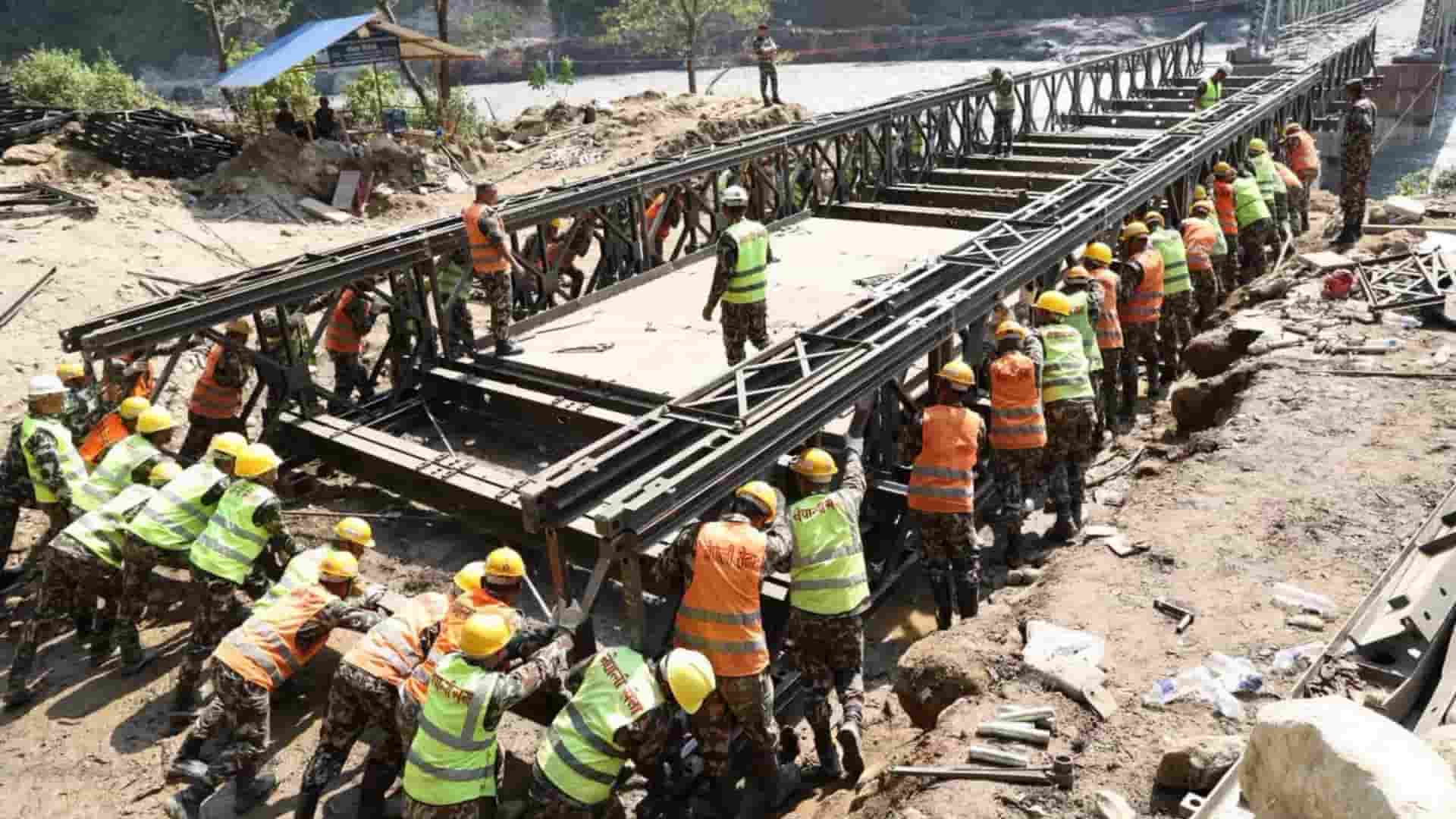
Nepal secures $66 million in climate funding following devastating floods
Nepal is set to receive $65 million in international climate funding, including a...

NEPSE ends seven-session rally, falls 4.34 points after Dashain
The stock market declined slightly on Monday in its first trading session after...
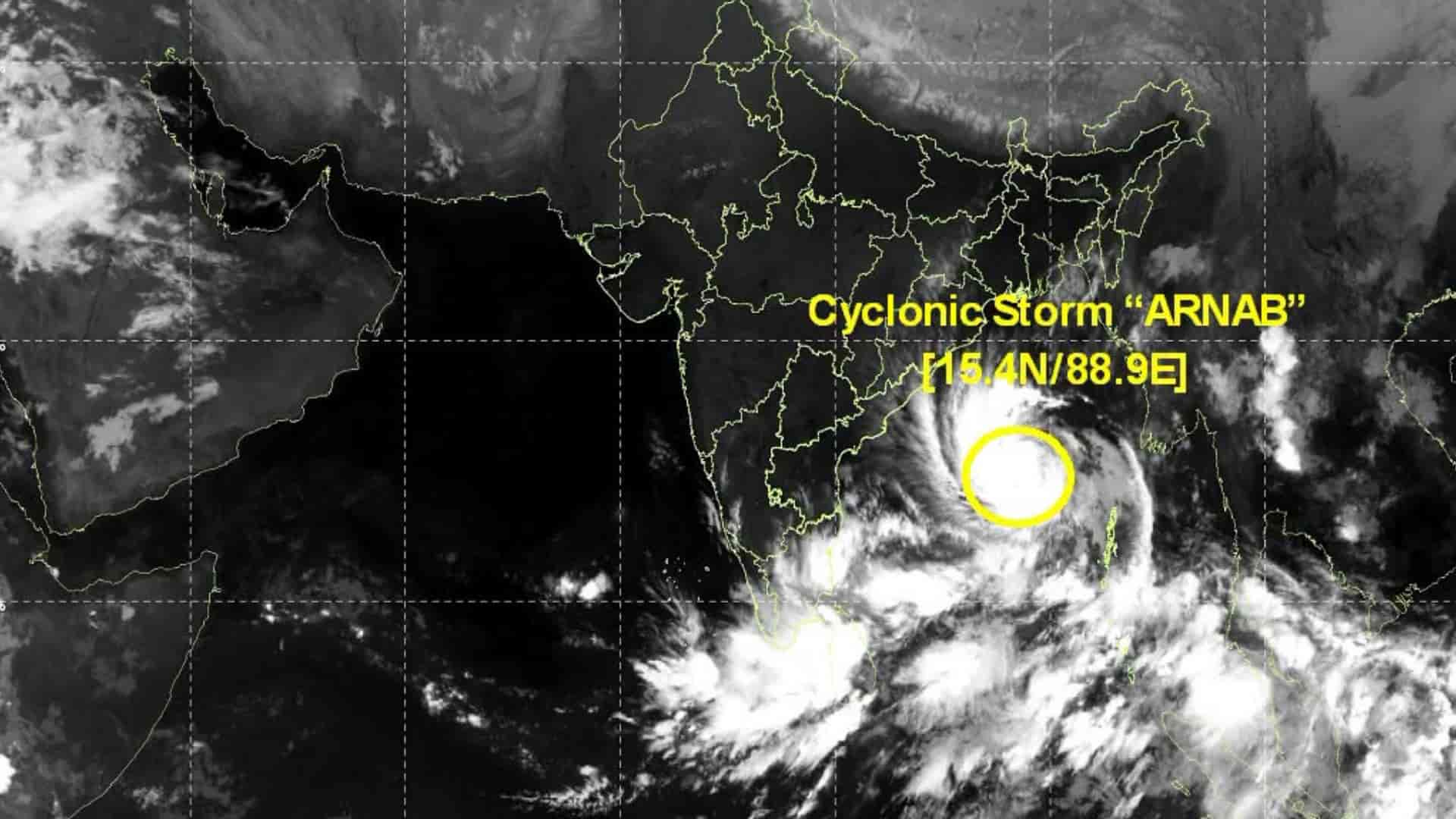
Cyclone Arnab threatens Nepal with widespread rainfall from Thursday
Nepal is likely to experience widespread rainfall from Thursday as Cyclone Arnab, developing...