What we do is costly! Your support will help us dig more stories.
Yes, I'm Interested!Ignorance isn't always bliss | Don't stay foolish.
Keep informed | Read our news and analysis.
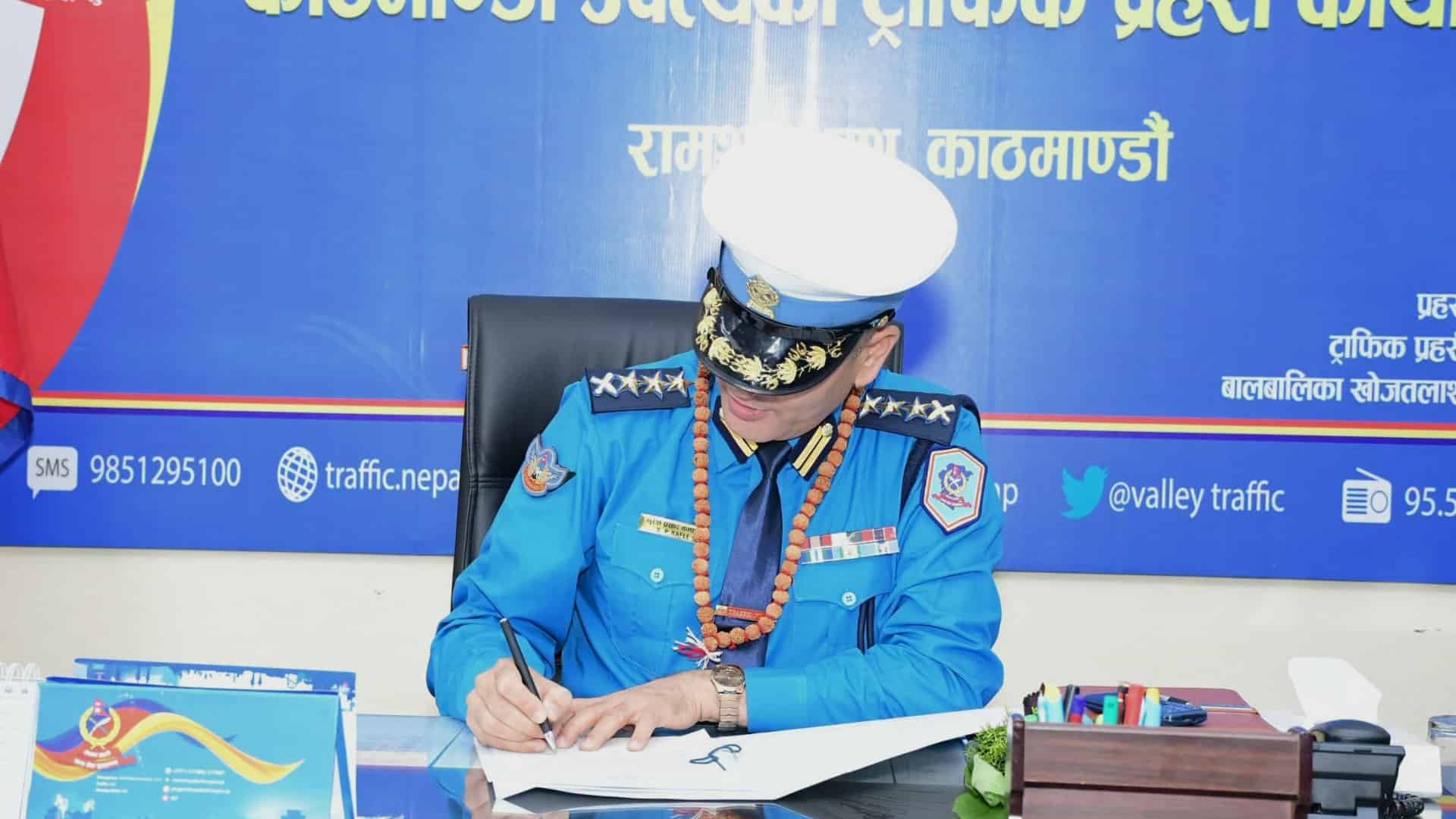
A public bus caught fire in Tripureshwor on Monday after its driver, Arjun Dong Tamang, became involved in a confrontation with traffic police. Tamang suffered severe burns and died while undergoing treatment at Kirtipur Burn Hospital later that night.
The incident was the second self-immolation involving a road user at the same location in about two and a half months.
In the earlier incident, Ganesh Nepali, a motorcycle rider, died after setting himself on fire following a dispute with personnel of the Kathmandu Metropolitan Police. Nepali had disputed the locking of his motorcycle by a municipal police officer over parking.
The two deaths have now prompted lawmakers to question whether there are broader problems in the way traffic enforcement is conducted, how drivers are treated and how disputes between road users and enforcement agencies are resolved.
What happened before the fire?
According to police, Tamang’s bus, operated by Riddhisiddhi Yatayat, had been stopped in a way that affected traffic near the Department of Passports in Tripureshwor. Traffic police sought his documents and attempted to take action over alleged unnecessary honking, according to police.
Video footage circulated on social media shows Tamang arguing with traffic police and saying that he had not committed a mistake. The footage also shows the bus being positioned across the road before additional traffic and Armed Police personnel attempted to reason with him.
Police have said their preliminary investigation indicates that Tamang set the bus on fire himself. The fire occurred after passengers had gotten off the vehicle, according to police reports.
Tamang was rescued and taken to Kirtipur Burn Hospital with burns over most of his body. He died during treatment later that night.
Police initially identified the driver as Dawa Lama, based on a driving licence found with him. They later confirmed the deceased as Arjun Dong Tamang, a resident of Sisneri in Makwanpur’s Indrasarowar Rural Municipality. Police said their investigation found that he had previously used driving licences and identity documents issued in other people’s names.
Police have also linked Tamang to a bus accident in Balaju in which three people were injured and to an earlier incident involving traffic police in Mulpani. Those are separate matters and do not by themselves establish what caused Monday’s confrontation.
Two incidents at the same place
The latest incident has drawn particular attention because of what happened to Ganesh Nepali at the same location about two and a half months earlier.
Nepali, from Soru Rural Municipality in Mugu, died after setting himself on fire following a dispute with personnel of the Kathmandu Metropolitan Police. The dispute involved the wheel-locking of his motorcycle in a no-parking area.
A committee led by former High Court Justice Keshav Prasad Bastola investigated Nepali’s death. The report is yet to be released after two months of the formation of the committee.
According to media reports, it recommended improvements in traffic management and road safety, including a single-handling system for traffic management. It also recommended measures to manage ride-sharing and the establishment of counselling centres for people experiencing severe stress.
There is even a media report, based on the committee’s finding, that a police officer had slapped Nepali during the earlier confrontation. The personnel involved were not punished.
The recurrence of a fatal self-immolation involving a road user at the same location has therefore brought renewed attention to what happened after the first case and whether recommendations from that investigation were acted upon.
Questions reach Parliament
The latest incident was raised in the House of Representatives on Tuesday.
Yubaraj Dulal, chief whip of the Nepali Communist Party (NCP), said it was concerning that two such incidents had occurred at the same location within about two months. He called for an investigation into Tamang’s death and questioned why authorities had not taken adequate precautions to prevent such incidents.
Dulal also questioned the chain of responsibility for traffic police under Nepal Police, asking Home Minister Sudan Gurung who is responsible for the traffic police force. He urged the government to ensure that regulatory agencies treat workers with dignity and called for counselling and changes to regulations governing heavy-vehicle licences.
Krantishikha Dhital, whip of the Rastriya Swatantra Party (RSP), said the incidents should prompt scrutiny of both police behaviour and the conditions in which drivers work.
She called for a review of how traffic police interact with drivers and passengers. She also pointed to drivers’ wages, working hours, rest, food, services and physical and mental health, arguing that drivers should not be viewed in isolation from the government, regulators, transport operators and police.
Other lawmakers focused on enforcement itself.
RSP lawmaker Ashika Tamang called for traffic police to use body cameras. She also raised concerns about the mechanism available to people who want to challenge traffic penalties. Under Section 171 of the Vehicle and Transport Management Act, people dissatisfied with action taken by traffic police or police can complain to the director general of the Department of Transport Management within 35 days. She argued that the system should be easier for citizens to use.
RSP lawmaker Ashish Gajurel, who chairs the House’s Infrastructure Development Committee, said Nepal has paid inadequate attention to the psychological wellbeing of road users and drivers.
NCP lawmaker Balawati Sharma questioned why a young man had reached the point of setting himself on fire inside a bus, while CPN-UML lawmaker Kulbhakta Shakya called for the incident to be treated as a serious matter rather than a routine occurrence.
A proposal for a traffic court
The parliamentary discussion continued on Wednesday.
RSP lawmaker Dr Ram Lama called for the establishment of a separate traffic court, arguing that both traffic police and drivers need a mechanism through which disputes can be resolved fairly.
Lama said traffic police should not face violence on the road while drivers should also have a mechanism to seek justice when they believe they have been treated unfairly. He said the recent Tripureshwor incidents demonstrated the need for a long-term solution and called for a separate court to establish facts and resolve traffic disputes in a fair and impartial manner.
The proposal adds another dimension to the debate: whether disputes over traffic enforcement should be resolved primarily through roadside interactions and existing administrative procedures, or whether citizens should have a more accessible judicial mechanism to challenge enforcement decisions.
Two investigations underway
A five-member committee led by SSP Ramesh Basnet of the Kathmandu Valley Police Office is investigating the latest incident. The committee includes representatives from the Valley Police Office, Kathmandu Valley Traffic Police Office, Kathmandu Valley Crime Investigation Office and District Police Range Kathmandu.
The Kathmandu District Administration Office has set up a separate committee to investigate the incident and recommend measures to prevent similar incidents.
The committees’ findings will be important in establishing the sequence of events between Tamang and traffic police before the fire.
What remains unresolved
Police have said Tamang set the bus on fire himself after the dispute and that there were no passengers inside. But the video of the confrontation and the competing accounts of what happened before the fire have made the conduct of both the driver and traffic police part of the public debate.
The available evidence does not by itself establish that traffic-police conduct caused Tamang to set the bus on fire. That remains a matter for the ongoing investigations.
The incident has nevertheless moved beyond a question of one driver’s actions.
In Parliament, lawmakers have raised questions about traffic-police conduct, drivers’ working conditions, the use of body cameras, mechanisms for challenging penalties, psychological support for transport workers and the possibility of a separate traffic court.
The investigations will have to establish what happened on the road in Tripureshwor. Meanwhile, the broader question is: what should change so that a dispute between a driver and traffic police does not escalate into a fatal incident?
Read More Stories
Why IPPAN opposes SEBON’s proposed IPO rules
The Independent Power Producers Association, Nepal (IPPAN) has urged the Securities Board of...
Market climbs by 4.12 points, turnover amounts NRs 4.68 billion
The Nepal Stock Exchange (NEPSE) climbed by 4.12 points (0.16%) to close at...

Junior PHP Developer (WordPress & Divi) – Internship / Entry Level
A small, new digital agency looking for a motivated junior developer to join...