What we do is costly! Your support will help us dig more stories.
Yes, I'm Interested!Ignorance isn't always bliss | Don't stay foolish.
Keep informed | Read our news and analysis.
Last year Nepal's goods exports jumped 81.8% to NRs 277.03 billion. That is the kind of number a finance minister puts on a slide.
Look at what moved it. Much of the increase came from processed edible oils, where Nepal imports the raw material, processes it and sends it to India under a favorable tariff structure. It is an arbitrage on a duty schedule. The day that schedule changes, the chart changes with it.
A lot of Nepal’s recent increase in its exports did not come from a consumer brand Nepal built.
I want to be careful here, because there is a comfortable version of this argument that I do not believe. The comfortable version says Nepali producers make superb things, and only fail at telling the world about them.
It’s a flattering narrative, but misses the mark.
Ask anyone who has had a tea consignment held at the border over pesticide residue testing, or their ginger consignment returned back.
The customs administrator at Kakarvitta has cited non-tariff barriers around quality testing among the reasons affecting tea exports. That is a process failure. No amount of storytelling fixes it.
So the honest version is narrower and harder.
You cannot brand a product you cannot repeat.
Consistency is the entry ticket. Brand is what turns repeated performance into preference. Nepal keeps trying to buy the preference without building the consistency, and often tries to buy it with logos.
Start with tea, because tea is a particularly clear case of where value can disappear between production and the customer.
Darjeeling has 87 recognised tea-gardens across more than 17,500 hectares. Its tea carries a geographical identity, a certification system, decades of reputation and a distribution infrastructure that tells the buyer exactly what the name means.
Nepal grows tea on the other side of the same Himalayan ridge.
In fiscal year 2082/83, Nepal shipped 13,045 tonnes of tea to India through Kakarvitta, worth NRs 3.53 billion. That works out to roughly NRs 271 per kilogram. The year before, it shipped 15,311 tonnes worth NRs 4.17 billion.
The interesting question is not whether Nepali tea simply becomes Darjeeling tea. The more interesting question is why neighboring Himalayan tea can enter the market with such different perceptions of value.
Nepal grows the leaf. Darjeeling owns a provenance. The customer pays for the difference. That difference is not created by a logo alone. It is built through geography, standards, processing, certification, distribution and decades of repeated experience.
Cardamom shows the same problem from another angle.
Nepal is the world's largest producer and exporter of black cardamom (alaichi) as per FAO. Last fiscal year alone, the country shipped about 6.38 million kgs worth NRs 12.63 billion, up 64.6 % in value. Around 60,000 families grow it, mainly in Taplejung, Panchthar, Ilam and Sankhuwasabha.
India takes about 99% of it.
As per published reports, from India, apparently the spice moves on to the international market, specially the Gulf region, where Nepali cardamom can earn a premium for the smoky character developed in the bhatti, a traditional over used while its dried on a direct heat and smoke. The sources attribute the premium in Pakistan and the Gulf to consumer preference for Nepali cardamom used in biryani and festival cooking. The product leaves Nepal as a commodity. Much of the value created after that is captured elsewhere.
The lesson is not that Nepal should stop exporting cardamom.
It is that being good at producing something and being good at capturing the value of it are two different capabilities.
Here is where most people would tell you Nepal needs to brand its products.
Pashmina already tried that, and pashmina is the reason I do not trust the easy answer.
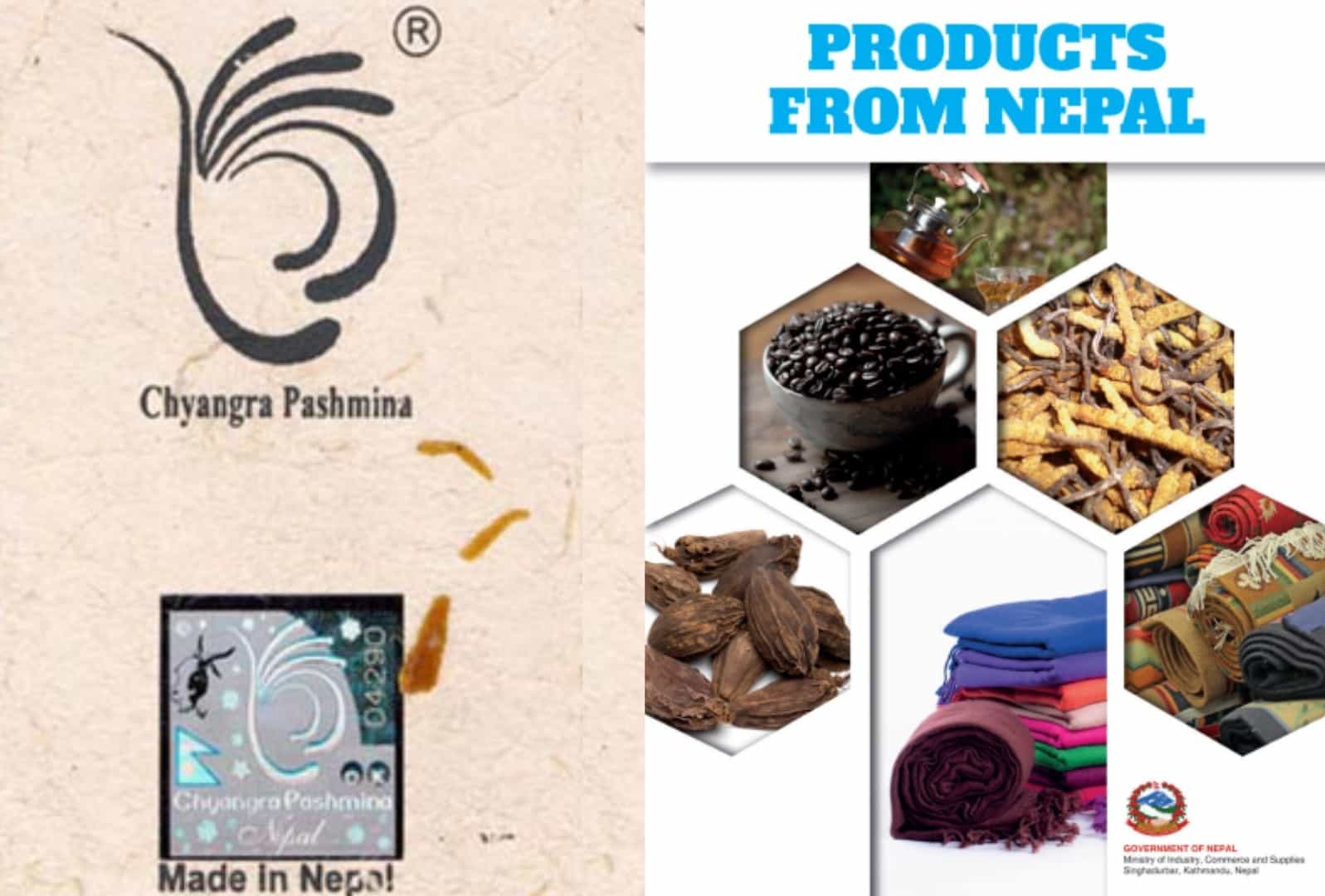
Chyangra Pashmina is a registered collective trademark with certification and traceability requirements. The mark is designed to distinguish genuine Nepali pashmina from the many products sold under the name. Chyangra Pashmina is a registered collective trademark in 47 countries, including the EU, the United States, Canada, Japan and Australia. Using it requires membership, compliance with a code of conduct, minimum 51 percent Chyangra content, and yarn that passes a specific test. The labels carry holograms, QR codes and unique serial numbers. This is not a half measure. It is a properly constructed mark.
The National Pashmina Sector Export Strategy supported by the International Trade Center (ITC) set a target of about NRs 10 billion, by the end of 2026. NRs 588 million was budgeted to get there, most of it public money. The ITC-supported pashmina project did produce measurable gains: higher farmer prices, more exports for participating firms. The sector-wide target however was not met: about NRs 3.22 billion in FY 2024/25. The program solved one problem. It did not automatically solve the others.
Registration is a legal act, not a commercial one.
A trademark tells who owns a name. It does not tell a buyer in Oxford Street, London why they should pay more. It does not guarantee consistent supply. It does not create distribution. It does not make consumer care.
Legal ownership, consistent supply and consumer preference are three different projects. Nepal has spent considerable effort on the first. The other two are harder. Let me argue against myself now, because the obvious conclusion is wrong.
The answer is not simply that Nepal should put more money behind brands.
Scale matters, and it constrains everything above.
New Zealand's kiwifruit industry offers a useful counterexample. After a period of severe competition and falling profitability, growers moved to a single-desk system in 1988 and eventually built Zespri around common quality standards, economies of scale, new markets and research.
The important thing is not the logo.
It is the system underneath it.
Growers accept standards. Fruit is graded. Quality is monitored. Supply is coordinated. Traceability and food-safety requirements are enforced. The organisation controls how New Zealand kiwifruit reaches much of the world.
Neither happened through a campaign. Both happened through a rule.
That distinction matters for Nepal.
Our exportable surplus in many categories is small. For some products, building and defending a global consumer brand would cost more than the premium it could recover.
And there is nothing wrong with being a reliable supplier of valuable input.
Contract manufacturing is not a moral failure.
Doing it by accident is.
The question, then, is not how Nepal builds brands.
It is which categories have enough volume, enough consistency and enough price difference to justify building one.
That is a very different question.
Because a brand is not magic applied to a commodity. It is a mechanism for helping a producer capture more of the value it has learned to deliver consistently.
And that means Nepal may have a branding problem, but perhaps not the one we usually describe.
Perhaps we have spent too much time asking how to tell our stories, and not enough time asking which stories are economically worth repeating.
Which leaves me with a question I don’t think Nepal has answered.
Of the products we export, which ones actually have the volume, consistency, and price gap required to support a brand of their own?
And which ones are better left as commodities, where trying to build a global consumer brand would cost more than the premium it could ever recover?
I feel Nepal's branding problem is not that we have failed to tell our stories. Perhaps we have never decided which stories are economically worth repeating.
Read More Stories

Banking stocks gain momentum as dividend season begins
Dividend announcements by banks and financial institutions (BFIs) for fiscal year 2025/26 have...

Nepal’s challenge of building strong democratic institutions
Over the past few decades, institutional dysfunction and massive dissatisfaction with political establishments...

Market ends pre-dashain trading on a positive momentum
The Nepal Stock Exchange (NEPSE) rose by 8.24 points (0.31%) on the last...