What we do is costly! Your support will help us dig more stories.
Yes, I'm Interested!Ignorance isn't always bliss | Don't stay foolish.
Keep informed | Read our news and analysis.
Nepal Floods 2026 | Nepal Earthquake 2015 | Disaster Vulnerability | Disaster Response
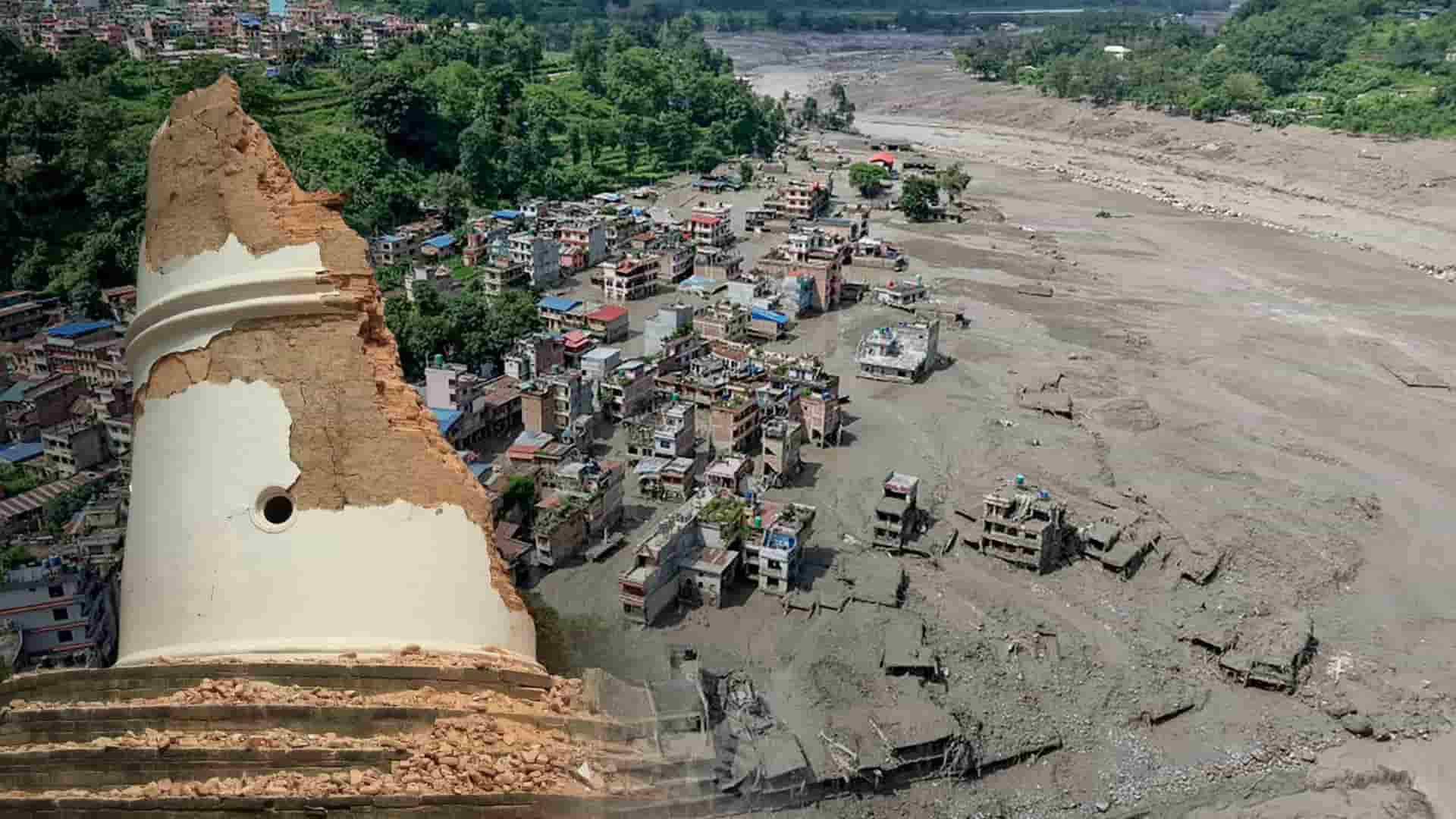
How big was the August 26 Bhotekoshi disaster compared with the 2015 earthquake?
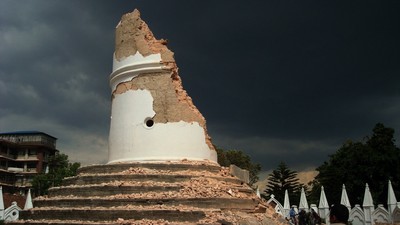
By most conventional measures, the answer is clear. The April 2015 earthquake was far larger. It killed nearly 9,000 people, injured more than 22,000 and affected about eight million people across 31 districts. The government estimated damage and losses at about $7.1 billion.
But the comparison becomes less straightforward when thousands of people remain missing after the Bhotekoshi floods.
A month after the floods, 1,453 bodies had been recovered while 5,285 people remained missing. This can put the death toll to over 6,500. The missing cannot be counted as confirmed deaths, but their number illustrates the continuing crisis faced by families searching for relatives.
The floods affected a much smaller area, but devastated a critical river corridor, damaging homes, businesses, roads, bridges and hydropower infrastructure.
The government’s rapid damage and needs assessment estimates that recovery and reconstruction will require NRs 723.31 billion. It found that 7,570 private homes and about 4,800 commercial establishments were damaged, while infrastructure accounts for roughly three-quarters of the estimated recovery bill.
The two disasters therefore cannot be reduced to a single number. The earthquake was larger in scale. The Bhotekoshi floods, however, caused concentrated destruction along infrastructure critical to the country’s economy and connectivity.
The numbers tell only part of the story
The 2015 earthquake affected about eight million people, nearly one-third of Nepal’s population at the time. Thirty-one of the country’s then 75 districts were affected, with 14 classified as crisis-hit. Homes, government buildings, schools, health facilities, roads, bridges, hydropower projects and heritage sites were damaged or destroyed.
The Bhotekoshi disaster was more geographically concentrated, with particularly severe destruction along the river corridor through parts of Rasuwa, Nuwakot, Dhading and surrounding areas, with an estimated 1.6 million people affected.
But geographical concentration does not necessarily mean limited consequences.
The floods damaged 69 kilometres of roads, 33 motorable bridges and 53 footbridges. Thirteen hydropower projects with a combined capacity of 759 MW were affected, along with five solar plants.
Roads connecting Nepal to the northern border were damaged. Businesses and homes were swept away. Trade and movement were disrupted.
The government estimates that NRs 473.57 billion will be required for infrastructure recovery alone. Another NRs 103.54 billion is required for housing and recovery in the private housing sector, while productive sectors, including trade, businesses, banks and agriculture, are estimated to need a further NRs 50.77 billion.
These figures should be treated with caution. The NRs 723.31 billion figure is an estimate of recovery and reconstruction needs, not simply the value of damage. The earthquake’s $7.1 billion figure, meanwhile, represents damage and losses calculated under a different assessment methodology.
The figures are therefore not directly comparable. They do, however, illustrate the different character of the two disasters: the earthquake spread destruction across a large part of the country, while the floods concentrated it along a critical economic corridor.
When Kathmandu itself became a disaster zone
There is another difference that numbers cannot capture.
The 2015 earthquake struck Kathmandu Valley as well as large parts of the country’s central and western regions. Kathmandu was not merely where the government was based. It was itself one of the disaster zones.
Singha Durbar, the country’s administrative headquarters, was severely affected. The Office of the Prime Minister and several ministries had to be relocated to safer buildings. The President’s Office, Nepal Army Headquarters, Supreme Court and Nepal Rastra Bank were among other major government institutions that suffered damage.
The centre of government had been hit. So had the centre of the national media.
The country’s largest concentration of political institutions, hospitals, businesses and communications infrastructure was dealing with the same disaster that the rest of the country was trying to respond to.
The government nevertheless mobilised on a large scale. The World Bank’s post-disaster assessment says the Central Disaster Relief Committee met within two hours of the earthquake, while the National Emergency Operation Centre provided an initial assessment and the government activated its cluster response mechanism. More than 90% of the security forces were mobilised for search and rescue.
The Bhotekoshi floods were different. The main disaster did not hit Kathmandu.
The capital remained operational while the worst destruction unfolded in the mountains to the north and west. Government institutions, security agencies and media organisations could continue functioning from Kathmandu while resources were mobilised towards the affected areas.
That difference may have made central mobilisation easier. But it also raises a question about what Nepal’s federal structure is supposed to change when a major disaster occurs far from the capital.
Nepal is no longer the country it was in 2015
The institutional context has changed considerably since the earthquake.
In 2015, Nepal was still operating under a unitary system of government, and local units did not have elected representatives. Bureaucrats ran local administrations under the central government, leaving them with limited decision-making authority and, in many cases, limited understanding of local needs.
Local authorities were understaffed and working without elected officials, while many local officials were themselves affected by the earthquake.
The earthquake therefore exposed the weaknesses of a highly centralised state that was also going through a major political transition.
More than a decade later, Nepal has three tiers of government and a dedicated national disaster-management authority.
The National Disaster Risk Reduction and Management Authority (NDRRMA) was established under the Disaster Risk Reduction and Management Act. Local governments have responsibilities for disaster risk management within their jurisdictions, including risk mapping, emergency response, search and rescue, relief and recovery.
In principle, that should change how disasters far from Kathmandu are managed.
Local governments are supposed to be on the frontline. They have firsthand knowledge of local hazards and communities and have legal responsibilities for disaster risk management.
But disaster reports have repeatedly identified capacity constraints at the local level. Many local governments in hazard-prone and geographically difficult areas lack adequate equipment, trained human resources and the capacity to undertake detailed risk assessments and preparedness measures.
The Bhotekoshi disaster exposed another constraint: some local governments and ward offices in the affected areas were themselves damaged, including the destruction of administrative buildings. The institutions expected to coordinate the response were therefore, in some cases, also dealing with the loss of their own facilities.
Federalism can give local governments greater responsibilities and authority, but that does not automatically give them the capacity to exercise those responsibilities during a disaster. Their ability to lead a response depends on functioning institutions, personnel, equipment and resources being available when a hazard strikes.
The Bhotekoshi floods therefore test not simply the federal government’s ability to mobilise from Kathmandu, but whether federalism has produced sufficient disaster-response capacity outside the capital.
Where a disaster is seen from matters
The geography of a disaster can also shape how it enters national consciousness.
In 2015, damage in Kathmandu was itself part of the national emergency. In 2026, Kathmandu could watch, report and respond to an emergency elsewhere.
For much of the country’s political, administrative and media establishment, Kathmandu remains the principal vantage point. A disaster that strikes the capital becomes a national experience almost immediately. A disaster that devastates a river corridor in the mountains can remain, at least geographically, someone else’s disaster.
That does not mean the Bhotekoshi floods have been ignored. Thousands of families are still looking for relatives, while government agencies continue to deal with recovery and identification. But geography may help explain why the two disasters have occupied different places in the national conversation.
The difference also affects what remains visible after the immediate emergency.
Why the earthquake stayed in the conversation
The 2015 earthquake did not disappear after the rescue operation ended. It became a long-running national project.
Reconstruction of homes, schools, hospitals, government offices and heritage sites continued for years. Questions about building standards, settlement planning, disaster preparedness, government coordination and the use of international assistance remained part of public debate.
The government established reconstruction mechanisms, prepared a Post Disaster Recovery Framework and eventually created the National Reconstruction Authority. UNDP’s later assessment described the earthquake as an opportunity to reassess Nepal’s resilience and disaster-risk governance, including institutional mechanisms, coordination, resource mobilisation and preparedness.
The earthquake also remained highly visible because its consequences were everywhere. For years, damaged buildings and temporary shelters were visible in Kathmandu and across affected districts. Reconstruction itself became news.
The Bhotekoshi disaster is entering a less visible phase.
Its consequences are now dispersed across missing-person cases, unidentified remains, damaged infrastructure, displaced families, disrupted businesses and a long reconstruction process.
Many of those consequences remain highly visible in affected communities but far less visible in Kathmandu.
A month after the floods, photographs of missing people were still displayed on hospital walls in Kathmandu. Families were waiting for identification, while some had conducted symbolic last rites for relatives whose bodies had not been found.
The disaster, therefore, has not ended. The question is whether national attention will remain as sustained as the recovery needs.
A different kind of cascading disaster
The Bhotekoshi event was not simply a conventional flood. The August 26 disaster involved a chain of hazards originating in the high mountains and propagating downstream through a river system.
A mountain hazard became a flood. The flood became a debris disaster. The destruction then reached roads, bridges, hydropower projects, settlements and a border corridor.
The 2015 earthquake demonstrated a similar problem in a different form.
The earthquake not only collapsed buildings. It triggered landslides and avalanches across the mountains. In the Everest region, an avalanche killed more than 20 people. In Langtang Valley, a massive rock-and-ice avalanche and associated air blast killed more than 350 people.
The lesson from both disasters is that hazards do not necessarily respect the categories used by institutions. A disaster-management system organised separately around earthquakes, floods, landslides and avalanches may struggle when one hazard triggers another.
The Bhotekoshi floods therefore raise a broader preparedness question: not simply whether Nepal was prepared for a flood, but whether it was prepared for cascading hazards.
When the warning system is itself vulnerable
The floods also exposed the limits of treating early warning as a matter of installing sensors and sending alerts.
The upper Bhotekoshi monitoring stations were swept away during the event. Information about the flood therefore had to travel through other channels as authorities attempted to warn downstream communities.
Early warning requires more than sensors. It depends on monitoring, communication, electricity, telecommunications, roads, local institutions and communities capable of acting on information.
If a hazard destroys the infrastructure supporting the warning system, the system can become vulnerable at precisely the moment it is needed. In a mountain environment, the available response time may be measured in minutes.
The Bhotekoshi disaster therefore raises a question that extends beyond technology: can an early-warning system remain functional when the hazard itself is disrupting the systems on which the warning depends?
The real comparison is vulnerability
The magnitude of a natural hazard alone does not determine the scale of a disaster. Hazards become more destructive when they encounter vulnerable people, buildings, infrastructure and institutions.
That was one of the central conclusions of the_farsight’s assessment a decade after the earthquake. Nepal remains highly exposed because disasters become more destructive when governance is weak, infrastructure is vulnerable and economic capacity is limited.
The evidence has appeared repeatedly since 2015.
The 2023 Jajarkot earthquake, for instance, was much smaller than the Gorkha earthquake but killed 157 people and fully damaged nearly 27,000 houses. The disaster exposed how geographic isolation, poor housing and uneven preparedness can magnify the consequences of a hazard that is modest by comparison with 2015.
A smaller hazard does not necessarily produce a small disaster. The consequences depend partly on where hazards occur, what they encounter and how prepared institutions and communities are.
Response capacity is not resilience
Nepal has learned a great deal since 2015.
The earthquake led to a long process of institutional learning, reconstruction planning and disaster-risk reform. There is now considerably more experience in emergency response, search and rescue, reconstruction and disaster-risk reduction.
But experience does not automatically translate into resilience. A country can become better at rescuing people after a disaster while remaining vulnerable to the conditions that make disasters so destructive.
The Bhotekoshi floods illustrate this distinction.
The challenge is not simply to respond faster after the next avalanche, flood or landslide. It is to understand where those hazards can occur, identify what infrastructure lies in their path, strengthen local institutions, maintain functioning warning systems and reduce exposure before the hazard arrives.
That is a different measure of progress.
The climate question needs care
The Bhotekoshi disaster also comes at a time when Nepal is confronting increasingly complex mountain risks associated with a changing climate. But the August 26 event should not simply be labelled a “climate disaster”.
Its immediate trigger involved an ice-rock avalanche and subsequent cascading processes. Establishing how much climate change contributed to this specific event requires event-specific scientific attribution.
The broader risk, however, is difficult to ignore.
A warming Himalaya is changing glaciers, snow, ice and high-altitude hydrology. These changes can alter the conditions under which mountain hazards occur. That does not mean every flood, landslide or avalanche is caused by climate change.
It means Nepal has to plan for a risk landscape that is becoming more uncertain and complex. Preparedness cannot depend on knowing exactly which hazard will strike, when it will strike or how it will behave. It must account for cascading events.
The missing cannot become invisible
The 1,453 recovered bodies and 5,285 missing people cannot simply be described as a confirmed death toll of 6,738. Some of the missing may eventually be found. Others may be among unidentified remains.
For families, however, the distinction between a confirmed death and an unresolved disappearance is not an abstract statistical problem. It affects legal recognition, compensation, inheritance, insurance and the ability to resolve basic questions about family members.
This is why the missing-person crisis may continue long after the immediate rescue operation has ended.
The disaster is no longer only about searching the river. It is also about identifying the dead, recognising the missing, rebuilding livelihoods and deciding where and how damaged infrastructure should be reconstructed.
Rebuilding cannot mean rebuilding the same vulnerability
The NRs 723 billion recovery estimate is more than a price tag. It is also a policy decision waiting to be made.
The question is not simply how quickly Nepal can replace the bridges, roads, homes and power infrastructure destroyed by the floods, but whether they should be rebuilt in the same locations, to the same standards and with the same assumptions about risk.
The 2015 earthquake showed what happens when vulnerability is embedded in the built environment. The Bhotekoshi floods have shown what happens when critical infrastructure is concentrated along a hazard pathway.
Reconstruction is an opportunity to change that equation. But reconstruction also comes with pressure to restore normality quickly.
Speed matters after a disaster. So does memory.
If the next bridge is built where the previous one was swept away without accounting for river behaviour, debris flows and future hazards, reconstruction may simply reproduce the conditions of the previous disaster.
The disaster after the disaster
Another similarity between 2015 and 2026 is that the immediate emergency eventually ends, but the consequences do not.
After the earthquake came years of reconstruction, disputes over land and housing, uneven access to assistance and debates about whether reconstruction had reduced or reproduced vulnerability.
The Bhotekoshi disaster is now entering that phase.
The bodies still being identified are part of the aftermath. So are displaced families, damaged livelihoods, broken roads and hydropower projects waiting to resume operation.
So is the fiscal burden.
Every large reconstruction bill competes with ordinary development spending. Every damaged road, bridge or power plant creates costs beyond the immediate repair. And every year spent recovering from one disaster can reduce the fiscal and institutional capacity available to prepare for the next.
So, how big was the Bhotekoshi disaster?
The answer depends on what is being measured.
By deaths, affected population and geographical spread, the 2015 earthquake was far larger. The Bhotekoshi floods, however, have killed 1,453 people and left another 5,285 missing, while damaging thousands of homes and businesses and disrupting roads, bridges, hydropower projects and a critical border corridor.
The government estimates that recovery and reconstruction will require NRs 723 billion.
The comparison is therefore less useful as a measure of which disaster was “bigger” than as a way of examining how Nepal experiences and responds to disasters.
The 2015 earthquake demonstrated how a major geological hazard could overwhelm a country whose political and administrative centre was itself hit. The Bhotekoshi disaster demonstrates how a geographically concentrated, cascading mountain hazard can cripple a critical economic corridor while leaving the capital largely untouched.
The two disasters were not the same. But both expose the consequences of vulnerability: where people live, where infrastructure is built, how institutions are organised and how much capacity exists before a hazard strikes.
A decade after the earthquake, Nepal has more institutions, more expertise and more experience.
The Bhotekoshi floods now offer a test of whether that experience can be turned into prevention, whether federalism can deliver capacity beyond Kathmandu, and whether a disaster far from the capital can command sustained national attention.
The measure of progress will not only be how effectively Nepal responds after the next disaster. It will be whether fewer people and less critical infrastructure are left exposed when that disaster arrives.
Read More Stories

ADB, NEA advance transmission and battery storage projects under PPP model
The Asian Development Bank (ADB) and Nepal Electricity Authority (NEA) have signed two...

Market reform measures fail to lift sentiment as NEPSE extends weekly decline
The stock market extended its downward trend on Friday, with the Nepal Stock...
Finance committee issues five-point directive with tighter oversight and modernisation
The Finance Committee of the House of Representatives has issued a five-point directive...