What we do is costly! Your support will help us dig more stories.
Yes, I'm Interested!Ignorance isn't always bliss | Don't stay foolish.
Keep informed | Read our news and analysis.
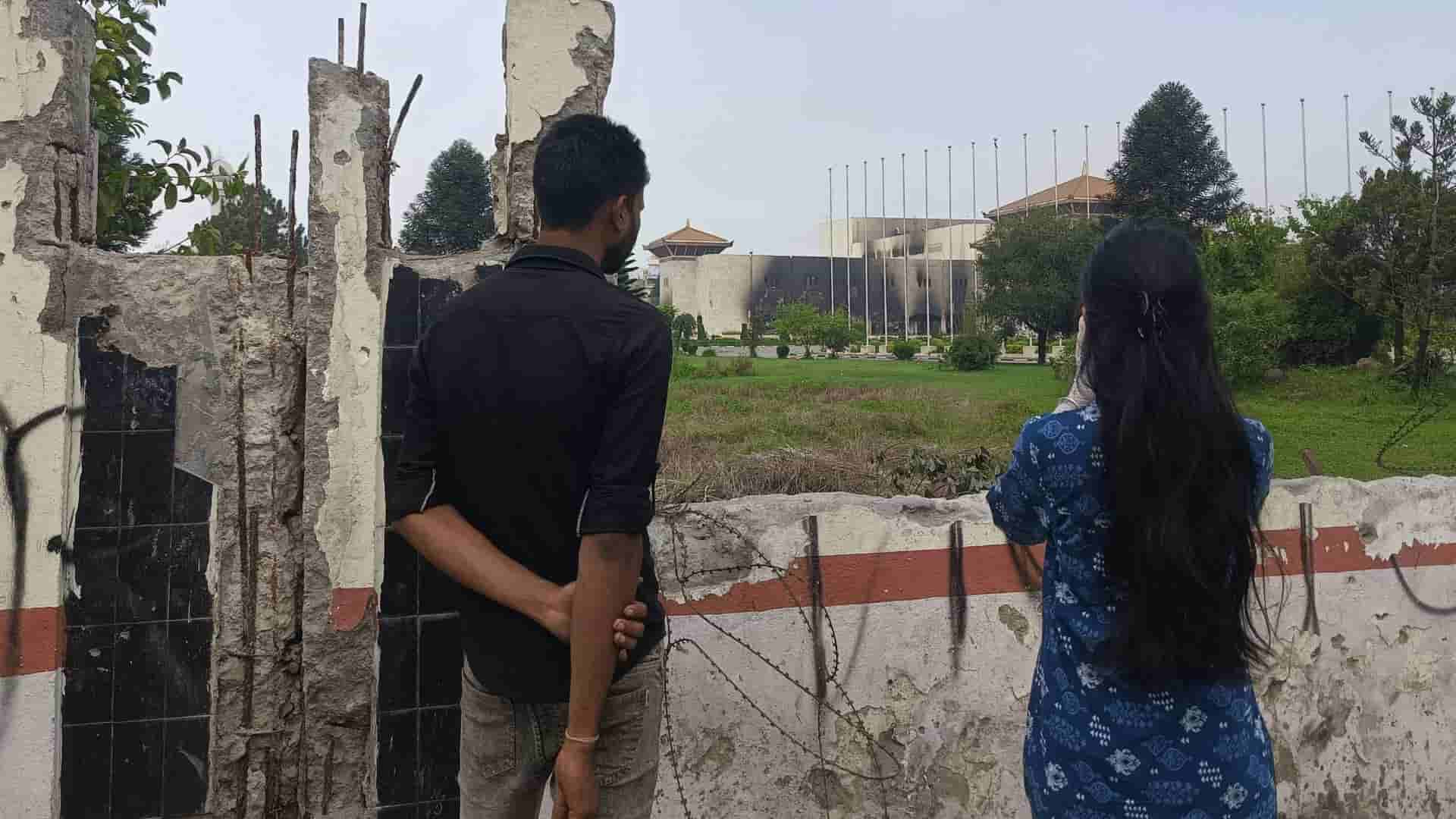
“The revolution devours its own children”
Pierre Vergniaud said it on his way to the guillotine in 1793, watching the Jacobins turn on the very Girondins who had helped bring down the monarchy. Revolutions rarely stay loyal to the people who make them possible. They eat the moderates first, then the idealists, then, if given enough time, the very slogans they were built on.
Nepal is watching its own version of this play out in real time.
I was about to write a review of the government’s first 100 days. Then three things happened in quick succession, and I no longer think we can dismiss this as a governing style with rough edges. At some point, you have to call it what it looks like: a betrayal.
Ganesh Nepali, a 25-year-old ride-sharing biker, set himself on fire after municipal police locked his motorcycle's wheel outside the Department of Passports in Tripureshwor over a parking dispute. He died in Bir Hospital days later. Almost simultaneously, the Kirtipur holding center, built to house squatter families evicted from the riverbanks, flooded, defeating the one purpose it was supposed to serve: keeping displaced people safe. When activists went to check on the families, police assaulted and detained them. Days after, suspicious vehicles appeared parked outside three major media houses, Kantipur, Onlinekhabar, and Himalaya Television, in what press freedom groups called a coordinated act of intimidation, at the exact moment coverage of the government's handling of Nepali's death was intensifying.
Individually, each of these might be dismissed as an unfortunate coincidence, a bureaucratic failure, an overzealous local officer. Together, they no longer look like accidents. They look like a pattern. And that pattern should end whatever benefit of the doubt this government still had left.
What did the public ask for
It is worth remembering the backdrop behind the September 2025 events, because the government's marketing has drifted too far from it. Nepalis did not take to the streets, at a cost of lives of 76 people, to install a personality. They asked for accountability, after decades of corruption and impunity. They sought good governance, and an end to nepotism and favoritism. They wanted a real shot at decent jobs in a country losing roughly two thousand people a day to outward migration. Rastriya Swatantra Party (RSP) rode that fury to a landslide victory in the March 5 election, campaigning explicitly on accountability, good governance, and economic opportunity. Four months into office, on each of those three fronts, the record seems close to a reversal.
A prime minister who won't answer for himself
Since taking the oath in March, the prime minister has addressed Parliament substantively exactly once, during his first question-and-answer session in late May. That session should have been reassuring. Instead, responding to a question about the Limpiyadhura-Lipulekh-Kalapani border dispute, he volunteered, unprompted, that Nepal had also encroached on Indian territory in several places.
Opposition lawmakers from across the spectrum, UML, Nepali Congress, RPP, immediately demanded he retract the statement, calling it dangerous for a head of government to make an unsubstantiated territorial claim on the record in Parliament. That is not a minor gaffe. Sovereignty language from a sitting prime minister becomes the country's official position the moment it leaves his mouth, whether or not he has the facts to back it.
Since then: silence.
Nineteen days into his term, beyond his oath of office and a short address at the Nepal Army event, the country had not heard Balen speak in public. That pattern has not broken. Instead of giving interviews or facing Parliament, Balen chose to address the controversy from behind a podium at his own party's convention, an audience that exists to applaud him rather than interrogate him. He has given no substantive press interview since taking office. On July 14, he walked into the House of Representatives alongside Rabi Lamichhane, sat for roughly twenty minutes, and walked back out, without addressing the chamber on the crisis convulsing the country outside its walls. A leader allergic to being questioned is not practicing accountability, he is performing the appearance of it.
Good governance, inverted
The RSP's entire pitch was that outsiders with clean hands would run the state better than the old guard. What has actually taken shape looks less like reform and more like a smaller circle with fewer checks.
Start with the cabinet itself. Within days of taking office, Balen filled the Council of Ministers largely with people from his own Kathmandu Metropolitan City network and advisors who had worked with him as mayor. It is the same favoritism that the public despised, now reemerging with younger faces attached to it.
What is even more troubling is the language coming from within the cabinet, reflecting the same confrontational, coercive style of politics. Infrastructure Minister Sunil Lamsal, inspecting a stalled road project, was caught on video instructing officials to find the contractor who had delayed the project, and, in his words, break his legs if the work wasn't done. He later called it a poor choice of words meant only to convey urgency. But legal experts and the contractors’ federation weren’t wrong to call it what it sounded like: a cabinet minister casually threatening a private citizen, with no consequence beyond a mild parliamentary scolding. Balen himself had used nearly identical rhetoric on the March election campaign trail, stating that his future government, if needed, wouldn’t hesitate to tie underperforming contractors to trees. When the rhetoric becomes cabinet policy, it stops being rhetoric.
Add to that the Sudan Gurung episode. Gurung, the home minister, was investigated by a government committee. The findings were never made public before he was quietly reinstated. A government that promised transparency conducted its own internal investigation into one of its own top ministers and then declined to divulge the results. That is not accountability. That is the old system with new letterhead.
As far as such commissions are concerned, the government has yet to officially release the Gauri Karki commission report formed to investigate the September events that led to the formation of the present government.
It later formed a three-member study committee to examine the role, conduct and response of the security apparatus during the events, including the actions of the police and other security agencies, with a one-month mandate, which was later extended. However, the Home Ministry has now reportedly refused to accept the report.
There is also a less visible, but at times quite visible, problem: the growing role of non-elected, non-state actors in the business of government. From the mayoral network and informal advisers around Balen to party-linked figures exercising influence without public accountability. The authority endowed to the likes of Kumar Ben, Asim Shah, James Karki, and Ojaswee Thapa are creating informal powers, raising critical questions about governance, and accountability.
Against this backdrop, an environment of fear and intimidation is taking hold. Activists, journalists, and ordinary citizens covering the fallout of the eviction drive are arrested, sometimes without warrants. A coordinated attempt to intimidate the media also occurred, with vehicles parked right at the media houses, blocking access. While it cannot be directly traced to the government’s office, it is hard to imagine anyone arranging such a coordinated blockade of three separate mainstream newsrooms on the same afternoon, at the height of a story damaging to the government, without at least some confidence that nothing serious would happen to them. Confidence like that does not come from nowhere.
The government’s economic record tells a similar story. The government's first budget, a record NRs 2.12 trillion, promised 7% growth and 300,000 new jobs a year. It cut income tax for salaried, middle-class earners and simplified customs tiers, real and defensible reforms. But it imposed a new 3% tax on private education and healthcare, which has since been withdrawn, as well as a new VAT on electricity, a measure that could disproportionately raise costs for industries producing medicines, rice, lentils and dairy products. Former energy officials have publicly disputed the government's technical justification for the tax.
Power over people
Go back further and the throughline gets clearer. During September 2025, the moment the country most needed to hear from the man a large section of the society venerated, Balen Shah went quiet. He skipped Sushila Karki's swearing-in as interim prime minister, refrained from visiting the families of the dead, neither inspected the damages that occurred, instead choosing sporadic social media posts. The latter continues till date.
That same unreachability resurfaced this year, when his own party leadership reportedly struggled to get sustained engagement from him even as the squatter and self-immolation crises escalated, followed more recently by unrest in the Terai-Madhesh region, which claimed four lives after Police firing.
This record is consistent with his mayoral record, when the Metropolitan Police under his command developed a reputation for aggressive, sometimes violent crackdowns on street vendors. While he used social media for stunts, like dumping garbage in front of the Department of Roads, rather than the patient work of building institutions. As prime minister, he has leaned on ordinances to bypass Parliament on matters that deserved debate. Inside his own party, the friction seems to be growing with the increasing criticism of the government from within the party. A pattern of centralising decisions and resisting scrutiny, even from allies, is how power that has stopped answering to anyone starts to look.
The hypocrisy
The self-immolation deserves its own reckoning, because it is the clearest test of whether this government still believes what it once said it believed. The September events' moral claim, the reason 76 people died then, meant something: the state should never again treat ordinary lives as expendable in service of rules and order. Several factors must have contributed to Ganesh Nepali’s death, but the state's lack of discretion clearly escalated the events that day, which locked his motorcycle over a parking violation, and would not let go unless the hefty fine is paid.
In Parliament afterward, the home minister deflected responsibility onto previous governments rather than answering for what happened during his own watch. Whether or not the parked cars outside the newsrooms were a deliberate plan to divert attention from Nepali’s death, the event had exactly that effect.
Then came the flooding at Kirtipur. The holding centers were built, in the government's own stated justification, to move squatter families away from the river for their safety. The very next serious rain, the centers flooded. The purpose failed on contact with the first real test. When activists went to check on the displaced families, they were humiliated and assaulted.
Majid Ansari, a young legal practitioner and one of the activists behind the September’s Gen Z campaign, was beaten badly enough to be hospitalised, and arrested without a clear warrant. Police first denied he was in custody, then cited unspecified orders from above to justify holding him anyway. A government elected on promises to end such impunity was, within four months, using the same tactics it replaced.
Read More Stories

Nepal needs to repeat to brand itself
Last year Nepal's goods exports jumped 81.8% to NRs 277.03 billion. That is...

Banking stocks gain momentum as dividend season begins
Dividend announcements by banks and financial institutions (BFIs) for fiscal year 2025/26 have...
Nepal’s challenge of building strong democratic institutions
Over the past few decades, institutional dysfunction and massive dissatisfaction with political establishments...