What we do is costly! Your support will help us dig more stories.
Yes, I'm Interested!Ignorance isn't always bliss | Don't stay foolish.
Keep informed | Read our news and analysis.
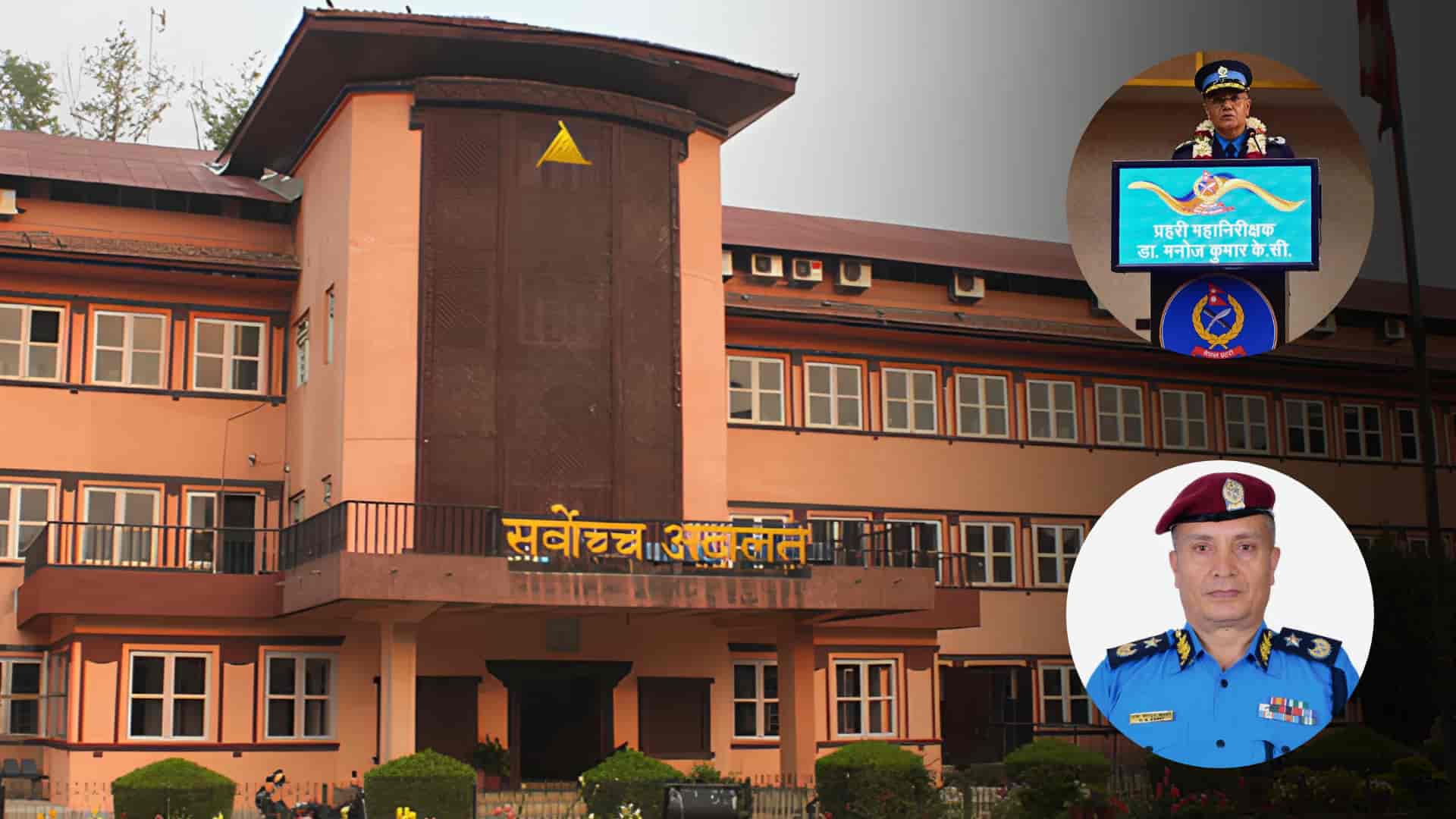
Former Inspector General of Police (IGP) Dan Bahadur Karki has approached the Supreme Court challenging the government’s decision to remove him from the leadership of Nepal Police before the completion of his tenure. The legal challenge comes amid conflicting accounts from the government and the ruling Rastriya Swatantra Party (RSP) over the party’s role in the decision.
Karki’s legal representatives submitted a writ petition to the Supreme Court on Thursday, seeking his reinstatement as police chief. Advocate Tika Bahadur Kunwar confirmed that the petition had been submitted, although further procedures were still underway. The petition had not been formally registered at the time of reporting.
The Cabinet decided on Wednesday to remove Karki as IGP and appoint him as the prime minister’s special security adviser. Additional Inspector General Manoj Kumar KC was promoted to the top police post and has since assumed office.
Karki reportedly had around 17 months remaining in his tenure. His removal has brought renewed attention to the legal provisions governing the appointment, transfer and tenure of the police chief, as well as the government’s authority to reassign senior public officials before the completion of their terms.
The decision has also exposed differences between the government’s explanation and the ruling party’s account of the events leading to the change in police leadership.
Government cites party directive
Government spokesperson Sasmit Pokharel said the Cabinet’s decision to change Karki’s responsibilities followed a directive from the ruling party concerning a sensitive matter.
Speaking after Wednesday’s Cabinet meeting, Pokharel said the circumstances had changed, and the party had instructed the government to take action on an issue of a sensitive nature. He linked that directive to the decision to reassign Karki.
The government has maintained that Karki was not subjected to disciplinary action but was given a different responsibility.
Pokharel said the Cabinet had created the position of prime minister’s special security adviser at the level of an IGP under the Office of the Prime Minister and Council of Ministers. The position was intended to provide security-related advice and consultation to the prime minister.
Karki was assigned to the newly created post, while KC was promoted to IGP under Rule 41 of the Nepal Police Regulations, 2014 (2071).
Pokharel rejected the suggestion that the reassignment amounted to punishment, describing it as a change in responsibilities.
However, his reference to a directive from the ruling party was subsequently disputed by the party itself.
RSP spokesperson Jagadish Kharel said the party had neither instructed the government to remove any individual from office nor recommended anyone for appointment.
Kharel said a meeting of the party secretariat on Saturday had directed the government to investigate the detention of journalists and take action against those responsible. The meeting, he said, had not called for the removal or dismissal of any particular individual.
Responding specifically to Pokharel’s remarks, Kharel reiterated that the party had not instructed the government to remove or appoint anyone. He said the government would have to explain the reasons behind its decision.
The differing accounts have left unclear whether the Cabinet decision was connected to the party’s demands concerning the detention of journalists or was taken independently by the government. Neither side has provided a detailed account reconciling the two statements.
A precedent from three decades ago
The legal dispute has drawn comparisons with the removal of then IGP Achyut Krishna Kharel in 1997, which resulted in a significant Supreme Court ruling on the government's authority to change the police leadership.
In April 1997, the government led by Prime Minister Lokendra Bahadur Chand, with Bamdev Gautam as home minister, transferred Kharel from the IGP office to the National Investigation Department and appointed Dhruba Bahadur Pradhan as his replacement.
Kharel challenged the decision in the Supreme Court. He was subsequently reinstated after a change in government, with Pradhan moved to the position of the prime minister's adviser.
In its judgment of July 3, 1998, the Supreme Court examined whether a serving IGP could be transferred to another position without sufficient justification.
The court held that the government’s authority to make appointments and transfers was not unlimited and had to be exercised within the bounds of law and for proper reasons.
It also warned that arbitrary changes in police leadership could undermine the morale, professional competence and impartiality of the force. The court cautioned against a system in which police administration became dependent on political favour.
Read also:
SC quashes govt move to remove Shakya from NEA leadership
Friday evening democracy: When the state acts and the courts go home
The decision to transfer Kharel was found to lack adequate grounds and to have been motivated by improper considerations.
Although Kharel had returned to the IGP office before the judgment was delivered, the ruling remains relevant to questions concerning executive discretion over police leadership.
The case is particularly relevant to Karki’s petition because both disputes involve the transfer of a serving police chief before the completion of his tenure.
The Shakya case and the limits of reassignment
Another relevant precedent emerged from the dispute involving former Nepal Electricity Authority (NEA) executive director Hitendra Dev Shakya.
Shakya was appointed as the NEA chief in March 2025. In September that year, the Cabinet transferred him to the Water and Energy Commission Secretariat as an energy expert and appointed Manoj Silwal in his place.
Shakya challenged the decision, arguing that the government had changed his responsibilities without following the procedures governing his appointment and tenure.
On December 8, 2025, a Supreme Court bench comprising Justices Nahakul Subedi and Shrikanta Paudel overturned the Cabinet decision and allowed Shakya to continue as the authority's executive director.
The court found that the proposal to transfer Shakya appeared biased and retaliatory. It held that the decision could not be considered fair, reasonable or consistent with the principles of the rule of law. The court also noted that the procedures governing the change had not been properly followed.
The Shakya ruling concerned a different institution and a separate legal framework. The provisions governing the NEA are not identical to those regulating Nepal Police.
Nevertheless, it provides a relevant comparison on whether the government can effectively displace an officeholder before the completion of a fixed term by assigning them another position.
Reported tensions with the Prime Minister’s Office
Karki’s removal also comes amid reports of disagreements between the police leadership and the Prime Minister’s Office over the handling of sensitive investigations and instructions to the police.
The disagreements have been linked in media reports to an investigation involving Inam Sapkota, who is accused of acting as an intermediary and having connections with individuals in political and judicial circles.
Reports have also described tensions over demands for immediate police action against certain individuals and disagreements over the legal basis for such instructions.
According to reports, tensions between Karki and the Prime Minister’s Secretariat had intensified over the investigation involving Sapkota and his alleged links with the prime minister’s political adviser. The report also described disagreements over police action and the handling of information emerging from the investigation.
These reported tensions provide context to Karki’s removal but do not, by themselves, establish the reason for the Cabinet decision.
The relationship between the police leadership and the Prime Minister’s Office had come under public scrutiny following the detention of journalists on October 30. The journalists had reported on matters concerning Sapkota, conversations involving Supreme Court Justice Hari Phuyal and the possible replacement of the police chief.
The PM Secretariat denied that the PM had ordered the arrests and said he had directed that the journalists be released.
The RSP secretariat meeting on Saturday subsequently called for an investigation into the detention of journalists and action against those responsible. However, Kharel has maintained that the party’s directive did not call for Karki's removal.
The distinction between the party’s stated directive and the government’s explanation for the police leadership change remains unresolved.
Read More Stories
Democrats win control of Congress in midterms, dealing Trump major setback
Democrats have won control of both chambers of the United States Congress in...

Nepal to present US$17 billion infrastructure projects at December summit
Nepal will present infrastructure projects with a combined estimated value of US$17 billion...

NEPSE edges higher as trading activity slows ahead of Tihar
The Nepal Stock Exchange (NEPSE) rose by a modest 2.64 points (0.10%) on...