What we do is costly! Your support will help us dig more stories.
Yes, I'm Interested!Ignorance isn't always bliss | Don't stay foolish.
Keep informed | Read our news and analysis.
education | equity | tax | fiscal policy
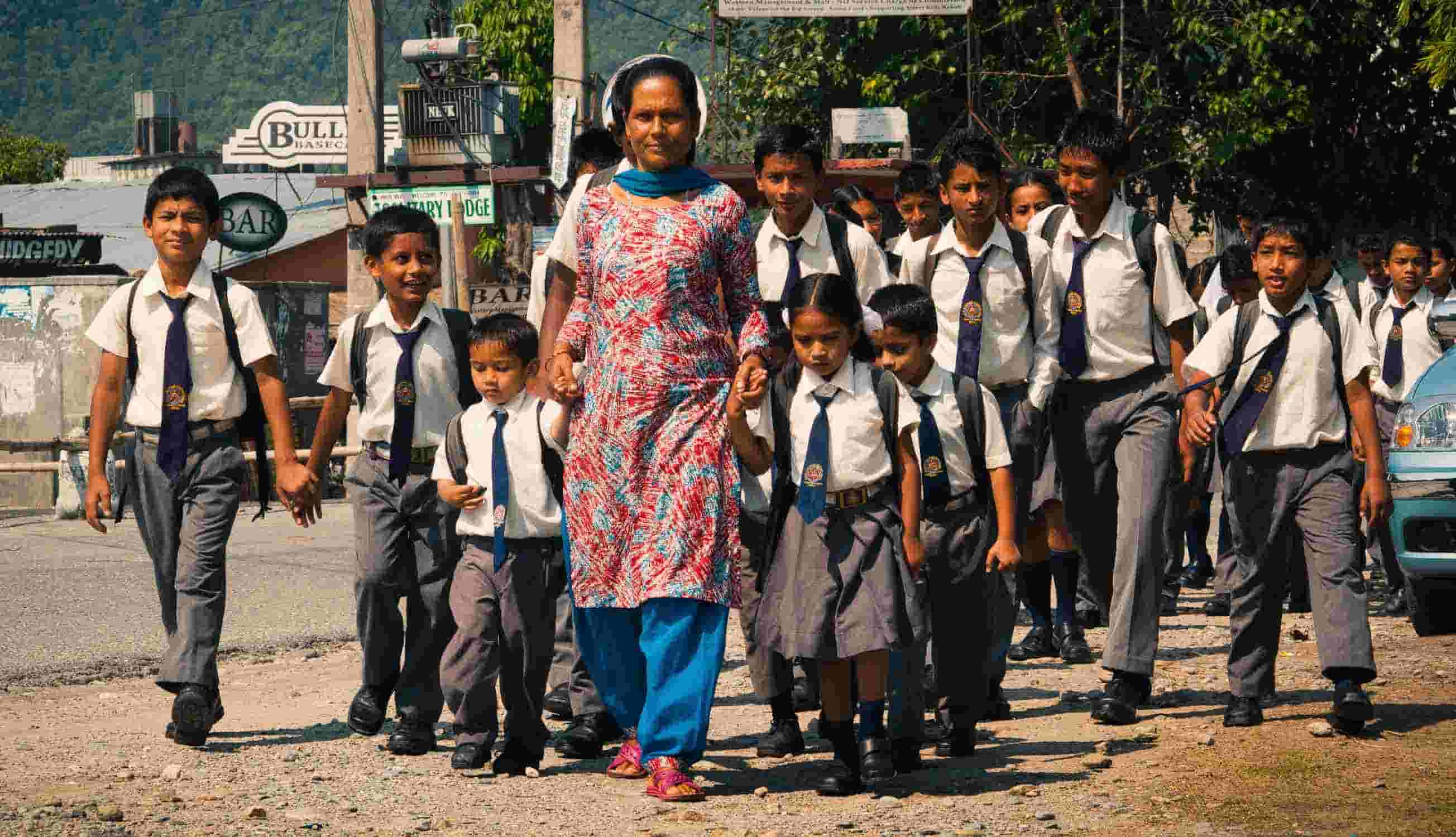
Somewhere in Qatar, migrant workers labours under an intense heat. They haven't seen their children in two years. Every month, they send money home with one purpose, keep their children in a private school. The choice is not out of luxury or status but out of survival. They know what the alternative looks like.
Finance Minister, Dr. Swarnim Wagle's federal budget introduced a 3% Education Equity Fee (Samata Shulka) on private school tuition. The stated goal is noble, which is to channel urban surplus to fund nutrition and early childhood care for Dalit and marginalised children in Karnali and Madhesh. The constitutional framing is sound but the political economy is complicated.
This piece isn't an argument against equity. It's a question about who carries it and when.
The case for the tax is real
Nepal's Constitution guarantees every child free basic and secondary education. Article 31 is unambiguous. What's also unambiguous is that the state has never fully honoured it.
As public schools struggled with underfunding, weak governance and politicisation, the private sector emerged to fill the gap, and it did so as a business enterprise. More than 90% of Nepal's private schools are registered under the Company Act. They distribute dividends, and treat tuition as a commodity.
As taxes are never desirable, private school associations will emphasise that they already pay corporate income tax, employ thousands of teachers, and reduce the state's burden. That's true but the argument for the equity tax isn't simply that private schools are profitable; many sectors are. As a constitutionally guaranteed right rather than an ordinary consumer good, education carries broader social obligations, creating a stronger case for expecting private providers to contribute to broader social equity goals.
Dr. Wagle has made the signal explicit. Trust-run schools, those that reinvest surplus into the institution, are exempt. For-profit schools are not. Internationally, private schools in the UK, Canada, and India largely operate as charitable trusts. Nepal's for-profit model is an anomaly. The levy attempts, however modestly, to correct it.
But the burden lands in the wrong place.
Here's where the design falters, not in scale, but in principle.
The Ministry of Finance argues that raising the personal income tax threshold to NRs one million offsets the equity fee for the middle class; it doesn't. That relief applies only to salaried workers earning in Nepal. It means nothing to a migrant worker, or to their spouse back home paying school fees from remittance. They receive no tax relief, instead pay the surcharge.
Nepal's remittance inflow is equivalent to roughly 25% of GDP. Millions of families fund private education specifically because public schools failed them. The issue isn't that the 3% is a financial burden as they can afford an additional 150 rupees if they are paying NRs 5,000 a month. The issue is fairness, a question of who bears it. When the state's own failure drives families into the private system, taxing that choice before demonstrating any measurable improvements in the public system is a difficult position to defend morally.
The middle class inside Nepal faces the same logic. A salaried civil servant or bank employee already spends a significant portion of disposable income on fees, transport, and books. Private school isn't a luxury. It's mandatory insurance against a system they've stopped trusting. Raising the income threshold with one hand while levying a consumption tax with the other means the relief disappears before it arrives.
The governance question no one wants to answer—
There's a harder problem beneath the tax debate, Nepal doesn't simply have an education funding problem. It also has an education governance problem.
Roughly 70–75% of the public education budget goes to teachers’ salaries. Yet when the School Education Bill sought to introduce greater accountability on politically affiliated teacher unions, they mobilised against the Oli government, and the government ultimately retreated.
The new government’s mandate is anchored on good governance. The Cabinet's 100-point agenda includes commitments to depoliticise schools and university campuses. These are the right promises. But the tax has arrived before the reforms. Collecting revenue to fix a system while deferring the structural changes that would make spending effective, is the core contradiction this budget hasn't resolved.
Passing the School Education Bill and devolving real authority to local governments is necessary, but it isn't sufficient. The Constitution already mandates devolution under Schedule 8, and that direction is right. But capacity gaps, elite capture, and a near-complete absence of technical understanding of what quality education actually means local accountability also has real limits. In many parts of rural Nepal, municipalities have responded to community pressure for results by subsidising SEE coaching, and in some cases, facilitating the very cheating practices they're meant to prevent. Proximity to communities matters, but it isn't a substitute for technical oversight. Provincial governments need to play an active monitoring role, not to override local authority, but to check it. And provincial governments themselves need a strong central mandate holding them to account. Devolution without this layered oversight doesn't fix the system. It just distributes the dysfunction.
Follow the money
There's one question the budget leaves entirely unanswered, where does the equity fund actually go?
How much will the equity fee raise? Who manages it? Will it be audited independently? Can parents and communities track expenditures? Without these answers, this has so far become a faith-based policymaking. Equity funds require radical transparency. Every rupee collected should be publicly traceable, from the classroom in Kathmandu that generated it to the child in Mugu it claims to serve. Without that accountability chain, the levy risks becoming another revenue line absorbed into a system already struggling to account for what it spends.
The verdict
The equity tax is a structurally legitimate idea. For-profit schools earning dividends from a constitutional right should contribute to equity. That argument holds.
But a tax on education is only as credible as the system it funds. If the government enforces the levy against profit margins rather than on parents' heads, passes the School Education Bill, and builds the layered oversight that devolution alone can't provide, the latest budget will be remembered as a genuine policy contribution. If it collects tax while deferring the harder reforms, the equity fund becomes a symbol of exactly what it claims to oppose, a burden carried by those least responsible for the problem.
Read More Stories

Nepal needs to repeat to brand itself
Last year Nepal's goods exports jumped 81.8% to NRs 277.03 billion. That is...
Banking stocks gain momentum as dividend season begins
Dividend announcements by banks and financial institutions (BFIs) for fiscal year 2025/26 have...
Nepal’s challenge of building strong democratic institutions
Over the past few decades, institutional dysfunction and massive dissatisfaction with political establishments...