What we do is costly! Your support will help us dig more stories.
Yes, I'm Interested!Ignorance isn't always bliss | Don't stay foolish.
Keep informed | Read our news and analysis.
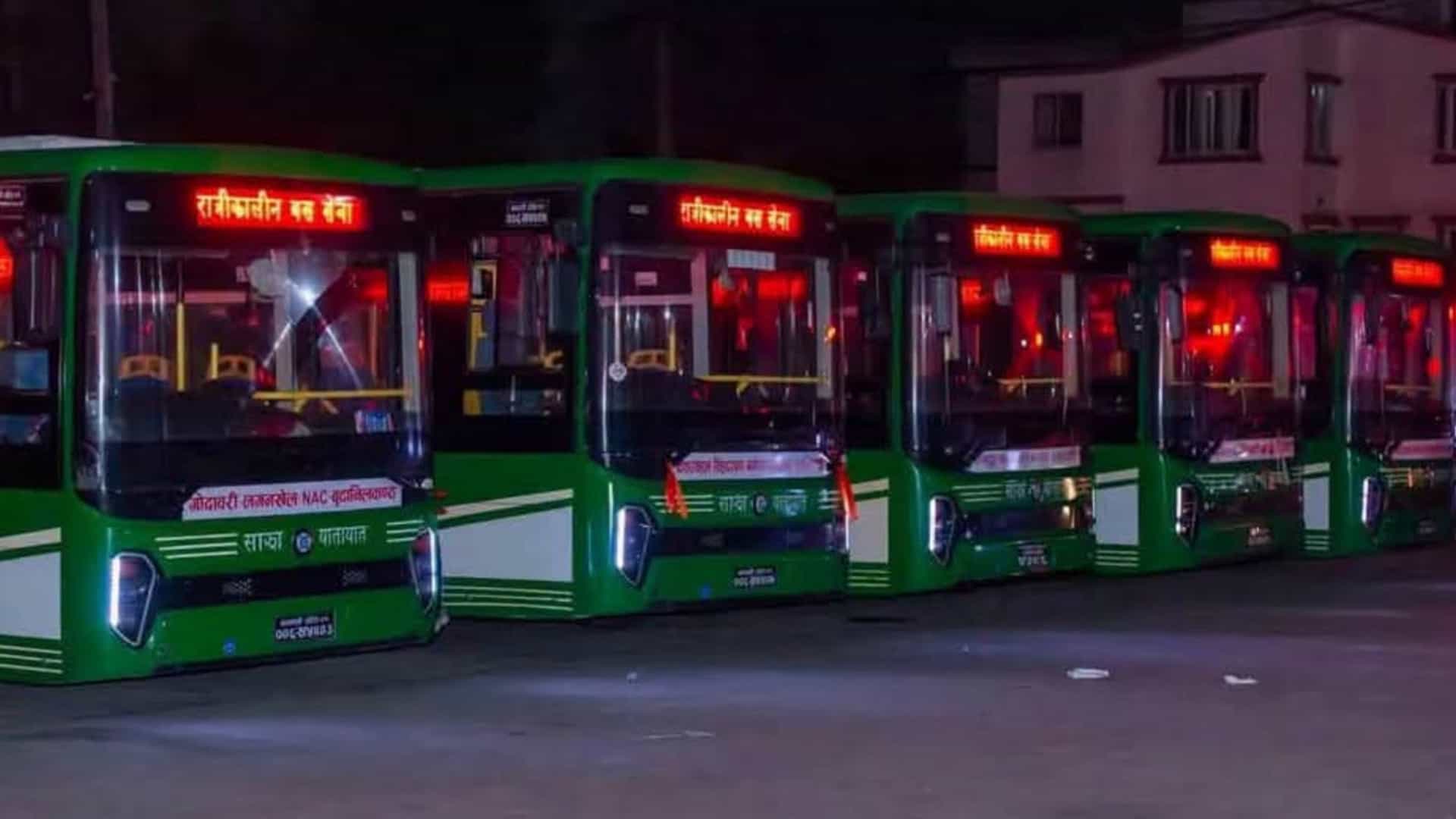
Sajha Yatayat has expanded its nighttime public transport service across the Kathmandu Valley, with nine local governments joining a joint programme to support and develop the service.
The expansion from seven to 28 across several routes was introduced from Saturday on the occasion of Constitution Day. The service is being operated in collaboration with the Kathmandu Metropolitan City and Sajha Yatayat.
Two metropolitan city, Kathmandu and Lalitpur and seven municipalities: Budhanilkantha, Godawari, Chandragiri, Kirtipur, Bhaktapur, Suryabinayak, and Madhyapur Thimi Municipality have signed a memorandum of understanding with Sajha Yatayat. Sajha Yatayat chairman Sushil Raj Pyakurel signed the agreement on behalf of the transport operator.
Nighttime services were initially launched on two routes from April 14 with seven buses. The service had been operating between Nagdhunga and the airport and between Lagankhel and Budhanilkantha.
Under the expanded service, buses will operate on the following routes:
Night buses will depart from their respective starting points between 8 pm and 11 pm. The number of buses and operating hours may be adjusted based on passenger demand and travel needs.
The expanded network is expected to improve nighttime connectivity between different parts of the valley, including Kathmandu, Lalitpur and Bhaktapur. It is particularly aimed at people who travel late for work, business, education and essential services, including students, healthcare workers, security personnel and others employed in night-shift jobs.
Lalitpur Metropolitan City mayor Chiribabu Maharjan said local governments had begun developing systems that could be implemented at the local level in the absence of wider mass-transit projects such as a metro or bus rapid transit system.
Sajha Yatayat chairman Pyakurel said having local governments support the operator represented an important development for the organisation. He said the agreement would provide a basis for continuing and expanding nighttime public transport in the valley.
Under the agreement, if passenger ticket revenue is insufficient to cover the cost of nighttime operations, 50 percent of the shortfall will be shared equally by the seven municipalities involved in the financial arrangement. The remaining 50% will be covered according to population-based contributions, with Kathmandu Metropolitan City and Lalitpur Metropolitan City each contributing 18.55% and the other participating municipalities contributing 9% each. Sajha Yatayat can request the required funding on a quarterly basis if operating revenue does not cover costs.
The participating local governments will determine bus boarding and drop-off points along the routes. Sajha Yatayat has been assigned responsibility for installing and operating digital bus stops and digital signage at those locations during fiscal year 2026/27, while the municipalities will provide coordination and facilitation.
The municipalities will also provide land where necessary for charging stations at the endpoints of designated routes, while Sajha Yatayat will install the charging infrastructure. The respective municipalities will be responsible for security at the charging stations.
The agreement also leaves room for the nighttime network to be expanded to additional areas if passenger demand increases. With services operating around the Ring Road, passengers will be able to reach different parts of the valley by changing buses at designated points, with the maximum fare for such a journey expected to be NRs 80.
To reduce financial leakage from ticket sales, Sajha Yatayat has introduced a digital ticketing system from September 17. Passengers can purchase tickets using QR payments or cash. POS machines have been provided to all conductors, and the system will automatically display government-set fares to ensure exact payments. It is also planning daily and monthly lucky-draw rewards.
Alongside, Sajha has introduced a Command and Control Center across its 111-bus fleet, which will monitor buses 24/7, including their locations and time at stops. Dash cameras are already installed, with 360-degree cameras, an ERP system and smart digital bus-stop displays planned for the future.
Sajha Yatayat currently has 111 buses and has equity investments of NRs 3 billion from the Government of Nepal and NRs 150 million from Kathmandu Metropolitan City.
Read More Stories

Inflation rises to 5.96% in first month of fiscal year
The annual consumer price inflation rose to 5.96% in the first month of...

Banking stocks lift NEPSE as turnover climbs to NRs 6.74 Billion
The stock market ended the week on a positive note on Friday, with...

NEPSE gains 11.9 points as market trades NRs 5.49 billion
Nepals stock market rose 11.93 points on Thursday to close at 2,624.36, while...