What we do is costly! Your support will help us dig more stories.
Yes, I'm Interested!Ignorance isn't always bliss | Don't stay foolish.
Keep informed | Read our news and analysis.
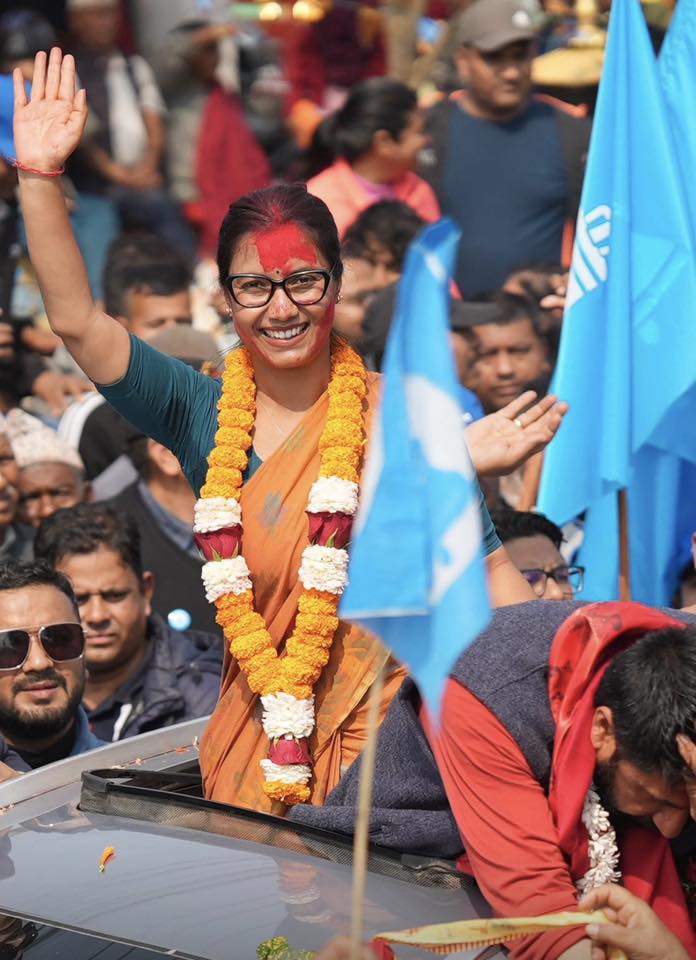
Nepal’s House of Representatives election concluded this March, ushering in a new lower house and a new government marked by fresh faces. It is worth reflecting on what this election revealed vis-à-vis women’s representation, given that 51% of the country’s population is female, including 48.9% of the 18.9 million registered voters.
Notably, there was a marked rise in the visibility of women in politics, with many demonstrating strong public presence, articulate expression, and active engagement in social and political issues.
At the same time, this progress underscores multiple challenges. Women continue to navigate structural barriers, unequal access to resources, and an increasingly hostile digital environment.
Rise in electoral representation, one election at a time
In this election, 14 women secured seats in the House of Representatives under the first-past-the-post (FPTP) system. Compared to previous results, this marks a steady upward trend in women’s representation: six seats (3.6%) in 2017, nine seats (5.5%) in 2022, and now 14 seats (8.5%) in 2026.
While this progress remains modest, it is nevertheless encouraging. At the same time, substantial gaps remain, raising important questions.
Persistent party-level failure
These total victories came amid a competition of a total of around 3,406 candidates, where only 388 of them were women, which equals just 11.40% women candidates. Of these, 157 ran as independents.
Despite the gains in women securing more direct seats than in the previous election, the overall statistics on candidacy reveal a persistent gender gap in political representation. The fact that fewer than 400 women, out of which 40% ran as independent candidates, points to two key realities: first, political parties have nominated a very small number of women; second, women remain active in electoral politics beyond party structures, as reflected in the significant number of independent candidates. Needless to say, party practices are behind exacerbating this gap, as leadership decisions and ticket distribution often favor men.
Thirteen of the 14 women parliamentarians were elected under the banner of the Rastriya Swatantra Party (RSP), a relatively new force with less than four years of organisational history. Yet it secured a sweeping success, winning nearly two-thirds majority in the 275-member house. The party fielded 16 women candidates, which is nearly 10%.
Where a newer party demonstrated a relatively greater willingness to embrace change, traditional parties with long political legacies fell notably short.
Only one woman candidate, Basana Thapa from Dailekh-1, secured a seat from the Nepali Congress (NC), the country’s oldest party and a long-standing advocate of democracy and equality. Despite its stated commitments, the NC fielded only 11 women candidates in the election, 6% of its total candidates.
Read also:
- Nepal prepares for polls, women candidates face online hate
The outcomes are even more striking when considering the country’s two major communist parties, CPN (UML) and CPN (Maoist Centre), both of which have historically claimed to champion equality. Not a single woman from either party managed to secure a direct seat, reflecting the gap between their stated progressive ideals and their efforts to elevate women leaders.
Together, these parties fielded only a small fraction of women candidates. CPN-UML and CPN (Maoist Centre) nominated only 8 (4.9%) and 10 (6%) women candidates, respectively, for the 2026 election. None secured a seat. These are the same parties that were once nurtured by influential communist leaders like Sahana Pradhan, who tirelessly fought to elevate women's voices and secure their social and political rights.
The Maoist Centre’s legacy, in particular, presents a paradox in its treatment of women, as nearly one-third of its combatants in the Maoists-led ‘revolution’ that lasted almost a decade were female, a participation that helped propel many of its male leaders into positions of power for long.
The proportional report
The overall trend highlights a sluggish pace of change over consecutive election cycles. In this context, the country’s proportional representation system provides much-needed respite to women politicians, effectively becoming a crucial corrective mechanism to secure at least one-third of the seats in the parliament.
Since 2015, the House of Representatives (HoR) has maintained a composition of around 33% women, the majority elected through PR mechanisms. Many often view such representatives as “quota-fillers” instead of considering them as full legislators.
The current lower house has 96 women lawmakers, nearly 35% of the lower house. 82 of them were elected via proportional representation, in line with the constitutional requirement of at least 33% female representation in the country’s federal legislature.
Certainly, political parties have once again used this system to fill the gap instead of supporting them wholeheartedly. While depending on this system alone forever is not ideal, it should nevertheless put to rest arguments why such provisions are needed.
Inclusion at debate
While the PR provision in essence requires representation to be inclusive across broader social groups, inclusion in that sense hasn’t been achieved. There are however a few positives.
The following illustrates the distribution of women candidates nominated through the PR system in this election.
The data indicates that Khas/Arya and Indigenous (Adivasi/Janajati) women together represent more than half of the total female representatives. Women from various intersectionalities, including caste and ethnic communities, account for the rest.
Representation, however, is notably lower among smaller demographic categories, with only two seats held by women with disabilities and a historic first being a single seat held by a transgender woman.
Despite more than a decade since the implementation of the federal democratic republican system, the representation of the Madhesi Dalit community remains almost negligible. In the last three elections, more than 800 MPs have been elected through both direct and proportional representation, yet only two Madhesi Dalits have ever entered parliament.
In the 2017 election, out of 19 Dalit MPs, only one, Dulari Devi Khatveni, was a Madhesi Dalit, chosen through proportional representation by Rastriya Janata Party Nepal. Similarly, in 2022, only one out of 16 Dalit MPs was a Madhesi Dalit, with Prabhu Hazara Dusadh nominated by the CPN (UML).
In the new parliament, a significant 134 lawmakers belong to the Khas Arya community, making it so that one out of every two members is from this group. Among the 110 total proportional representation seats, 34 Khas Arya members were elected, which includes 26 women and 8 men from six national parties.
From a critical perspective, as the ideas of Antonio Gramsci suggest, the continued presence of women in parliament can be read not only as progress but also through the lens of cultural hegemony, where power is sustained by shaping norms and perceptions of what counts as “inclusion.”
While women’s representation is often highlighted as a marker of a more inclusive democracy, such visibility can also function to create a sense of consent around existing power structures. True inclusion must go beyond mere numerical representation; it requires a genuine engagement with power dynamics and hierarchies, ensuring that diversity is actively enacted on them. In such contexts, a critical question arises about who genuinely represents the marginalised.
In practice, the country’s reservation system has often benefited party loyalists and kith and kins of mainstream political elites. In the new context, this approach has merely shifted its tendency from traditional powerholders to a new group of influencers, reinforcing existing inequalities rather than challenging them.
For instance, earlier political debates raised concerns over how PR lists doubled as family patronage vehicles. More recently, in the lead up to the 2026 elections, even the RSP, which rides its ethos on a youth-driven, anti-establishment surge, itself curated a cartel of influencers, wealthy elites, well-connected, and “aspirational” figures on its PR lists, who already possessed significant social and political capital for an electoral campaign. Their involvement in the list aims to engage women and marginalised representatives, although reproducing a rebranded elitism.
That said, there have been important gains: Bhumika Shrestha’s entry into the house as the first transgender woman MP, followed by the appointment of five women to executive positions, raising female cabinet representation to 33%, the highest in the country’s history. Among them, Sita Badi, a PR-elected MP from the marginalized Badi community, became the first person from her community to hold such a position.
Structural barriers, not shortcomings
A common argument on the low participation of women in elections is that female politicians are not adequately prepared for leadership and have lower winnability than male candidates. While this view is sometimes advanced, it is important to critically examine the structural barriers and party-level decisions that shape candidate selection and electoral success. Political parties, in particular, play a key role in either reinforcing or addressing these disparities through how they recruit, support, and nominate female candidates.
The internal structures of these parties, from grassroots to boardrooms, have contributed significantly to this issue. Major parties frequently nominate fewer women for the direct election, often citing “gender-blind” processes, but using criteria that favor male candidates, such as economic influence and networks.
A study by Sankalpa on the 2022 elections highlighted that parties may superficially include women for compliance but fail to provide internal democracy, training, or funding support, reinforcing tokenism across all levels of politics.
Financial exclusion further discourages women. This type of economic constraint often manifests in the form of inadequate funding for constituency work, hindering female Members of Parliament from fulfilling their roles effectively. This budgetary exclusion means PR women MPs cannot fund constituency work or build the patronage networks that male, directly elected members rely on for political clout .
Cultural expectations also reinforce these barriers. Land and other assets are primarily associated with men, which severely limits women’s access to finance and property ownership. According to the 2021 census, only 17% of the 2.1 million households in rural Nepal have female ownership of fixed assets like land or houses. This pervasive property-ownership norm leaves women without the productive resources necessary for financial mobility. Nationally, women hold only 8.1% of total land holdings, and a mere 4% of households grant women both house and land ownership.
Women encounter a continuous array of barriers to political participation due to their entrenched gender expectations and social roles. These societal norms create obstacles that span from domestic responsibilities to public leadership, significantly hindering women's involvement in politics.
Additionally, politics is often perceived as “men's work,” reinforcing stereotypes that portray women as emotional or inadequate leaders. Cultural biases further scrutinize women based on appearance, emotions, and loyalty, which are now explicitly exacerbated by online harassment and violence. Such factors tend to deter women from pursuing political ambitions.
The challenge is greater for intersectional groups such as women with disabilities, Dalits, Indigenous, and Madhesi women. In a 2019 study by Nepal Disabled Women Association (NDWA), women with disabilities pointed out that political parties, at every level, ignore principles of inclusion in their discussions about priorities and programs, as well as in their decisions on significant issues. They further noted that candidates are often selected based on their economic status and personal connections rather than fostering the involvement of women with disabilities.
Visibility with hostility
Social media has become a powerful platform for women politicians to share their agendas and develop strong personal brands, especially during this election cycle. However, this digital empowerment is significantly undermined by widespread online hostility and gendered attacks, with female candidates facing a disproportionate amount of abuse. Such abuse often includes sexualised slurs and personal attacks that tend to overshadow their political messages.
Online harassment against women in politics at large is drawn upon the gender stereotypes targeting their appearance through body-shaming, policing them with traditional gender roles, and sexualizing them inappropriately, which often includes slut-shaming, rape threats, and other violence.
The infamous cases of Nisha Adhikari and Ranju Darshana from this election exemplify the complex and hostile environment faced by women in the political sphere, highlighting the absurdity of online and offline aggression. Incidents like the rape threats against Amisha Parajuli, a young political campaigner, highlight that women in politics face not just political criticism, but gender-based harassment meant to silence them and undermine their leadership.
This reflects a wider pattern: while social media gives women visibility, it also exposes them to extreme sexism and abuse. With little regulation, online spaces can discourage women from participating fully in politics.
Read More Stories
Nepal needs to repeat to brand itself
Last year Nepal's goods exports jumped 81.8% to NRs 277.03 billion. That is...

Banking stocks gain momentum as dividend season begins
Dividend announcements by banks and financial institutions (BFIs) for fiscal year 2025/26 have...
Nepal’s challenge of building strong democratic institutions
Over the past few decades, institutional dysfunction and massive dissatisfaction with political establishments...