What we do is costly! Your support will help us dig more stories.
Yes, I'm Interested!Ignorance isn't always bliss | Don't stay foolish.
Keep informed | Read our news and analysis.
Online Hate | Nepal Election | Women Candidates | Nisha Adhikari
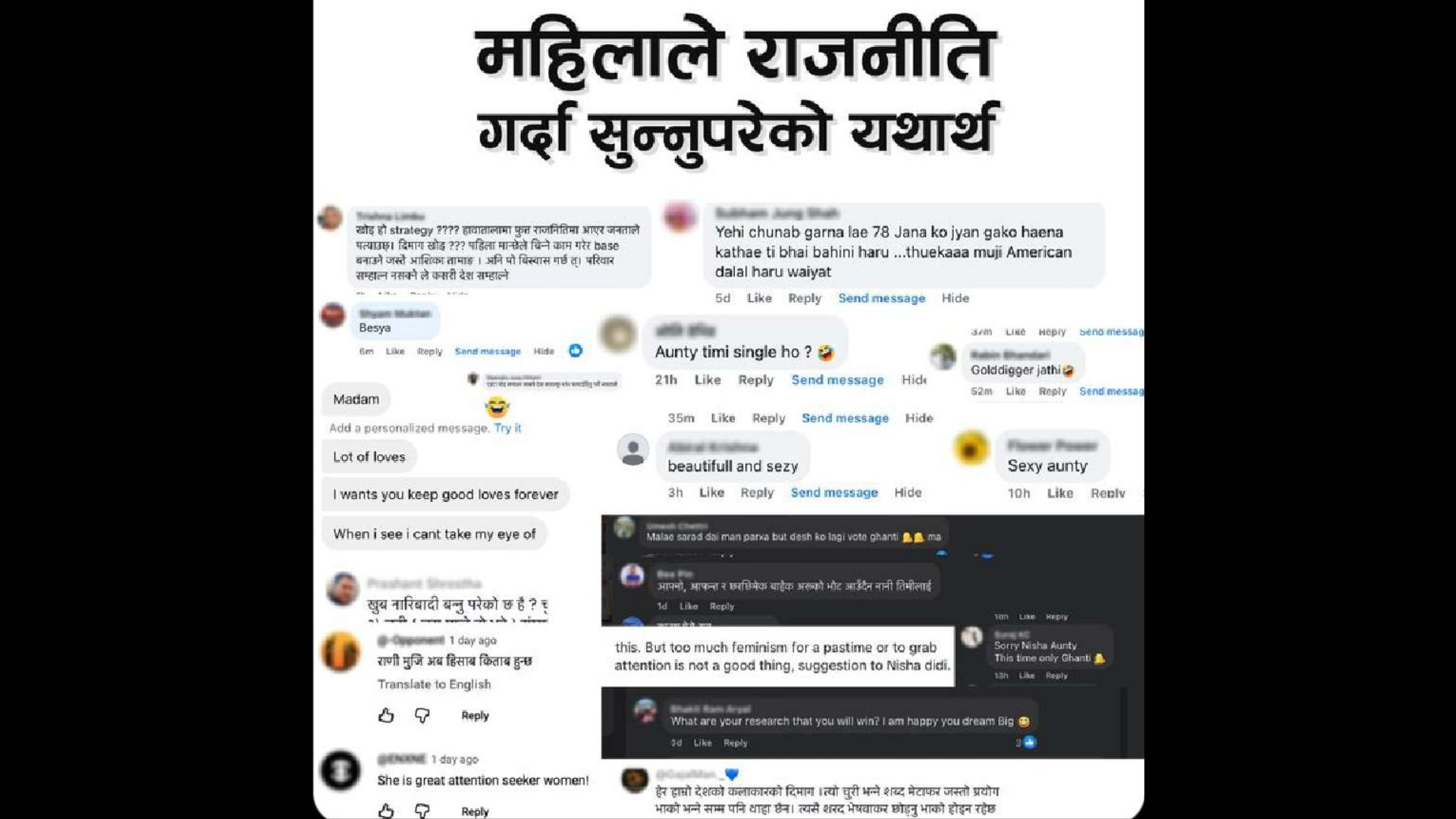
On Saturday, February 7, artist-turned-candidate Nisha Adhikari took to her social media accounts, exposing a slew of hateful and misogynistic comments following her political campaigning. Nisha highlights in her post how women in politics are often targeted with degrading language that bears no relation to their ideas or contributions.
“I think this is a reflection of how our society views women in leadership. The hate comments have never been about my manifesto or my party’s agenda, but rather about their judgment of how I am supposed to behave as a woman. It shows that they are uncomfortable with women in leadership,” Nisha explains in her post. “The hateful and degrading language used against women candidates exposes how deeply misogyny is still rooted in our society.”
While it is striking that politicians across the country are facing high volumes of online backlash during this political cycle, the real concern lies when it gets vehemently gendered. Female politicians have been targeted with attacks related to their appearance, gender, ethnicity, and, their role of motherhood.
Ranju Darshana, a candidate contesting from Kathmandu-1, faces routine vitriol over her pregnancy. What follows is a relentless scrutiny of her body, autonomy, questions on maternity, and persistent misjudgment, shifting public attention away from her political agenda to deeply personal and gendered comments. Ranju contested for Kathmandu’s mayoral position in 2017 local elections at a remarkably young age, securing nearly 23,500 votes, almost 12% of the valid votes . Although her decision to contest elections were also ridiculed at the time, few acknowledge that her bold step helped open the political space for independent figures like Balen Sah to later enter and reshape the electoral landscape. Sah, who first contested the election in 2022, is a candidate for the country’s Prime Minister this election.
Yet, comments in the social media persistently belittle women, framing them as incidental and subordinate, while the digital sphere has become a space where gendered power imbalances are enforced in the most blatant way possible.
“As a young woman who speaks publicly about politics and power structures, I have repeatedly witnessed how political disagreement on social media rarely remains political for long. What begins as a difference of opinion quickly mutates into something far more personal,” explains Tanuja Pandey when asked about how online hate and misinformation has shaped her experience of political engagement.
Tanuja, a prominent voice during the Gen-Z protest and the following events, has faced persistent threats that have severely disrupted her everyday life. Since September, she has been subjected to multiple death threats. Averse to her political engagement, Pandey is often and falsely labelled as a politician's granddaughter, putting her to intense online scrutiny and widespread accusations.
“In my experience, political discourse in social media rarely remains focused on substance. Instead of engaging with arguments, online backlash often takes the form of targeted character attacks, speculative accusations, and fabricated political affiliations. Misinformation is not merely a byproduct of polarised discourse; it is strategically deployed to undermine credibility and manufacture doubt.”
Tanuja further adds, “What makes this particularly harmful is the way online hate exploits existing gendered power hierarchies. Women are not only challenged for what they say, but for the audacity of saying it at all. The focus shifts from political positions to personal morality, emotional stability, or perceived loyalty. The labor of explanation becomes endless, and the cost of participation is disproportionately high.”
Nisha Adhikari, Ranju Darshana, and Tanuja Pandey thus only exemplify a broader, recurring pattern of targeted online hostility against women.
Other women leaders, such as Sumana Shrestha and Toshima Karki, continue to face relentless gendered scrutiny.
In 2023, Sumana was sharply trolled for wearing a pantsuit in the parliament, sparking a dress-code controversy that largely bypassed male lawmakers.
Gendered stereotypes and everyday misogyny remain entrenched barriers that women in politics are often forced to endure as an unwritten test of survival within this “democratic” space.
This trend remains persistent and is strongly amplified by the unregulated nature of the internet. Women, in particular, have long borne the brunt of such hostility; the accessible online sphere has made it only easier to contribute to this disjuncture.
Tanuja further adds, “Online hate also functions through accumulation. It is not one comment or one post, but the sustained repetition of harassment, distortion, and surveillance that wears individuals down over time. This slow violence has real political consequences. It encourages self-censorship, limits the range of acceptable speech, and pushes many out of visible political spaces altogether.”
Gender inequality, expressed through entrenched stereotypes and everyday sexism, can be widely understood as a key driving factor of violence against women, including its digital form. While sex refers to biological differences between men and women, gender essentialises the socially constructed identities, roles, and expectations assigned to them.
These norms influence how women are judged, disciplined, and targeted, particularly in political and online spaces.
Amidst the wave of online hostility, we spoke to Nisha Adhikari about her resilience in the face of online hate. Here is a condensed version of the interview:
How do you feel about contesting the election amidst all the hate comments?
Obviously, it is not pleasant, but it has fueled me to leverage my position to be even more vocal for my own leadership, it pushes me to be true to my values of representation, and it makes me feel solid about my manifesto because nobody has said negatively about it.
As in this election campaign, women candidates have frequently been subjected to personal and gendered attacks. How did it affect you? What message do you think it gives to the women trying to make their space in politics?
Well, the message is clear: women who want to come to politics and claim their space must be prepared to face the hate that men are not subjected to based on their gender. It doesn’t affect me negatively because I have been in the public eye for more than 20 years now. But at the end of the day, I see this reaction is not because I am stepping into politics, but because I am going out of the box that society has drawn around me.
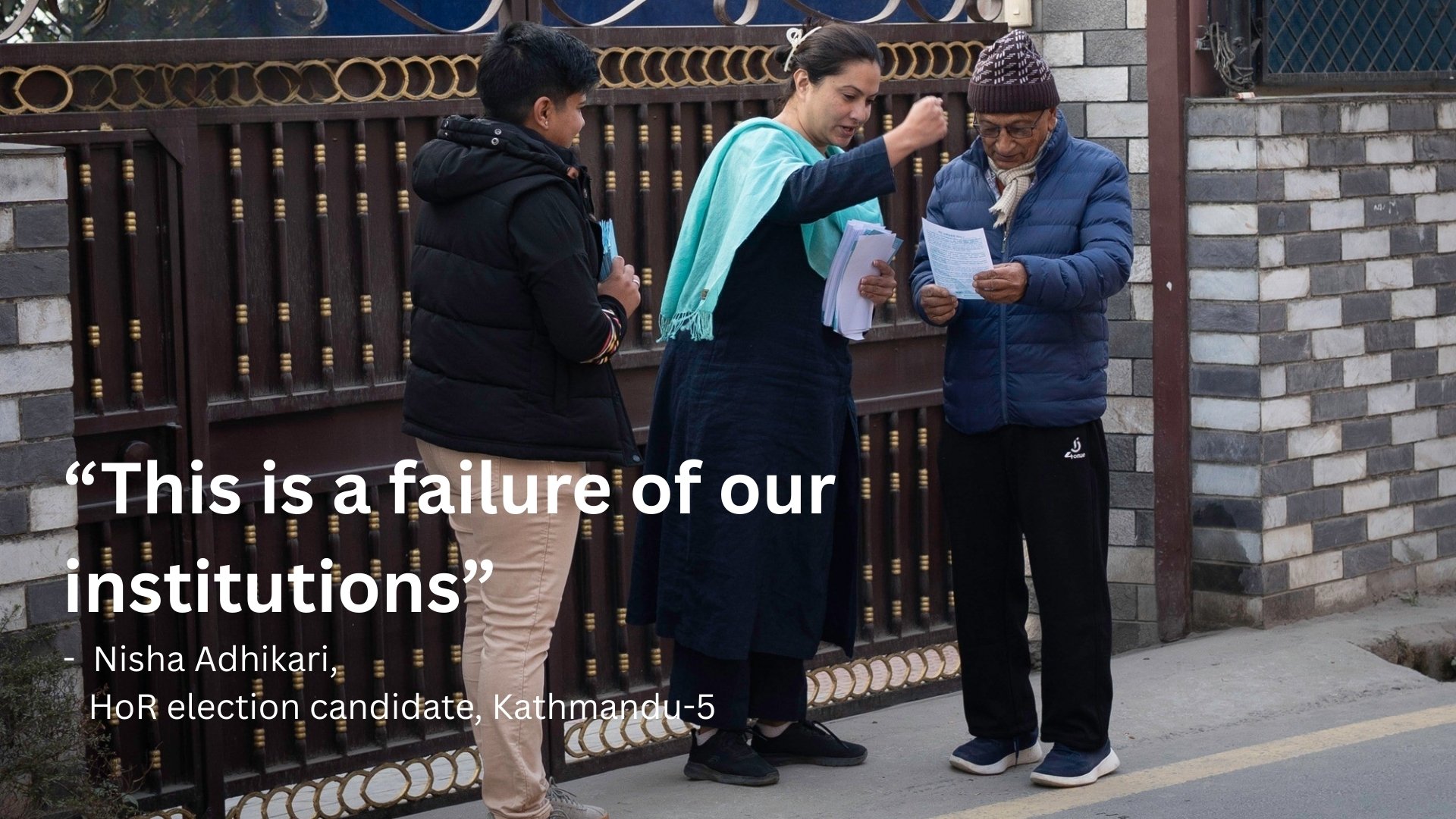
I don’t view myself as the cause of this hate. That is something I would like to tell other women candidates. Do not view yourself as the cause of such hate. This is a failure of our institutions, from our houses to the parliament: we have failed to teach our society that women too can be leaders.
Did the public scrutiny and online hate in any way reshape the way you campaign?
It has not. It has instead strengthened my resolve in what I am doing. I am trying to be a voice of reason amid the ongoing political noise, which has overwhelmed the public with personality over agenda. Even with the scrutiny, people, particularly those who read my manifesto, have shown their utmost support and respect.
Do you have any better recommendations or proposed way out, like in your campaign, to effectively tackle online hate and harassment targeting women/leaders?
The most effective way to tackle online hate is to foster a regulated social media environment. It would be great to have policy-level monitoring of social media because currently, we have mechanisms such as Directives for Managing the Use of Social Networks, 2023, that don’t allow hateful remarks online, but the problem lies in their enforcement. So strict monitoring and enforcement are essential because I, as an individual, cannot pursue cyber bureau for 200 people who sent me hate.
For society at large to be more accepting of women's leadership, how we teach gender in our education systems must be overhauled. The inclusion of women in all spheres of gender making is much needed for all of our public spaces, including virtual ones, to be framed and formed from the perspectives of women and other gender minorities, for them to feel safe. We cannot expect women to feel safe in spaces that they had no stake in defining.
Read More Stories

Nepal needs to repeat to brand itself
Last year Nepal's goods exports jumped 81.8% to NRs 277.03 billion. That is...

Banking stocks gain momentum as dividend season begins
Dividend announcements by banks and financial institutions (BFIs) for fiscal year 2025/26 have...
Nepal’s challenge of building strong democratic institutions
Over the past few decades, institutional dysfunction and massive dissatisfaction with political establishments...