What we do is costly! Your support will help us dig more stories.
Yes, I'm Interested!Ignorance isn't always bliss | Don't stay foolish.
Keep informed | Read our news and analysis.
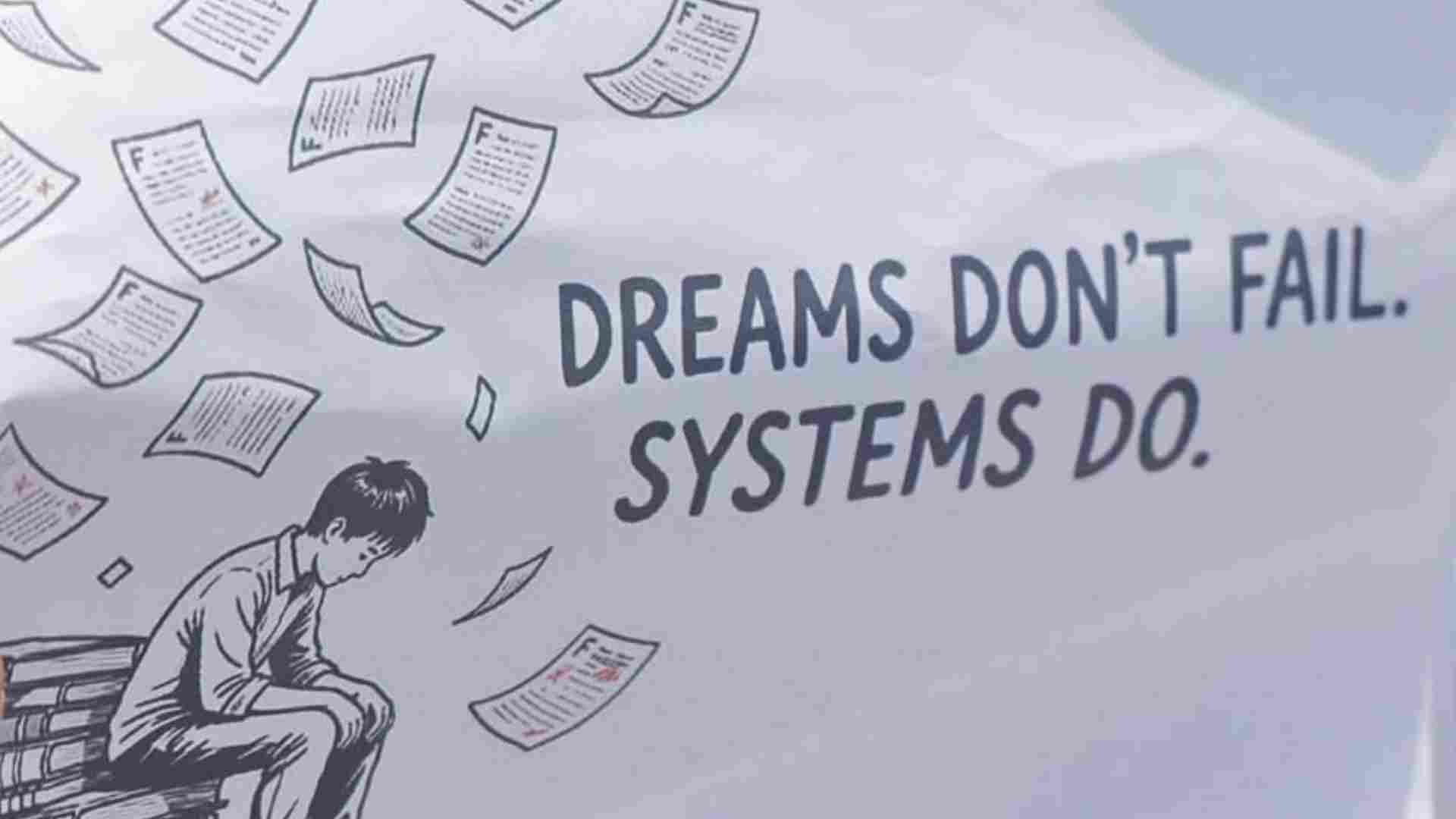
The students are standing outside the National Examinations Board office in Bhaktapur and gathering at Maitighar Mandala with placards that say what many Nepali students have felt for years: that the state does not take their futures seriously.
Last week's Grade 12 result anomalies, where consistently high-performing students found themselves holding inexplicable C+ and D grades, brought them into the streets. They are right to be there.
The NEB published results in a record 35 days. The Ministry of Education publicised this as a triumph. But speed without accuracy is not governance, but a loss of credibility for mere press releases. According to reports, more than 32,000 students have applied for re-totalling.
Just a while earlier, a similarly large number of SEE students also applied for re-totalling, with reports indicating that nearly 6% had their final results revised.
The current government's instinct to move fast and to publicise its appearance of speed is not without value. In education, as in development, this choice over quality is a political one. When this choice harms the most vulnerable students, those who cannot afford private re-evaluation support,or navigate the NEB's bureaucracy, it stops being a management failure and becomes an equity failure.
The amount of fees charged make that obvious. The NEB charges 1,000 rupees for every subject re-totalled. Students are being asked to pay to correct the state's own errors. This is not a technical inconvenience, but a structural injustice, one that falls hardest on students from poor households who already had to fight harder to reach Grade 12 in the first place. The fees must go. The anomalies must be investigated fully, independently, and without cost to students. The minister must answer for the recklessness of chasing headlines over accuracy.
All of this is true. Amidst the uproar, the probe committee announcements, and the ministerial deflections, there is another deeply concerning question nobody in parliament is asking.
Nepal's education system has a crisis far older and far deeper than the NEB's latest failure. According to UNICEF's Multiple Indicator Cluster Survey, only 20% of children in Grades 2 and 3 in Nepal possess foundational reading and numeracy skills. 80% are being pushed up the academic ladder without the ability to read simple sentences or do basic maths. They are not learning. They are being registered, counted, and passed along, and the system records them as enrolled, which looks like progress, until they sit a high-stakes exam at eighteen and the numbers finally tell the truth.
Children from Nepal's wealthiest households have a 58% chance of mastering basic numeracy. Children from the poorest households have a 22% chance.
The National Assessment of Student Achievement (NASA) data is equally stark. Mathematics is the weakest subject nationwide. By Grade 10, nearly 60% of students score at or below the lowest proficiency tier. This is not a Grade 10 problem. It is a Grade 2 problem that has been compounding, quietly, for eight years, and is invisible because it happens in community schools in Kalikot and Doti and Sunsari, not in examination halls in Bhaktapur.
The inequality embedded in this data is not accidental. Nepal has, in practice, created two education systems. Community schools, which serve the poor, the rural, the Dalit, the Janajati, consistently underperform on every measure. Institutional private schools, serving wealthier urban families, outperform them across every subject. A child's chance of learning the basics in Nepal is not determined by their effort or their teacher's dedication. It is determined, with statistical regularity, by what their family earns.
The consequences follow children for life. Longitudinal research from South Asia shows that students who fail to secure foundational literacy and numeracy by Grade 3 face dramatically higher rates of dropping out before completing secondary school.
World Bank data shows that every year of schooling where a child actually learns raises lifetime earnings by roughly 9%, but years spent in a classroom without learning return almost nothing economically. In Nepal, the consequences are real: children lacking foundational learning early in their education face limited opportunities, often leading to low-skill employment rather than pursuing higher education.
So yes, investigate the NEB. Remove the re-totalling fees. Hold the ministry accountable for its reckless haste. Stand with the students at Maitighar, because their anger is legitimate and their futures matter.
But when the probe committee files its report and the news cycle moves on, a broader question will remain: how do we bring the same sense of urgency to Grade 3 classrooms, where children are being taught and passed along without foundational learning. Those children will be eighteen in ten years. We will be very surprised when they fail.
Read More Stories

Nepal needs to repeat to brand itself
Last year Nepal's goods exports jumped 81.8% to NRs 277.03 billion. That is...

Banking stocks gain momentum as dividend season begins
Dividend announcements by banks and financial institutions (BFIs) for fiscal year 2025/26 have...
Nepal’s challenge of building strong democratic institutions
Over the past few decades, institutional dysfunction and massive dissatisfaction with political establishments...