What we do is costly! Your support will help us dig more stories.
Yes, I'm Interested!Ignorance isn't always bliss | Don't stay foolish.
Keep informed | Read our news and analysis.
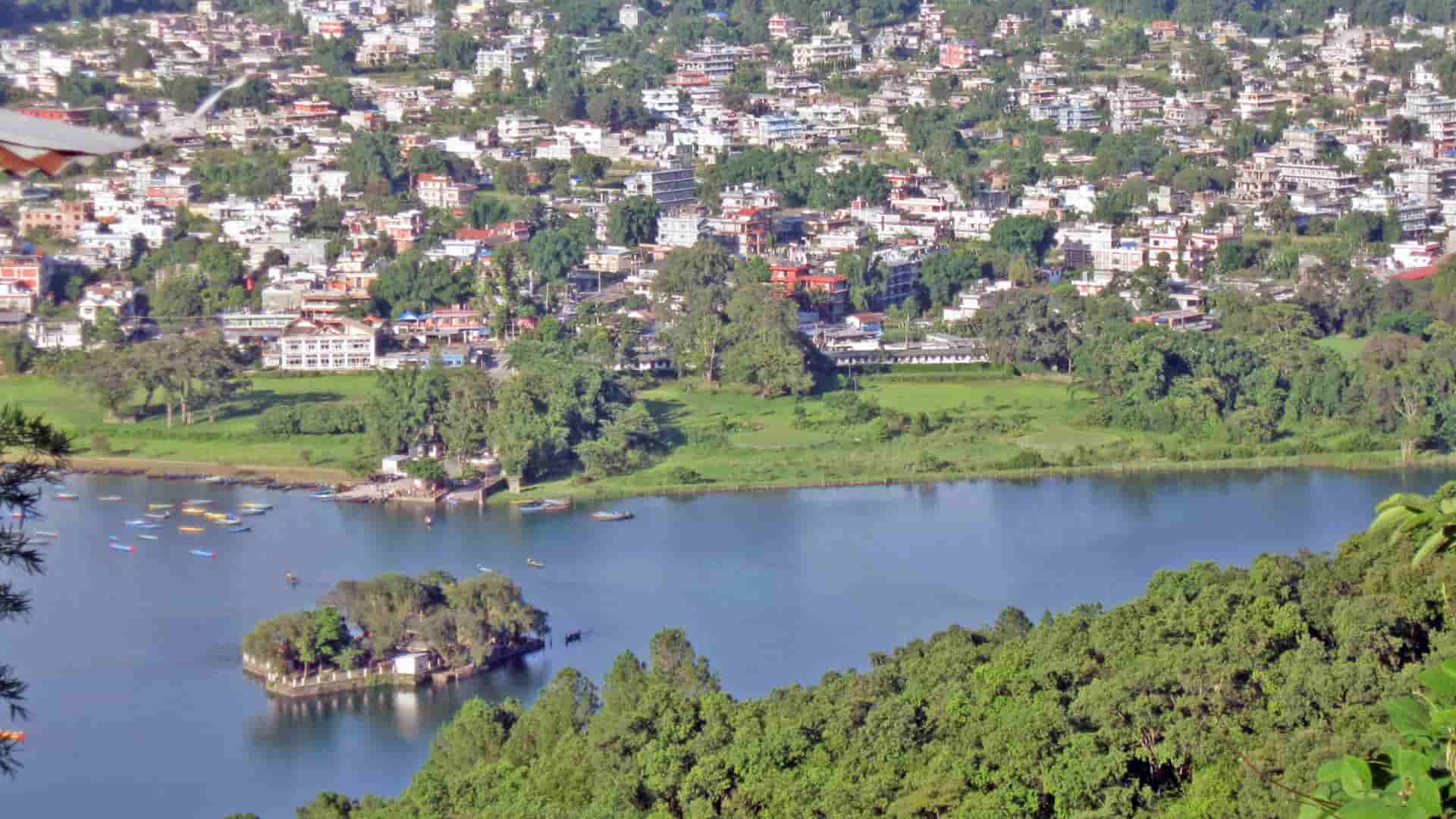
On the morning of April 4, 2026, bulldozers moved through Pokhara's lakeside neighbourhoods as around 150 security personnel drawn from the District Police Office, Baidam Police, municipal police, and the Armed Police Force stood watch. The Pokhara Metropolitan City had begun demolishing illegal structures along the shores of Phewa Lake. Among the first structures to be torn down were the swimming pool, gate, and walls of the Park Village Waterfront Resort owned by renowned tourism entrepreneur Karna Shakya. By mid-morning, around 30 structures had been demolished.
These demolitions were not without warning. The Supreme Court had issued two landmark verdicts on the lake's conservation: the first in April 2018, directing federal, provincial, and local governments to remove illegal structures within a specified timeframe.
The second in June 2023, ordering that illegal structures on the Waterfront Resort site be demolished. Both verdicts went largely unenforced for years until the impasse broke this April.
The current drive follows a phased approach. First, boundary pillars marking the 65-metre zone were installed, with structure removal now underway as the second phase. The current government had included the removal of encroachment in Phewa Watershed under its 100-point reform agenda, including its restoration, landslide management, and source protection, with implementation to begin within three months. Yet the scale of the task is significant: within the 65-metre boundary alone, there are roughly a dozen government structures and over 500 private ones, requiring full clearance and restoration.
The Supreme Court had also ordered the government to declare the lakeside a protected area and prohibit the construction of any physical structures within the 65 metre boundary. It also directed that land registered in the name of individuals within the lake area be annulled within one year and brought under the name of the lake.
For residents and business owners who had built their livelihoods on these shores, the demolitions are devastating. For environmentalists, they are long overdue. For the city itself, they represent a reckoning centuries in the making.
How the lake was encroached
According to a 2012 government report, some 1,692 ropanis of lake land are illegally registered to private individuals, which traces back to a manipulated 1976 land survey conducted while the lake's water level was temporarily low. Surveyors, exploiting the receded waterline, effectively redrew the lake's boundaries on paper, allowing vast stretches of lakebed and buffer land to be privatised. Decades of construction followed on land that was never legally anyone's to build on.
A similar case is seen with the Waterfront Resort. A six-member government probe committee led by Chief Survey Officer Narayan Regmi from the Ministry of Agriculture, Land Management and Cooperatives was formed in the wake of the first Supreme Court verdict to investigate the extent of encroachment at the Waterfront Resort, which found out that the resort had been built almost entirely on the lake’s land, with only two of its structures built on legitimate private property.
Additionally, the committee found that although the resort had developed a system to treat waste water before releasing it into the lake, laboratory tests showed that the discharged water was unfit for consumption.
Born from a catastrophe
That Pokhara exists at all is itself a product of tectonic upheaval. According to a work by Monique Fort, The Pokhara Valley: A product of a natural catastrophe, the valley was formed after one of the biggest rockslides in Himalayan history, believed to have occurred at the time of a huge earthquake, estimated at a 7.8-magnitude scale, in 1255. The earthquake killed a large population of the Kathmandu valley, including King Abhaya Malla himself.
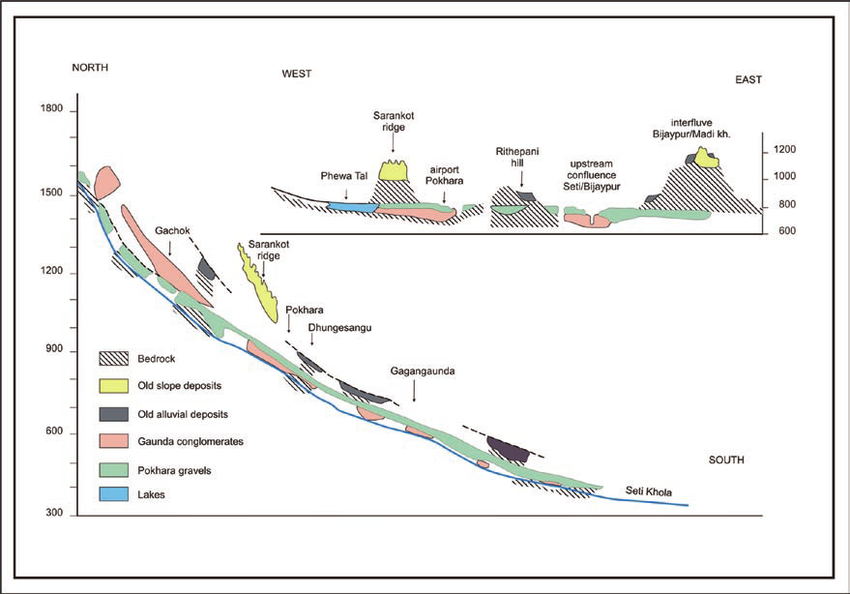
Around the same period, a massive part of the western side of the Annapurna IV collapsed, with the rock and ice plunging nearly 3,000 vertical metres down. The debris dammed the Seti River gorge and blanketed the surrounding basin, shaping the valley floor that Pokhara now occupies.
Phewa Lake itself formed through the gradual work of alluvial gravels in the Seti Valley's tributary systems, its size later expanded by artificial damming first in the sixties, which was destroyed in a flood in 1974. The current dam (Damside) was constructed in 1982. The dam helped stabilise water levels and supports both irrigation and hydropower. But it could not hold back the tide of urban expansion that followed.
A lake that must be saved
Phewa is Pokhara's jewel: a semi-natural freshwater lake spanning 5.73 sq km, reaching a maximum depth of roughly 24 metres, framed by the Sarangkot and Kaskikot hills to the north and the sacred Rani Ban forest along its southern shore. Its surface mirrors the Annapurna range on clear mornings, an image that has drawn travellers from around the world.
But that reflection now competes with a grimmer reality. The lake has been shrinking. Siltation, encroachment, and untreated urban runoff, most notoriously from Phirke Khola, which carries sewage and solid waste directly into the lake, have degraded water quality and pushed the shoreline steadily inward.
The primary feeder of Phewa Lake is the Harpan Khola, which meanders approximately five kilometres above the inlet before turning sharply southeast to converge with Phurse Khola at the valley's western edge. The hydrological system is delicate, and it has been under sustained pressure for decades.
On April 29, 2018, the Supreme Court Justice Om Prakash Mishra and Sapana Pradhan Malla directed the National Lakes Conservation Development Committee, the Pokhara Town Development Committee, and the Pokhara metropolis to coordinate and set enforceable standards to prevent activities that pollute the lake, threaten its biodiversity and aquatic life, or encroach upon its natural area. The demolitions of April 2026 are, at last, the first concrete step toward honouring those directives.
The legal foundation: Three defining cases
Case I: Bhagwati Pahari vs. Prime Minister (2018, DN 10086)
This petition challenged a government-backed cable car project planned across the Phewa Lake periphery, Basundhara Park, and Rani Ban forest, arguing it violated the constitutional right to a clean environment under Article 16 of the Interim Constitution. The Supreme Court agreed. It ruled that the right to a pollution-free environment is inseparable from the right to life, and that the state, as guardian of its citizens, must protect natural heritage. The Court prohibited all construction in Basundhara Park and Rani Ban and directed the government to pursue UNESCO World Heritage Site status for Phewa Lake.
Case II: Khagendra Subedi vs. Government of Nepal (2018, DN 10087)
This petition focused on decades of state failure to protect Phewa Lake from encroachment and pollution. Invoking the principle of intergenerational equity, the duty of the present to preserve nature for future generations, the Court declared Phewa Lake a protected watershed area under the Land and Watershed Conservation Act and ordered the removal of all structures built within 65 meters of the lake's bank.
Case III: Khagendra Subedi vs. Government of Nepal (NKP 2080, DN 11204)
This is the most direct legal basis for the demolitions currently underway. Heard by justices Kumar Regmi and Hari Prasad Phuyal, this follow-up ruling enforced and expanded the earlier orders after years of non-compliance.
The Court found that Phewa Lake, once measuring 10.35 sq km according to a 1961 Nepal-India mission report, had shrunk to just 5.73 sq km due to unchecked encroachment and sedimentation. It confirmed that the government had officially demarcated the lake's boundaries and published them in the Nepal Gazette in 2020, formally declaring Phewa Lake a protected watershed under the Land and Watershed Conservation Act 2039.
The Court ordered that all structures within 65 meters of the lake's High Flood boundary, including hotels, resorts, restaurants, homes, and offices, must be demolished without exception, with the buffer zone converted into a green belt. Any land registered in an individual's name within the lake's historic boundary was declared automatically void under the Land Revenue Act, with no compensation owed. Violations of the protected watershed declaration would henceforth be treated as a criminal offence.
A government-commissioned survey confirmed that Waterfront Resort had built multiple structures, including a swimming pool, parking area, and gate within the prohibited 65-meter zone, and on public land to which it had no legal title. The Court ordered the complete demolition of all unauthorised structures.
These three rulings, spanning nearly a decade of litigation, constitute the direct legal mandate for the demolitions underway today. Hotels and resorts that operated for years in clear violation of the 65-meter rule, many with permits obtained through unauthorised or procedurally invalid approvals, are now being brought down under court order.
The Court stated plainly, “Phewa Lake is the heartbeat of Pokhara. If the lake dies, Pokhara, as the world knows it, ceases to exist. Its protection is not optional; it is a constitutional and legal obligation that all individuals, businesses, and government bodies must uphold.”
Conservationists and environmental advocates have largely welcomed the demolition drive as a long-overdue enforcement of rights established in law years ago. Affected hotel and resort owners have raised concerns over due process and compensation. However, the Court has been clear on the matter of land that no compensation is owed.
Karna Shakya, the Waterfront resort owner resort has disputed both the legality and the manner of the action: "Early yesterday morning, the municipality arrived to demolish our hotel wall without any prior notice. We are filled with deep pain and concern. It is currently the tourist season, and the hotel is full of guests. Why was our hotel the first target so early in the morning? Are we bad entrepreneurs?" he wrote.
He further insisted, “The 65-meter standard is not a private issue; it is a matter of national concern. Whether the policy itself is correct is a separate question. But our hotel has not violated any rules. We have not encroached on any land. We hold legal ownership documents, approved building plans, a tourism department license, an industry registration certificate, and authorization from the central bank. We pay taxes every year and have no bank loans. We have complied with all the requirements an entrepreneur must meet to operate a hotel. Even so, why are we being treated so harshly?”
Read More Stories

Nepal needs to repeat to brand itself
Last year Nepal's goods exports jumped 81.8% to NRs 277.03 billion. That is...

Banking stocks gain momentum as dividend season begins
Dividend announcements by banks and financial institutions (BFIs) for fiscal year 2025/26 have...
Nepal’s challenge of building strong democratic institutions
Over the past few decades, institutional dysfunction and massive dissatisfaction with political establishments...