What we do is costly! Your support will help us dig more stories.
Yes, I'm Interested!Ignorance isn't always bliss | Don't stay foolish.
Keep informed | Read our news and analysis.
Commentary | Communal Tensions | Hindu-Muslim Rift | Terai-Madhes | Nepali Society
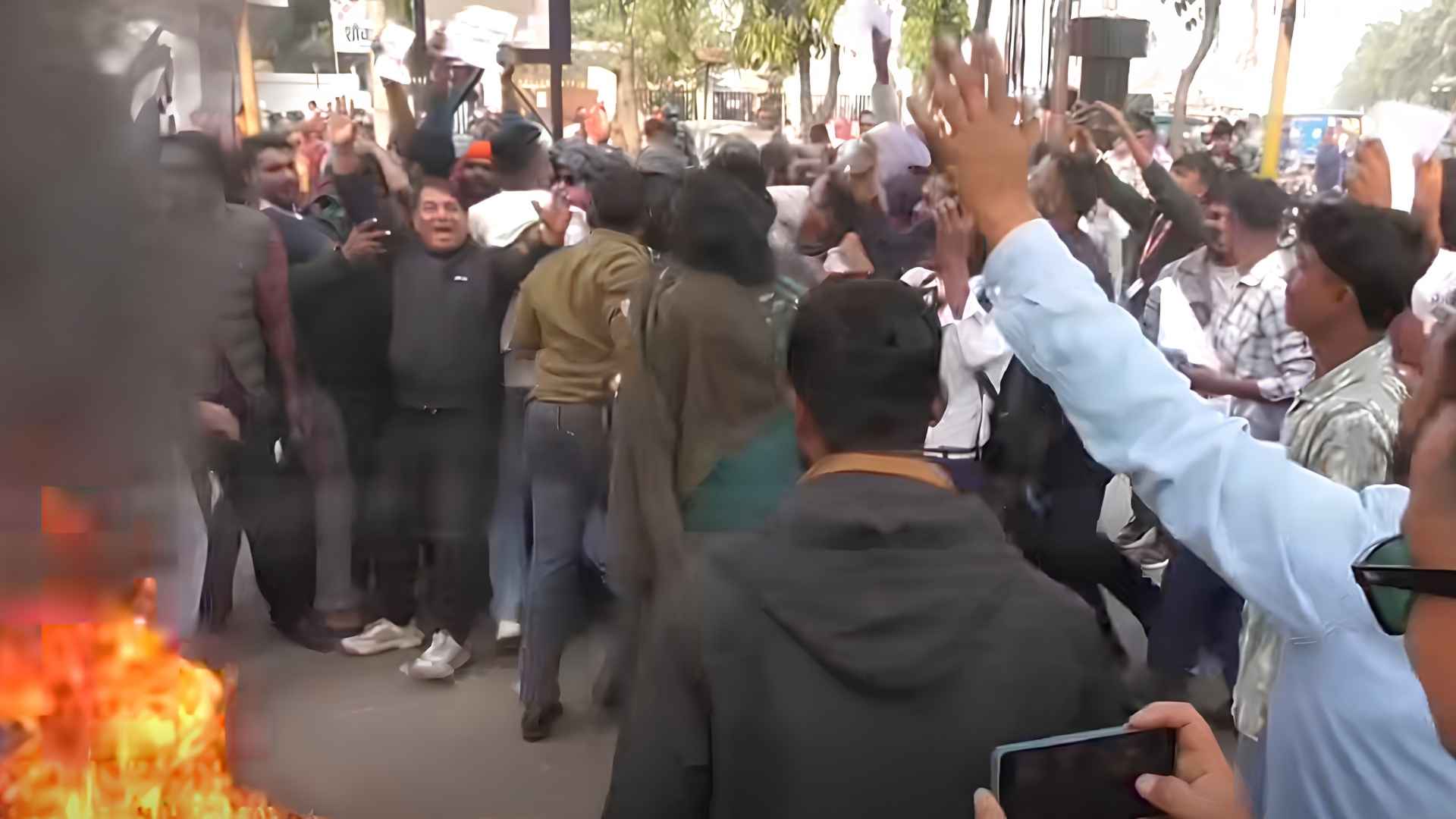
On the night of March 4, Nepalis went to bed carrying a familiar burden: uncertainty. The promise of elections the next morning, framed as a reset after months of youth-led anti-corruption protests and a near-collapse of governance, offered a fragile hope. But in parts of the southern plains, that hope was already under quiet strain.
In Birgunj, the detention of teenagers, some as young as 16, initially appeared as a routine security intervention. It was anything but. According to police, the youths were carrying a pig’s head and were allegedly planning to throw it into a nearby mosque, an act widely understood as deeply offensive in Islam.
This was not anger spilling over. It was a provocation by design.
Had the plan succeeded, the consequences could have been immediate and explosive. In regions already simmering with mistrust when it comes to religious identity, such an act would not merely insult religious sentiment but would signal an attack on identity itself. That it involved minors only deepens the concern. A generation is coming of age not in shared civic space, but at the edge of communal confrontation.
Rising tensions, changing patterns
Since January 2026, at least five communal incidents have been reported across Rautahat, Dhanusha, Kapilvastu, and Birgunj. But the Birgunj episode reveals a shift. These are no longer just reactive clashes triggered by rumours or local disputes. Increasingly, they carry elements of premeditation, symbolism, and performative escalation.
Read also:
- Curfew imposed in Birgunj following religious protests and police clashes
- Nepal sits on ticking Hindu-Muslim tensions in Terai-Madhes
- Hindu-Muslim trade stones at each other from temple, mosque in Rautahat
- Birgunj under curfew, Gaur recovers; Critics question ‘repeat curfew’ response
- Kapilvastu marks fifth reported communal tensions since January
Symbolic acts, like targeting a mosque with a pig’s head, are designed to provoke maximum emotional response with minimal effort. They bypass dialogue and go straight for outrage. In deeply plural societies, such gestures are among the quickest ways to transform tension into confrontation. This marks a dangerous evolution. Conflict is moving from accident to strategy.
The ground beneath the spark
The Terai-Madhes is not an empty stage where such provocations unfold randomly. It is a densely layered social landscape, where 80% of the total population is Hindu. Muslims form a significant part of this fabric. They make up over 13% of Madhesh Province and about 7% across the wider plains. In districts like Rautahat, Kapilvastu, and Parsa, their presence is deeply embedded in local economies and everyday life.
Demography does not determine conflict. But in regions marked by socio-economic stress, it shapes how quickly grievances travel and how widely they resonate.
Madhesh Province continues to lag on key indicators. Literacy remains below 64%, and only 14.5% of the population has studied beyond the school level. Youth unemployment stands at 33%. Nearly 37% of young people fall into the NEET category, meaning they are neither studying, working, nor training.
This is not just a development deficit. It is a vacuum, one that identity can easily fill.
When institutions fail to provide dignity, opportunity, or voice, belonging is sought elsewhere. Religion, in such contexts, becomes more than belief. It becomes an assertion.
When identity is reduced to a weapon
What makes the current moment particularly fragile is not just the presence of identity, but its simplification.
In Identity and Violence, Amartya Sen warns against reducing individuals to a single, overriding identity. Every person, he argues, belongs simultaneously to many groups by language, profession, region, class, and belief. Violence emerges when one identity is artificially elevated above all others and becomes the only lens through which people see themselves and others.
The Birgunj incident reflects precisely this danger.
The alleged attempt to desecrate a mosque is not merely an insult. It is an act that defines an entire community through religion alone and anticipates a response in equally singular terms. In that moment, a neighbour ceases to be a co-worker, a fellow citizen, or a participant in a shared local economy. He becomes only “the other.” This is the solitarist trap Sen describes.
In the Terai-Madhes, where coexistence has historically depended on overlapping identities such as shared marketplaces, interdependent livelihoods, and linguistic overlaps, this reduction is especially corrosive. It erases the pluralism that sustains everyday life.
More dangerously, once identities are hardened along a single axis, grievances become collective and absolute. An insult is no longer local. It becomes civilisational. Retaliation is framed not as a choice, but as an obligation. This is how symbolic acts spiral into sustained conflict.
Digital echo chambers, real-world consequences
These dynamics are no longer confined to physical spaces.
Social media has become a parallel arena where identities are performed, amplified, and weaponised. A review of circulating videos and posts reveals openly hostile rhetoric, provocative slogans, and competitive displays of strength between groups.
Young users, often excluded from formal economic and political participation, find in these spaces a sense of agency. But that agency is increasingly expressed through antagonism. Calls to defend communities or challenge rivals travel faster than appeals for restraint. What begins as online posturing frequently spills onto the streets, especially in districts with a history of communal flashpoints.
In such an ecosystem, a symbolic act like desecrating a mosque is not just a local provocation. It becomes a potential viral trigger.
A state that reacts, but does not anticipate
The state’s response remains largely reactive. Curfews are imposed, security forces are deployed, and a temporary calm is restored. But the warning signs are no longer subtle.
When teenagers are allegedly mobilised for symbolic acts of provocation, the issue is no longer just law enforcement. It is about preventive governance, intelligence, digital monitoring, community engagement, and above all, trust.
Equally critical is consistency. Any perception of selective enforcement risks reinforcing grievance narratives. When communities begin to doubt the neutrality of the state, each intervention deepens division rather than resolving it.
So far, the response has addressed incidents in isolation, not the pattern they form.
The risk of normalisation
The greatest danger is not a single large-scale riot. It is the normalisation of recurring tension. When provocations become easier to stage and faster to spread, conflict no longer requires large mobilisation. It can be triggered by a single act, a single object, or a single video.
Over time, society adjusts. Suspicion becomes routine. Coexistence becomes conditional. This is how long-term uncertainty takes root. It does not arrive through one dramatic rupture, but through a slow and steady erosion.
An uncertain horizon
Nepal has long taken pride in its social harmony. But harmony is not a permanent condition. It is a practice that requires constant reinforcement.
What is unfolding in the Terai-Madhes is not yet a full-blown crisis. But it is no longer a series of isolated disturbances either. It is a pattern that reflects deeper structural failures and a shifting nature of conflict.
The arrest of a few teenagers carrying a pig’s head may appear, at first glance, as a minor incident. It is not. It is a glimpse into a changing landscape where conflict is not just erupting, but being imagined, rehearsed, and increasingly engineered.
Elections may offer moments of renewal. But unless Nepal confronts the forces driving these tensions, economic exclusion, youth alienation, digital radicalisation, and the narrowing of identity, the uncertainty will persist. And next time, the provocation may not be intercepted in time.
Read More Stories
Why IPPAN opposes SEBON’s proposed IPO rules
The Independent Power Producers Association, Nepal (IPPAN) has urged the Securities Board of...

Market climbs by 4.12 points, turnover amounts NRs 4.68 billion
The Nepal Stock Exchange (NEPSE) climbed by 4.12 points (0.16%) to close at...

Junior PHP Developer (WordPress & Divi) – Internship / Entry Level
A small, new digital agency looking for a motivated junior developer to join...