What we do is costly! Your support will help us dig more stories.
Yes, I'm Interested!Ignorance isn't always bliss | Don't stay foolish.
Keep informed | Read our news and analysis.
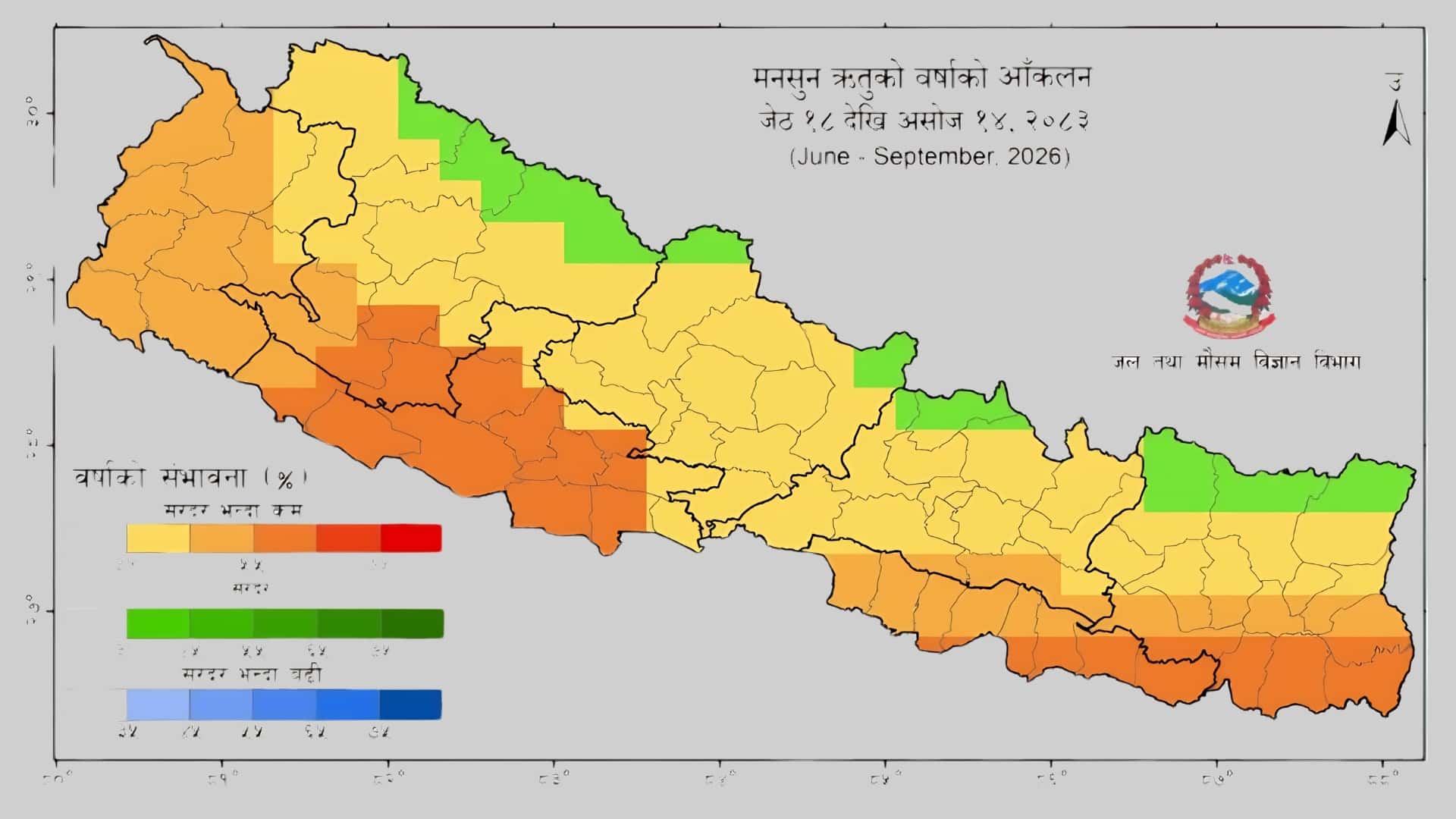
Nepal is likely to witness a weaker monsoon and hotter-than-average temperatures this year, with the Department of Hydrology and Meteorology forecasting below-average rainfall across most parts of the country during the monsoon season.
The department expects the monsoon to bring less rainfall than normal across the country, particularly in southern Karnali Province, most of Lumbini Province, eastern Madhesh Province, and southern Koshi Province, where the likelihood of below-average rainfall is estimated at 55–65%.
Other regions, including most parts of Sudurpashchim Province, western Madhesh, and central Koshi, are also likely to receive less rain than usual.
Northern parts of Karnali and Koshi provinces are expected to receive near-average rainfall, while the remaining areas are also projected to experience below-average precipitation.
The forecast also indicates that both maximum and minimum temperatures are likely to remain above average throughout the monsoon season. Higher daytime temperatures are expected in parts of Sudurpashchim, Karnali, Lumbini, Gandaki, Bagmati, Madhesh, and Koshi provinces, while nighttime temperatures are also projected to stay warmer than normal across most regions.
The department’s outlook is based on climate analyses from regional and international weather centers, including assessments of the El Niño–Southern Oscillation (ENSO) and the Indian Ocean Dipole (IOD).
Current Pacific Ocean conditions remain ENSO-neutral but are expected to gradually shift toward El Niño conditions, which are typically associated with weaker monsoon activity and reduced rainfall in South Asia, including Nepal. However, seasonal climate patterns depend on oceanic, atmospheric, and land-use factors, making it difficult to produce fully accurate forecasts during seasonal transitions, states the DHM.
Meteorologists also expect the first half of the monsoon season to remain relatively dry, potentially affecting paddy plantation and reducing rice production this year.
Last monsoon, Nepal received only 87.5% of its average monsoon rainfall in the period of June 1 to September 30. The country recorded 1,295.40 mm of rainfall during the period, compared to the normal average monsoon rainfall of 1,472 mm.
Review of last year’s forecast
The department had forecast that during the 2025 monsoon season, most parts of the country would receive above-average rainfall, while the eastern and southern parts of Madhesh Province were expected to receive near-average rainfall.
In contrast to the forecast, actual observations showed that most meteorological stations recorded below-average to near-average rainfall, with only a limited number of locations receiving above-average precipitation.
The department had also projected that both maximum and minimum temperatures would remain above average across most parts of the country. Observations during the season were largely consistent with this outlook, as most areas recorded higher-than-average daytime and nighttime temperatures.
Read More Stories

Nepal needs to repeat to brand itself
Last year Nepal's goods exports jumped 81.8% to NRs 277.03 billion. That is...

Banking stocks gain momentum as dividend season begins
Dividend announcements by banks and financial institutions (BFIs) for fiscal year 2025/26 have...

Nepal’s challenge of building strong democratic institutions
Over the past few decades, institutional dysfunction and massive dissatisfaction with political establishments...