What we do is costly! Your support will help us dig more stories.
Yes, I'm Interested!Ignorance isn't always bliss | Don't stay foolish.
Keep informed | Read our news and analysis.
Federal Parliament Session | House of Representatives | National Assembly | House Business
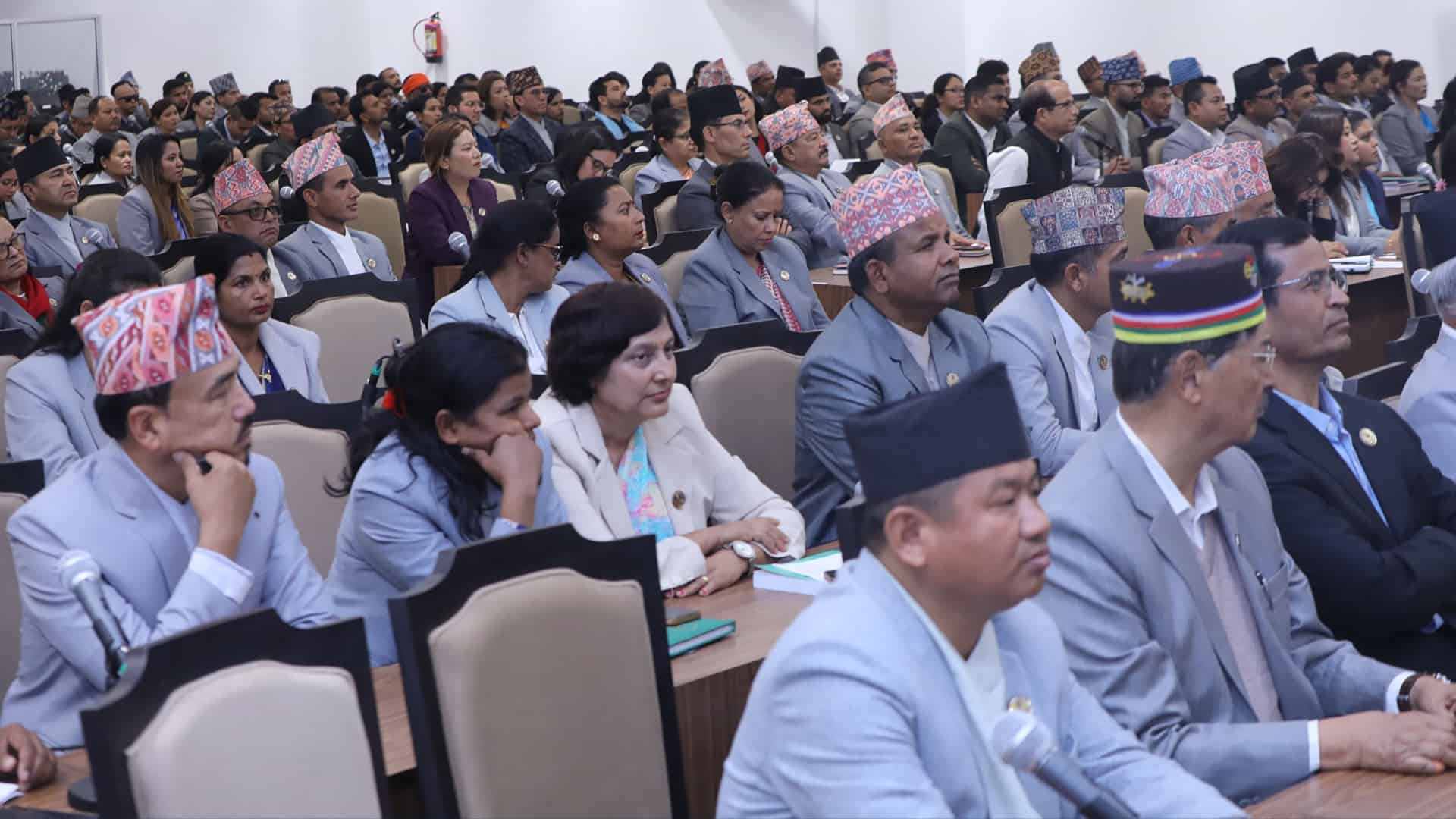
The federal parliament session, convened on April 2, was prorogued on April 10 after just eight days, with proceedings largely dominated by procedural business, ordinance approvals, and executive communications.
President Ram Chandra Paudel had summoned the session under Article 93(1) of the Constitution on the recommendation of the Council of Ministers. The session has been prorogued under Article 93(2), effective from April 10 midnight.
The House of Representatives (HoR) held six meetings, and the National Assembly five, during the brief eight-day session. Both houses held a joint meeting, addressed by the President on April 10.
In the HoR, the session opened with the reading of presidential communications, including the government’s formation and the summoning of Parliament. Lawmakers then endorsed continuing proceedings under existing parliamentary rules.
A key development during the session was the election of Rastriya Swatantra Party (RSP) lawmaker Dol Prasad Aryal as Speaker, alongside the formation of key parliamentary mechanisms, including the Business Advisory Committee and a House rules drafting committee. (Every newly elected HoR formulates a set of rules for its daily operations during its tenure.)
On the final day on April 10, the lower house elected Shram Sanskriti Party (SSP) lawmaker Rubi Kumari Thakur as deputy speaker through a majority vote, defeating her rival candidate, Rastriya Prajatantra Party (RPP) lawmaker Saraswati Lama, in a contest backed by the ruling party, RSP.
The government also pushed through three ordinances, the Voter List (First Amendment), the House of Representatives Election (First Amendment), and the Nepal Special Service (Second Amendment), which were tabled and later approved during the session. Their passage underscored the executive’s reliance on ordinances rather than full legislative debate.
Beyond that, the House’s business included tabling of bills received from the National Assembly, such as those related to forensic science, tourism, and film, as well as the introduction of the Alternative Development Finance Mobilisation Bill.
Prime Minister Balendra Shah presented multiple annual reports, including that of the National Natural Resources and Fiscal Commission.
In the NA, proceedings similarly focused on administrative and procedural matters. The upper house elected Leela Kumari Bhandari as its vice-chairperson unopposed, reconstituted committee memberships, and received annual reports from constitutional bodies, including the National Women Commission, the National Indigenous Nationalities Commission, and the Commission for the Investigation of Abuse of Authority.
The NA’s session concluded with a joint sitting of both Houses addressed by the President on Friday, followed by tabling of the address and motions of thanks.
Despite the range of formal activities, the session saw limited substantive legislative deliberation, reflecting that the short sessions focused on fulfilling constitutional formalities and advancing executive business. With the budget season approaching, attention now turns to the next session.
Read More Stories

Nepal needs to repeat to brand itself
Last year Nepal's goods exports jumped 81.8% to NRs 277.03 billion. That is...

Banking stocks gain momentum as dividend season begins
Dividend announcements by banks and financial institutions (BFIs) for fiscal year 2025/26 have...
Nepal’s challenge of building strong democratic institutions
Over the past few decades, institutional dysfunction and massive dissatisfaction with political establishments...