What we do is costly! Your support will help us dig more stories.
Yes, I'm Interested!Ignorance isn't always bliss | Don't stay foolish.
Keep informed | Read our news and analysis.
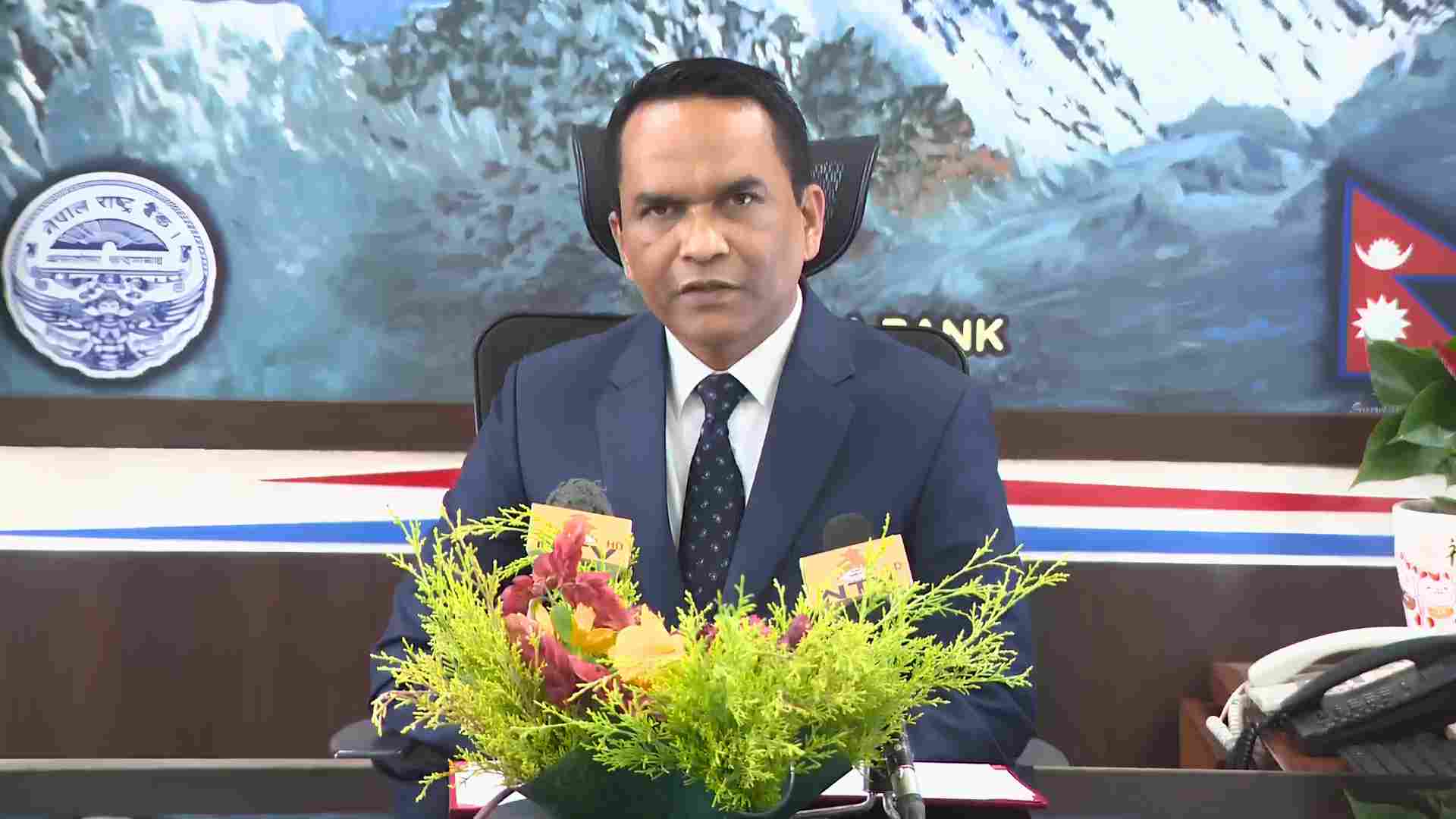
The Nepal Rastra Bank (NRB) has continued a cautiously flexible monetary policy stance for fiscal year 2026/27, while shifting its focus from conventional interest rate adjustments to structural reforms aimed at reducing borrowing costs, improving banking efficiency and supporting economic growth.
Unveiling the monetary policy for the upcoming fiscal year 2026/27 on Tuesday, NRB Governor Biswonath Poudel said the central bank would continue the flexible policy direction adopted earlier to boost confidence in the private sector.
“Private sector morale needs to remain high, and the cautiously flexible policy direction adopted earlier has been continued,” Poudel said while presenting the policy.
The governor said inflationary pressure caused by external factors, particularly rising fuel and food prices, would continue for some time but gradually ease. Despite short-term pressure, NRB has projected inflation to remain within 5.5 percent in fiscal year 2026/27, lower than the government’s budget estimate of 6%.
Poudel said the comfortable foreign exchange reserve position and favourable macroeconomic outlook would allow the country to maintain a low-cost economic environment and support the government’s target of achieving higher economic growth.
The central bank’s new policy shifts attention away from direct interest rate changes and places greater emphasis on structural reforms in the banking sector. NRB has kept key monetary policy instruments, including the policy rate, standing deposit facility rate and bank rate under the interest rate corridor unchanged. Existing provisions relating to the cash reserve ratio (CRR), statutory liquidity ratio (SLR) and standing liquidity facility (SLF) have also been retained.
Instead of relying on further interest rate cuts, NRB plans to reduce banks’ operating costs and improve efficiency so that the benefits can reach borrowers through lower lending costs.
“To enhance the effectiveness of monetary policy transmission, financial sector reforms, improved management of bank and financial institution branches, and digitalization will be pursued to reduce financial costs, pass the benefits on to customers, and improve the quality of services available to consumers,” the new policy outlines.
The bank is already set to conduct the Financial Customer Satisfaction Survey 2026 to assess customer satisfaction with banking and financial services across the country.
The nationwide survey will collect 10,405 samples from all 77 districts using random sampling to evaluate access to financial services, service quality, transparency, complaint handling, and consumer protection.
Additionally, the new monetary policy states that it will review the classification of banks and financial institutions and gradually move towards a specialised banking model based on the size, nature and business focus of institutions. NRB believes the reform will reduce the cost of capital mobilisation, improve efficiency and allow banks to provide more targeted financial services.
The policy also provides greater flexibility to banks in opening and closing branches. Previously, NRB had required commercial banks to maintain at least one branch in every local level, leading to rapid branch expansion. Banks have recently sought easier provisions to close branches due to rising operating expenses.
NRB has also encouraged wider adoption of digital banking services to reduce costs and improve service delivery.
The central bank has introduced a more flexible framework for share-backed lending. Limits on share collateral loans will now be determined based on the financial strength, risk management capacity and institutional stability of individual banks and financial institutions.
Similarly, loan-to-value provisions for large electric vehicles used as public transport will be eased to encourage investment in electric mobility. NRB said the move aims to support the expansion of public electric transportation.
The monetary policy has also announced new policy tools to manage non-performing loans in sick industries and support the revival of stressed loans. NRB said the measures would help financially viable businesses facing temporary difficulties return to operation while improving loan recovery and reducing pressure on banks’ balance sheets.
To make regulation clearer and easier to implement, NRB will rewrite existing directives issued to banks and financial institutions. The first phase will focus on lending, interest rate determination and financial consumer protection-related instructions.
The central bank said the rewriting process would remove language-related confusion and overlapping provisions, making regulatory requirements more transparent for banks and financial institutions.
NRB has also announced changes to personal guarantee rules for institutional borrowing. The central bank plans to remove the practice of unlimited personal liability for promoters and directors providing guarantees for institutional loans through necessary policy and legal reforms.
The blacklisting system will also be reviewed. Particularly in cases involving cheque dishonour, NRB said it would revise existing arrangements to reduce unnecessary blacklisting while maintaining credit discipline.
The central bank expects private sector credit to expand by 11% and broad money supply to grow by 14% in fiscal year 2026/27. NRB had projected a 13% growth in broad money supply and 12% growth in private sector credit during the fiscal year. However, by May 2026, broad money supply had increased by 15.2%, while private sector credit growth stood at only 6.5%.
Additionally, the bank aims to maintain foreign exchange reserves sufficient to cover at least seven months of imports of goods and services.
Poudel said geopolitical tensions, especially in West Asia, had increased inflation risks through higher fuel prices. However, he expected global conditions to improve gradually, helping reduce inflationary pressure.
NRB said continued remittance inflows, tourism earnings and government spending would keep liquidity conditions comfortable and support economic activity.
The central bank will continue using macroprudential measures to safeguard financial stability but said such measures would not be frequently changed except in exceptional circumstances, providing greater certainty to financial markets.
The new monetary policy also includes plans to study modern financial instruments such as peer-to-peer lending based on individual credit scores. NRB said the initiative would support the modernisation of Nepal’s financial system.
Alongside the monetary policy document, NRB has introduced a new reporting framework by separately publishing a review of previous policy implementation and a macroeconomic outlook report.
The policy also indicates that the central bank will review foreign exchange regulations applicable to authorised dealers and simplify procedures to make foreign exchange management more efficient.
With the new policy, NRB has signalled a move from short-term monetary easing towards long-term institutional reforms, aiming to create a more efficient banking system, improve access to affordable credit and support sustainable economic growth.
Read More Stories

Nepal needs to repeat to brand itself
Last year Nepal's goods exports jumped 81.8% to NRs 277.03 billion. That is...

Banking stocks gain momentum as dividend season begins
Dividend announcements by banks and financial institutions (BFIs) for fiscal year 2025/26 have...

Nepal’s challenge of building strong democratic institutions
Over the past few decades, institutional dysfunction and massive dissatisfaction with political establishments...