What we do is costly! Your support will help us dig more stories.
Yes, I'm Interested!Ignorance isn't always bliss | Don't stay foolish.
Keep informed | Read our news and analysis.
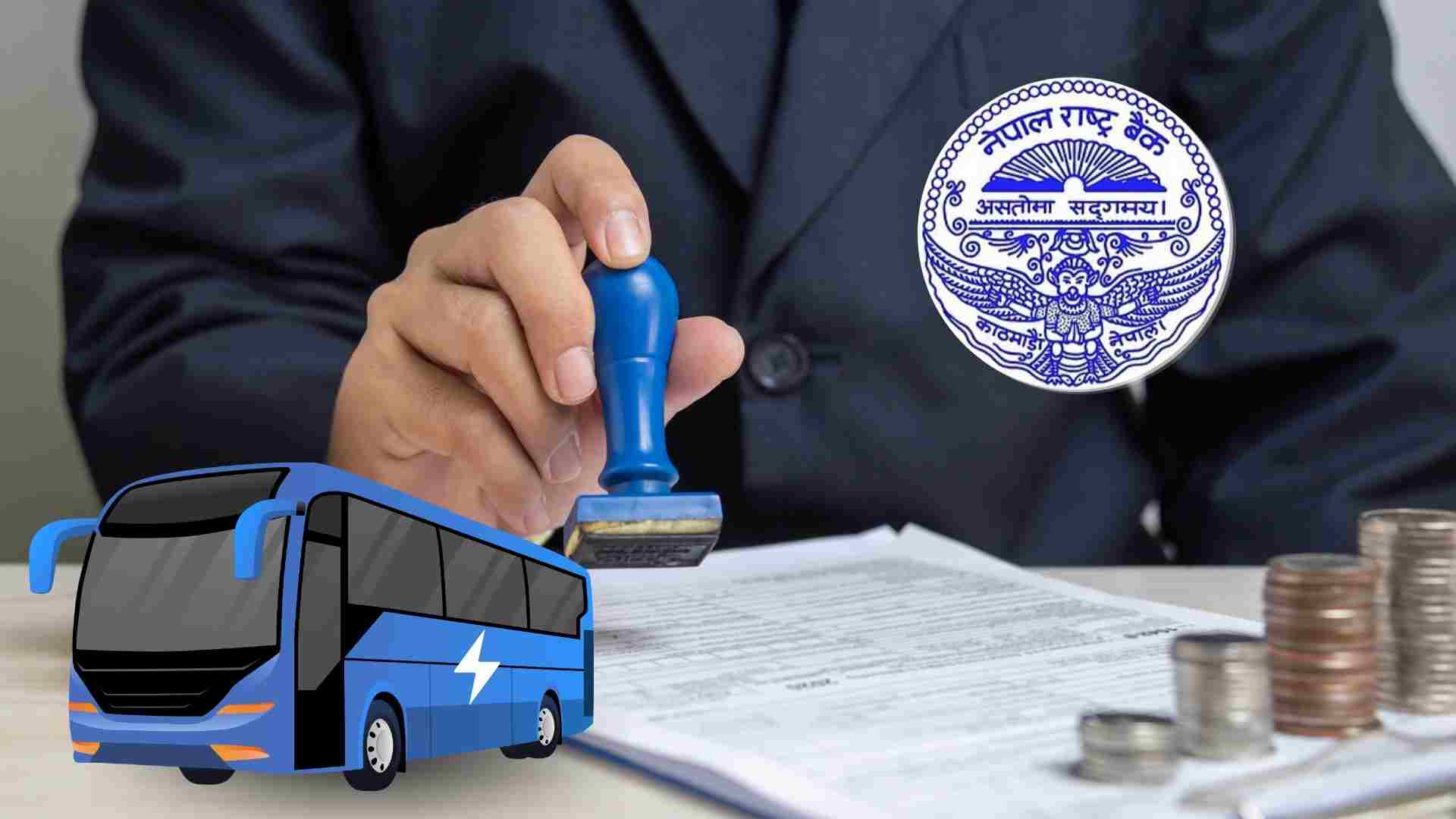
The Nepal Rastra Bank (NRB) has unveiled a series of regulatory changes aimed at boosting credit flow to businesses, promoting electric public transportation, and supporting the construction sector.
Under the new provisions, banks and financial institutions can now extend loans of up to 80% against the shares of financially strong listed companies. The central bank has also raised the loan-to-value (LTV) ratio for large electric passenger vehicles used in public transportation to 80%, while introducing loan restructuring facilities for eligible construction contractors awaiting government payments.
Higher loan limit for quality listed companies
Until now, banks were allowed to provide share-backed loans of up to 70% of the lower of either the average closing price of a stock over the previous 180 trading days published by the Nepal Stock Exchange (NEPSE) or its prevailing market value.
The revised policy allows lenders to increase the LTV ratio by as much as 10 percentage points for companies that demonstrate strong financial performance and sound corporate governance, raising the maximum financing limit to 80%.
To qualify, banks must assess companies using a clearly defined evaluation framework and publish the methodology in a product paper on their official websites.
According to NRB, the assessment should consider factors such as paid-up capital, the duration of stock market listing, consistent profitability, dividend distribution history, credit ratings, regulatory compliance, and the timely conduct of annual general meetings.
The central bank said the new framework replaces the previous uniform lending limit with a more risk-sensitive approach that rewards financially stronger companies.
Public electric buses eligible for 80% financing
NRB has also increased financing support for large electric passenger vehicles operating in public transportation.
Banks may now finance up to 80% of the vehicle's purchase price, requiring buyers to arrange only 20% as a down payment. However, the existing 60% LTV ceiling for privately owned electric vehicles remains unchanged.
The policy is expected to encourage investment in electric public transport and support the country’s transition toward cleaner and more sustainable mobility.
In addition, the central bank has allowed banks to maintain an 80% LTV ratio for loans issued to replace vehicles and transport equipment damaged during the recent September event.
Construction sector receives debt relief
As part of the new measures, NRB has introduced loan restructuring and rescheduling facilities for construction contractors whose projects have secured government funding but whose payments are still pending.
Eligible borrowers must pay at least 10% of the accrued interest to access the facility, and loan restructuring must be completed by mid-October.
Banks will also be required to maintain a 5% loan-loss provision against restructured loans, although this requirement will not apply to loans that have already been classified as non-performing.
Additionally, NRB has permitted banks and financial institutions (BFIs) to treat interest income received within 15 days of the close of a fiscal year as income earned during that same fiscal year.
According to the revised rule, only interest that remains unpaid beyond the 15-day window must be allocated to the regulatory fund after the applicable statutory deductions have been made. If the overdue interest is recovered at a later date, the corresponding amount can subsequently be reclassified from the regulatory fund to retained earnings.
Read More Stories
Sino-American stability without trust
At the recent summit between US President Donald Trump and Chinese President Xi...

NEPSE makes a modest gain of 2.31 points
The Nepal Stock Exchange (NEPSE) recorded a modest gain of 2.31 points (0.09%)...
VAT on electricity raising business costs, says FNCCI calling for withdrawal
The Federation of Nepalese Chambers of Commerce and Industry (FNCCI) has urged the...